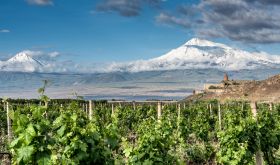
It can’t be easy representing Putin’s pal Viktor Orbán in Europe, but the Hungarian ambassador to the UK Ferenc Kumin has hit upon a novel form of soft diplomacy: wines made from the Furmint grape. Introducing a masterclass devoted to them in London recently, he pointed out that Furmint occupies a unique position among Hungary’s many native wine grapes: it’s not just the main ingredient in Hungary’s most famous wine Tokaj but it’s also unusually easy to spell and pronounce (unlike, for example, Cserszegi Fűszeres). ‘Foor-mint’, not ‘Fur-mint’, he instructed us sternly, adding, ‘now comes the tricky part: we have to explain that there’s more to Tokaj than sweet wines’.
The Tokaj region in the far north-east of modern Hungary, once spelled Tokay, was for long the source of an incredibly rich nectar, one of Europe’s most revered wines. By the 18th century it was famously known as ‘the wine of kings and king of wines’. Fans included Frederick the Great, Louis XIV, Beethoven, Haydn, Napoleon III and Queen Victoria. More recently, sweet Tokaj was sold in Hungarian pharmacies, so rich in nutritious minerals was it thought to be. (Most of the best vineyard sites are on volcanic soils.)
But 12 of the Furmints shown in this masterclass of 14 of them were dry, all chosen to exhibit the deliciousness of dry Furmint and its ability to age gracefully. The oldest of the dry wines shown was 23 years old and was absolutely stunning.
István Szepsy’s Úrágya Furmint 2003 Tokaj was the first vintage under his own label of the seminal 2000 that showed his fellow Tokaj wine producers just how good dry wines could be. The gifted Szepsy, seventeenth-generation Tokaj vintner, is the acknowledged godfather of this wine region so his peers took notice. Which is just as well since classic Tokaji Aszú, like sweet wine everywhere, has become so difficult to sell. As long ago as 2010, Szepsy admitted, ‘nowadays we couldn’t survive financially without dry wines. For a long time I didn’t drink them because I have a very weak stomach and they used to be too acid. But today I couldn’t imagine our future without them.’
The first great post-communist vintage in Tokaj, 1999, produced huge quantities of rich, botrytised Tokaji Aszú but in 2000 the summer and autumn were so hot and dry that there was a real shortage of the botrytis fungus that is responsible for serious sweet wines. So Szepsy made an experimental dry Furmint from old vines in the Úrágya vineyard, albeit not under his label as he was working for someone else at the time. Today he and his son, another István, make a range of single-vineyard dry Furmints, all demonstrating the fiery richness, life-saving acidity and ageability of dry Furmint. And fine dry Furmints are now made by virtually all Tokaj producers, many of them single-vineyard wines taking advantage of Furmint’s ability to express individual terroirs with precision.
The Szepsy, Úrágya Furmint 2003 Tokaj shown in February was the product of Europe’s famously fierce ‘heatwave vintage’, which generally produced early-maturing wines. But this wine had such intense purity and vivacity that I thought it would still be going strong in 2033, so I checked our database of more than 290,000 wine reviews to see which other 2003 whites we thought might enjoy such longevity. There were only 27 of them, and all are either sweet and/or fortified. Even grand cru 2003 white burgundies are already well past it or nearing the end of their life. Furmint clearly has special qualities as the basis of a long-lived dry wine.
It’s helped presumably by its naturally high acidity, even in summers as hot as Hungary’s was in 2003, that generally acts as a preservative in white wines. The grapes reach full ripeness without necessarily producing high-alcohol wines; 12% is not uncommon. As for flavour, quince, apricot, white peach and almond all feature in my tasting notes, which also include the words ‘smouldering’, ‘creamy’ and ‘not unlike a Savennières’, the pungent dry Loire white made from another high-acid grape, Chenin Blanc. And dry Furmint, even better, is not ridiculously expensive.
The vintages shown in the masterclass varied from 2021 back to this 2003. I thought the average potential lifespan of them was probably about 20 years, far longer than for most dry white wines. Admittedly these wines had been chosen to demonstrate Furmint’s longevity, but even the 21 dry Furmints I tasted after the masterclass in the more general tasting were so concentrated, fresh and well balanced that they seemed to have all the ingredients to age well.
In order to switch to making dry wines rather than encouraging the botrytis responsible for sweet Tokaji Aszú, producers had to identify those sites best-suited to dry wine production, generally higher and drier than those that had previously been admired for being prone to botrytis, or noble rot. They also retrained their vines, opening up the leafy canopy to encourage drying, refreshing breezes through it rather than the dense, humid canopies that encourage botrytis.
Dry Furmint is generally made rather like white burgundy, often fermented and generally aged in oak barrels, usually bigger than the traditional Burgundian 228-litre pièce and more likely to be made of Hungarian than French oak. (Hungarian oak has become increasingly popular with non-Hungarian winemakers – see below.)
Until the fall of communism in the 1990s, the production of Tokaj was in state hands, hands that were none too concerned with quality, although some individual growers quietly kept the flame of carefully made sweet Aszú wine alive on their own properties. But when privately owned land came up for sale there was an influx of interest from foreign wine producers.
While Szepsy is still regarded as the local master, some very fine wines, sweet and now dry, have been made for some time by Orémus, founded in the early 1990s by the Spanish owners of Vega Sicilia. At about the same time, Disznókő was added to AXA’s extensive wine portfolio. First in, however, was my friend and co-author of The World Atlas of Wine Hugh Johnson, who, with a group of other foreign investors, founded Royal Tokay in 1990. The name was subsequently changed to Royal Tokaji (Tokaji meaning ‘from Tokaj’). A much later outside investor, in 2009, was the proprietor of Château Cos d’Estournel, Michel Reybier, whose Tokaj Hétszőlő estate includes the much-admired organic vineyard Kis-Garai.
But most of the 11 producers showing their wares at the Liszt Institute just off Trafalgar Square in the general tasting, including Kolonics from Somló in the equally volcanic west of the country, were small, family-owned enterprises.
A little Furmint is grown over the border in Slovakia where a sort of Slovakian Tokaj is produced. Some is grown over the Austrian border in Burgenland, and it’s also found to a limited extent in Slovenia and Serbia and, as the recently rescued Kolorko, in Thrace. But, for the moment at least, dry Furmint is something that Hungarians, diplomats or not, can truly boast about.
Dry Furmints from Tokaj
Those with a comma after the name of the producer are single-vineyard wines.
Chateau Dereszla Furmint 2023 11%
£10.80 Fine Wine Offers, £11.65 VINVM, £13.63 Armit
Patricius 2024 12.5%
£11 Waitrose Cellar, £12.20 Great Wine Co
Disznókő 2024 13%
£15.06 Vinatis, 2023 is £16 (reduced from £18.50) Ocado, £21.50 Lea & Sandeman
Chateau Dereszla Tokaji Dry 2023 11.5%
£16.37 Armit
Hétszőlő 2022 13.5%
£19.28 Les Caves de Pyrène
Füleky 2022 14%
£22 Amathus
Royal Tokaji, Szent Tamás 2020 13.5%
2021 is £23 The Wine Society
Kikelet Furmint 2021 12.5%
£23.50 Wanderlust Wine
Oremus, Mandolás 2023 13.5%
£23.82 Winebuyers.com, £27.68 Vinatis
Füleky, Mestervölgy 2021 13.5%
£28.50 Amathus
Szepsy 2023 13%
£55 Hedonism, 2022 is £33.75 Oxford Wine Co
Szepsy, Urbán 73 2017 14.5%
£60 Wanderlust Wines
Szepsy, Urbán 73 2020 12.5%
£60 Oxford Wine Co, £68 Hedonism
For tasting notes, scores and suggested drinking dates, see our tasting notes database. For international stockists, see Wine-Searcher.com.
Back to basics
Wood and wine |
|
Wine has a natural affinity with oak. Historically, barrels were used to ship wine and nowadays they are used for ageing, and sometimes fermenting, a wide range of fine wines. Watertight and easy to bend, oak has been the favoured sort of wood. It allows a little bit of oxygen in, which helps stabilise and clarify young wine.
Oak from France’s unusually well-tended national forests has been the oak of choice, with different winemakers favouring different sources, often because of the grain of the oak. Allier, Tronçais and Vosges all have their fans. But even more important than the source is how well the oak is seasoned, sometimes over years in the open air, and how heavily, or not, the inside of the barrel is toasted. The heavier the toast, the fewer tannins and the less fruit or oak flavour find their way into the wine.
Age and size of barrel are also extremely important. New, small barrels have maximum flavour impact while those producers making delicate, aromatic whites, for instance, may deliberately age the wine in huge casks that are so old they impart no flavour at all. (New French oak barrels can cost thousands of euros each.)
Chestnut was used in Iberia. Vanilla-scented American oak is chosen for some fuller reds in Australia and the US and was traditional in Rioja. In recent years there has been a vogue for Hungarian oak, and the use of acacia wood is growing in some quarters, as is experimentation with locally grown oak in some wine regions. Evan Martin of Martin Woods, for instance, is a great believer in Oregon oak. |