See also my tasting notes and the videos Anne Gros in the Minervois and Anne Gros' curious Cinsault – which gave rise to the relatively long thread on the forum Hurrah for Cinsault!
Anne Gros is one of the most respected, and most fortunate, wine producers in the world. As an only child she inherited all of her father François's three hectares of prime Côte d'Or vineyard land around the most bejewelled village in Burgundy, Vosne-Romanée, and has been running it with great aplomb since the age of 22. When only 25, she expanded Domaine Anne Gros to 6.5 ha. She then went on to build a completely new winery – quite unlike the traditional underground cellars of her neighbours, and converted an outbuilding into a stylish modern guesthouse, La Colombière. Most importantly, she makes extremely good wine. Her Clos Vougeot was my favourite in the blind tasting of 56 2008s I reported on recently.
Now she has gone and done something apparently crazy: established an entirely new domaine in what is arguably France's most challenging wine region, the Languedoc, where the local growers are being bribed to pull up their vines, so great is the surplus of cheap wine being produced there.
This time she is not alone. The new domaine carries not just her name but that of the father of her three teenage children, Jean-Paul Tollot of another well-regarded Burgundian domaine, Tollot-Beaut. And the two of them are on a mad cycle of constant overseeing of their cellars and vineyards in both Burgundy and Minervois. She drives the five hours to the Languedoc every two or three weeks; he visits more often during the harvest, which, to make things more complicated, usually coincides with the vintage in Burgundy.
I put the most obvious interrogative word to Anne Gros. 'Because I'd turned 40 and needed a new challenge', she replied. 'And because Jean-Paul and I had all this experience but had never worked together.' They took a good look at Provence and considered a nice, established property with a maison de maitre in the middle of it, but it was 'too bourgeois'. The Languedoc is also awash with pretty nineteenth-century houses desperate for a buyer, but they wanted to build an ecologically respectable house, from scratch.
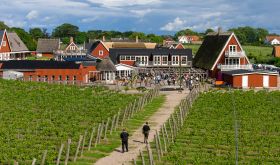
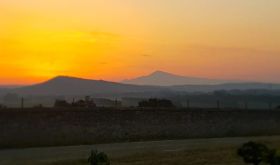
This is why Les Cazelles, a tiny hamlet on the north-eastern border of the Minervois appellation – average age of humans 60, average age of vines probably not much less – now has an extraordinary bright orange, baked earth, metal and wooden two-storey building, all curves and oblongs, on the brow of a hill overlooking the Montagne Noire in the distance and an irrigation-free cactus plantation in the immediate foreground.
On the first floor is a minimalist living area equipped with full electronic teenage support systems while below is probably the single most lavishly equipped winery in the whole of Languedoc-Roussillon. I have certainly never seen so many top-quality Burgundy barrels in this part of the world. They even put the delicate wine produced by the Cinsault grape into 100% new oak in their first vintage, 2008. The wines do taste eerily burgundian – just as those of Ostal Cazes, Château Lynch Bages' outpost in the Minervois 10 miles to the west, taste strangely Bordeaux-like.
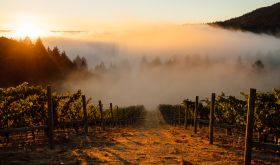
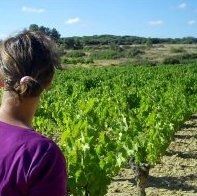
I tasted only the 2008s, which may naturally have been rather higher in acidity than most vintages in the Languedoc. But all of them were highly distinctive, with none of the density and occasional rusticity that is more usual in the reds of the Midi. Admittedly, Les Cazelles is one of the highest villages in the Minervois appellation, at 220 m elevation – 'like Vosne-Romanée', as Anne Gros points out on her carefully tended www.anne-gros.com. Even midsummer nights here are cool and the winters are savage. On a day that was blisteringly hot in the Aude valley whence I'd come, she met me wearing a fleece, although soon stripped off as we toured her – sorry, their – growing total of 8.5 hectares of Grenache, Syrah, Cinsault and 104-year-old Carignan vines. Here walking shoes and 4 x 4 were essential to navigate this rocky terrain.
Their vines are dotted around the village in almost as many parcels as they own in the Côte d'Or, and they have decided, Burgundy style, to group them into three terroirs and three different blends of the four varieties they grow. Les Fontanilles is the freshest, fruitiest and arguably most burgundian, from north-facing plots on mainly the flaky grey sediments known as grès. La Ciaude comes from hotter terrain with some clay and limestone, and incorporates the produce of the extraordinary tree-like 104-year-old Carignan. (All of the grapes are now picked by hand – Anne Gros is already on her second picking team – but some of the vines are still recovering from the shock of manual treatment after years of being shaken by mechanical harvesters.) Les Carrétals comes from just one hectare of vines that celebrated their centenary last year. It tastes particularly exotic and intense and carries its oaky burden with the most ease.
And then there is 50/50, an unoaked cocktail of fruit and acidity that reminded me of nothing more than a young Bourgogne Rouge. The name reflects the ownership of the domaine (the Crédit Agricole is not mentioned, though probably should be) rather than the assemblage. It has to be sold as a Vin de Table because it contains a higher proportion of Carignan than is officially sanctioned by the Minervois appellation regulations (themselves subject to constant revision).
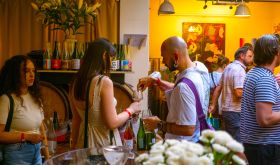
Anne Gros keeps the stock in Burgundy and assures me that the wines have done well in blind tastings there with red burgundies. But it seems as though, however sought-after Anne Gros burgundies are (the average price for her 2005s is £250 a bottle), the Languedoc wines with their bright orange, defiantly modern labels have been a tough sell. 'The Tollot-Beaut clients are not at all interested', she told me, 'and the UK market has been particularly disappointing. The best is restaurants in France, especially outside Paris.' The wines are available in the UK, however (from £12.95 to £26.75 in Lea & Sandeman shops), and are also imported into the US, Switzerland, Germany, Japan and Australia. They have so far sold half of the 60,000 bottles of 2008 they produced. The 2009s are not yet bottled. There is clearly work to be done.
Anne Gros and Jean-Paul Tollot are not the first Burgundians to be tempted by this seductively wild landscape. Ten years ago, talented winemaker Jean-Marie Fourrier of Gevrey-Chambertin, five miles up the road from Anne Gros' base in Vosne-Romanée, bought a property in Faugères, two appellations east of Les Cazelles. I loved his 2001 but by 2005 the bank was so unimpressed by his financial performance that he couldn't afford to bottle his 2003 and 2004 and had to sell them off in bulk while the property was put back on the market.
I asked Anne Gros whether she had discussed her new enterprise with Fourrier but she told me she hadn't tasted his Languedoc wines – in fact she didn't even know his burgundies. I then asked Fourrier what advice he would give Gros and Tollot and this is what he'd advise: 'spend lots of time with local people from the Languedoc as they can be very helpful – or they can make your life much harder. When you run two businesses 400 miles from each other, the temptation is to work, work and work with the obligation of success. But don't forget that you are considered a foreigner by the local people. And maybe the second advice would be bring your passion concerning details of vineyards and winemaking to the Languedoc, but don't try to make something too much in the style of Burgundy.'