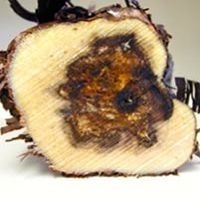
Remington Norman, author of several books on wine, wrote to me about a company with which he is associated, Eden Research, which supplied this photograph. 'Their terpene formulations have significantly increased the vigneron's armoury against nematodes, vascular vine diseases (esca, eutypa etc) and their lead product deals effectively with botrytis. The components are non-toxic and may be used pre- or post- harvest, unlike the synthetic alternatives. Eden are currently mired in EU regulation but their products are now patented worldwide. They also have several major players as international partners. This all seems to me exciting, not only for vine growers but for stone fruit, soft fruit etc where similar infestations contribute to crop losses.'
And one of the most interesting responses came from Robert Cripps of Domaine du Poujol in the Languedoc. He drew my attention to a fungus that he thinks might act as a cure for the range of vine wood diseases whose incidence seems to have increased so markedly recently.
'Trichoderma harzianum is a soil-borne fungus that can kill the (also fungal) pathogens responsible for esca, eutypa and black dead arm. Its properties have been known for at least 20 years but because it’s so difficult to work with, it’s generally discounted as impractical. Certainly all research in France was stopped in the late 1980s when Bernadette Dubos, the chief vine researcher at INRA [the official French viticultural research institute] in Bordeaux, decided that while Trichoderma was most effective at killing esca, etc, in a petri dish, it could not be made to work on a large scale. Meanwhile research (that I know of) continued in Germany, Switzerland, Israel and New Zealand.
'In the late 1990s a company in Montpellier claimed that they had succeeded in producing viable Trichoderma cultures that could be used practically in viticulture. Although their products were never officially approved, we tried them out over three years (1999, 2000 and 2001) and found that, although not as effective as the company claimed, there was nevertheless a great deal less esca and eutypa present. However, we discontinued the trial for several reasons. We began to lose confidence in the company responsible. They kept changing their name, which is hardly the sign of a rigorous approach to business. (Prestobiol and Biophytech both come to mind, but there may have been more.) In addition, their claims of an anti-botrytis effect were found to be untrue during the 2002 growing season. Also at that time I was getting more interested in biodynamics. The use of a soil-borne fungus to treat above-ground diseases definitely goes against the biodynamic philosophy.
'At about the same time we met and befriended Paolo di Marchi [of Isola e Olena in Tuscany] who was also working with Trichoderma (Sangiovese is a martyr to esca). He was getting his cultures from Israel. We have not discussed esca for five or six years so I don’t know how his trials went.'
I asked Paolo's UK importer David Gleave MW about these trials and he responded that since he hadn't discussed esca with Paolo for many years, he assumed the trials must have been successful, which is intriguing. Robert Cripps continued:
'Since then the company in Montpellier has definitively disappeared, but sold their patent to another company. Unlike Prestobiol/Biophytech, the new company has been granted official approval for Trichoderma with more modest claims for protecting the vine from infection by treating pruning wounds. Trichoderma kills any spores that land on the point of access into the vine thus preventing infection.
'As I understand it, the practical problem with using Trichoderma as a curative treatment is getting the live culture into the vine. The most successful approach that I heard of when I was looking into it was from New Zealand, where they drilled a hole in the trunk and immediately injected the Trichoderma. Apparently the problem is that the live Tricoderma spores need to get into the vine in the 15 seconds or so after the cut is made. If this is done in the autumn, than the vine’s circulatory system will carry the live Trichoderma throughout the vine and wherever Trichoderma encounters any other fungus. It will destroy it (well, eat it in layman’s terms).
'I have an idea about how this can be done practically, but lack the resources to try it ourselves. And because officially Trichoderma cannot be used in France (thank you, Bernadette Dubos), I have not been able to interest any official researchers in trying it. I’m telling you so that maybe you can pass this on to some better-funded and more open-minded vignerons.
 'We pre-prune many of our vines with a pre-pruning attachment mounted on a machine harvester chassis. Why not fit some panneaux recuperateurs [recycling tunnel sprayer, along the lines of the one pictured] on the back of the same chassis and spray Trichoderma at the same time as pre-pruning? If this is done at leaf fall, then in theory you can cure the vine of any fungal diseases in the wood.
'As our losses from esca are now rising again (especially in our 11-year-old Mourvèdre), I am becoming more interested in finding a practical solution. If you can help disseminate this idea to interested parties, then maybe we can find a solution to these diseases.'
So, who out there would like to develop this encouraging initiative? You are most welcome to comment below, or you can contact Robert Cripps at [email protected].
He has worked out that Bayer are now marketing Trichoderma under the brand name Esquive as a preventative for eutypa contamination of pruning wounds.