
The idea was so blissfully simple. Why hadn’t I come across it before? A major consumer wine tasting was organised by and in aid of a group of local disabled young people. Everyone benefited. The exhibitors had a chance to talk directly to seriously interested wine consumers for the first time. We participants had the pleasure of meeting and being impressed by these young people about whom, I am ashamed to say, I might in other circumstances have made all sorts of wildly inaccurate assumptions. And the young people themselves had a chance to show off their many skills while raising money for a minibus.
Where did I encounter this benign marvel? Somewhere perhaps unexpected, the city of Timișoara in south-western Romania. The fact that it is in the extensive region known as Transylvania did not put our children at ease. There were many pre-departure comments about watching our necks, eating well beforehand, and taking bath plugs. But the reality, as usual, was very different.
Timișoara turned out to be a handsome, boulevarded city. On the first night, after a superb dinner informed by local cuisine, we were driven back to our decidedly hip hotel in the Maserati of one of the wine event’s generous sponsors, a Timișoara businessman. The locals, including the Ceva de Spus (‘something to say’) group of young disabled, spoke English shamefully well, English having displaced French and German as the most popular second language in post-Ceaușescu Romania.
The key to it all was a young ethnic Hungarian resident of Timișoara, Szövérdfi-Szép Zoltán, or Zoli as everyone called him. This irredeemably enthusiastic beanpole works closely with the Ceva de Spus group helping them campaign for better rights for the disabled than are common in Romania. They have found that Brussels can often provide a better route for negotiation than Bucharest – hence the need for a minibus. But most importantly for me, Zoli has the wine bug – hence the wine fair idea. Wine fairs are not a novelty in post-communist Romania, but they tend to be dominated by the most powerful companies and boycotted by the promising new producers to have emerged in recent years. Some of them have been fuelled by a romantic notion of returning to Romanian roots. Virtually all of them have been underpinned by the 50% reconstruction grants that were available under the SAPARD scheme before Romania joined the EU in 2007, often topped up by subsequent EU funding.
About 30,000 hectares (75,000 acres) of new, well-designed vineyards have been planted since 2007, representing almost a third of the country’s total area planted with wine-friendly Vitis vinifera vines. According to some estimates, no fewer than 120 new wineries came on stream in Romania last year alone. Romanians have always been keen wine drinkers and most smallholdings have a few vines. What is new is that a fragile domestic market has emerged for wines with real aspirations to quality and high prices (much higher prices than the wines would command abroad). The Romanian wine industry will almost certainly have to export to thrive, but has yet to learn the art of co-operation. Zoli’s feat of assembling the country’s finest wine producers in one large room in the Hotel Timișoara was yet another benign consequence of his wine weekend.
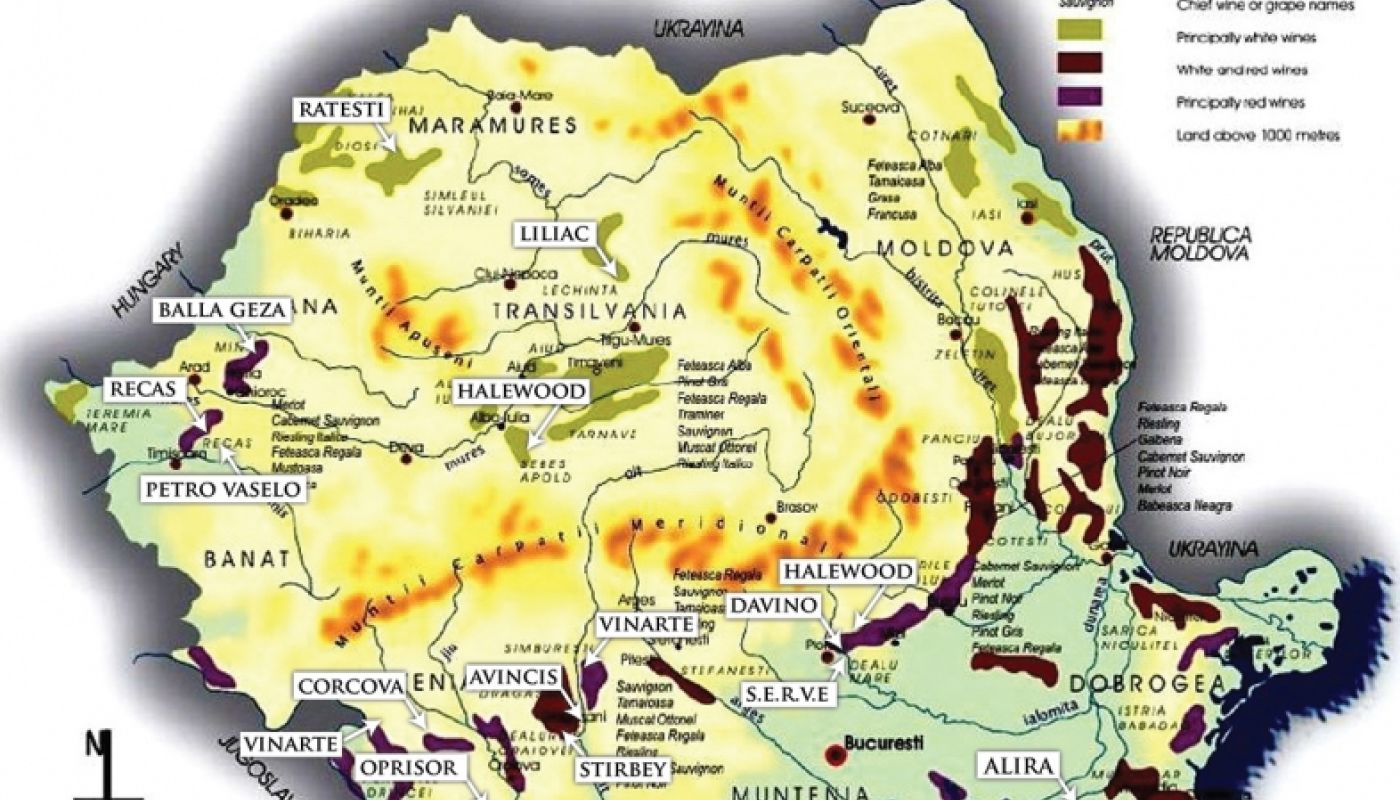
Perhaps one significant factor in a lack of commercial cohesion is the wide variety of cultural influences. One of the first foreign investors, just five years after the revolution, and the first to celebrate Romania’s own grape varieties, was Guy de Poix, owner of Corsica’s Comte Peraldi wine estate. His enigmatically named SERVE in the south east of the country is obviously one of the over-achievers. Avincis, an incredibly glamorous modernist temple built by a Romanian politician, is run by a French winemaker and his Colombian wife. Corcova has an English sales director, while Halewood and Recaș, the two biggest Romanian wine exporters, have their roots in Liverpool and Bristol respectively. Recaș’ wide array of own-label wines deliberately and none-too-variously aimed at UK supermarket shelves are made by a Australo-Spanish couple who spend the rest of the year making Yellow Tail wines in Australia. Oprișor is one of the many German- or Austrian-backed wine producers in Romania while Balla Gaza close to the Hungarian border is Hungarian in spirit, down to its espousal of the Furmint and Cadarcă grapes of Hungary. Davino was set up by a US returnee, while Prince Știrbey, whose wines are available in the UK via The Wine Society, is a private estate recuperated by a Romanian baroness whose family fled the communists many decades ago. Her German winemaker Oliver Bauer also produces his own eponymous wines. Alira in the extreme south east is a sister operation to Enira, produced by Bessa Valley, one of the more successful of the new-wave Bulgarian wineries with a connection to the widely respected St-Émilion property Château Canon-La-Gaffelière.
We visited the two wineries closest to Timișoara. Recaș is pure, workmanlike, recuperated eastern European. Italian-owned Petro Vaselo on the other hand is the most extraordinarily stylish modernist building, contrasting dramatically with the dirt tracks leading to it, and the rusticity of the one-storey houses and their inhabitants in the local villages. It was established by an Italian family who outsourced the production of their coffee machines to Romania. Apparently their first grapes, harvested before the futuristic winery was built, were solemnly shipped back to Montalcino in Tuscany to be vinified.
Overall I was agreeably surprised by the general competence of the winemaking, even if some Romanians are still in thrall to the oak barrique, and see it as a way to compensate for picking too early or yields that are too high. There is clearly very good potential for the whites that Romanians have traditionally favoured, even if the majority of the wines cited below are red, and dry. The wines I saw were a far cry from the chemical-infused sweet reds that were at one time shipped out in such quantity to the German mass market.
It has been only relatively recently that Romanian wine producers have realised that export markets are much more interested in the country’s indigenous grape varieties than in yet another oaked Chardonnay or Cabernet. The most important of them are Fetească Regală, Fetească Albă and Crâmpoșie Selecționatăfor whites and Fetească Neagră, Negru de Drăgășani, Novac and Babească Neagră for reds. Congratulations to Zoli, who managed to get more than a dozen of Romania’s best producers in one room on the Sunday morning for a private tasting of each other’s wines when the qualities of these intriguing specialities were discussed.
The weekend culminated in a dinner at Timișoara’s best restaurant, significantly perhaps called Merlot, at which we were treated to a fashion show of designs by Geanina Bolba of Ceva de Spus, who, undeterred by the fact that she is confined to a wheelchair, struggled up to the third floor where the fashion department of the local art college is located and learnt everything there was to learn. This is clearly a group to be reckoned with.
See my tasting notes on 37 of Romania’s best wines and Nick eats in Romania.
SOME FAVOURITES
WHITES
Rătești, Fetească Regală 2013
Delicate aperitif from the northernmost, coolest wine region in the far north west.
Prince Știrbey, Crâmpoșie Selecționată 2013
Pungent and lively with good acidity from 40-year-old vines. Dry and with some extract.
Balla Géza, Furmint 2013
Hungarian-owned winery has made a refined, still youthful dry wine from the most famous grape of Tokaj over the Hungarian border.
REDS
SERVE, Terra Romana Cuvée Charlotte 2011
Unusually sophisticated, complex and smartly packaged blend of Cabernet, Merlot and Fetească Neagră.
Vinarte, Cabernet Sauvignon 2009
Very respectable answer to red bordeaux from Vinarte, the first big winery to be created after the revolution, founded in 1998 by Romanian, French and Italian investors.
Petro Vaselo, Ovaș 2011
Red Bordeaux blend from a particularly snazzy new Italian-owned winery.
Vinarte, Nedeea 2011
Interesting, well-balanced blend of equal parts of Fetească Neagră, Negru de Drăgășani and Novac.
Balla Géza, Fetească Neagră 2011
Particularly tangy version of Romania’s most famous indigenous red wine grape.













