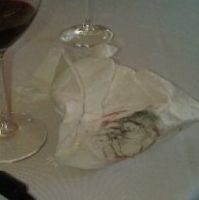
This rather disgusting image is the tissue I wiped my teeth with after tasting 2010s for less than an hour last Thursday.
Bordeaux has been showing off its 2010s, its second very promising vintage in a row, with the Americans back in the market, Asian demand showing no sign of abating and what seems like every wine merchant and his dog blogging daily from Bordeaux about last week's tastings of hundreds of barrel samples. But it is worth stopping for a moment to consider just how approximate these samples are.
Over the last few decades the Bordelais have become increasingly dependent on selling their young wine 'en primeur': showing barrel samples to the hordes of black-tongued visitors in late March and early April; waiting for scores and comments on them to be published; and then, in May, June and sometimes July, announcing their prices and eking out various tranches to their favoured middlemen.
The presentation and judgment of samples of these six-month-old babies from the barrels in which they will be aged for nearly two years is absolutely crucial therefore. The notes, and especially scores, handed out to these infants can make all the difference to the opening price of a specific wine so producers make every effort to ensure the wine is drawn out of cask as recently as possible, and is not going to oxidise en route to the tasting table.
But the samples we pore over so assiduously may bear remarkably little relation to the final wines once all the ingredients have been blended and the wine has been bottled. For a start, there can be enormous variation between different barrels, as a discreet tasting I was treated to last week showed. The eventual wine will be made up of a blend of hundreds of barrels that may have come from a wide range of different forests, coopers and barrel treatments. Some barrels produce wines that look particularly good one day but not the next week. It must be tempting, to say the least, to choose a sample from the most flattering barrel type for the primeurs tastings, but that wine will not be truly representative of the final blend.
Wine is a living, petulant thing that goes through all sorts of phases during its two years in barrel. Some producers make their final assemblage of the various lots they decide will go into their top wine, the grand vin, and what into the second and sometimes third wines, quite early on, do the requisite blend and age the final blends as long as possible in oak. But the fleshy Merlot grape is likely to be much more seductive at six months old than the tougher Cabernet Sauvignon. In years in which the tannins and acids are particularly pronounced, a Merlot-heavy sample may win more approbation than a more representative Cabernet-heavy one at six months. While in a vintage that tended naturally towards overripeness, the reverse could be the case.
Some producers, even in the grander parts of the Bordeaux region, may make up for Nature's deficiencies by either deacidifying their wines, generally adding potassium bicarbonate, as some producers did in 2010, or by adding extra tartaric acid in the riper vintages. However, there is an argument that a wine from a vat that was acidified, for example, might not look at its best after only six months of integration between acid and fruit, so you might not want to include that vat in the blend from which primeurs samples were taken.
Then there is the whole question of when and where the softening second 'malolactic' fermentation takes place. In recent years there has been a great vogue for doing this in barrels rather than the more traditional technique of encouraging it to take place in the sort of large tanks or wooden vats in which the first, alcoholic, fermentation takes place. This is in the belief that the more cumbersome barrel-by-barrel approach produces wines that show particularly well at the crucial six-month evaluation stage, even though most authorities are agreed that it doesn't necessarily have much long-term benefit for the wine (and some oenologists report that, oddly, malolactics in barrel didn't seem to produce this effect very markedly in the 'twin peaks vintages' of 2009 and 2010).
Racking is the process of aerating and moving young wine off its lees and into a clean barrel. More and more producers are ageing their wines longer and longer on the lees. As Bordeaux wine merchant Bill Blatch of Vintex pointed out in his invaluable annual vintage report, 'little information is given about which of the samples come from unracked barrels and which from racked ones – often very recently – maybe for fear of complicating each year's conveniently simplified hierarchy of the wines. Why rock the boat? "Don't ask, don't tell"!'
The role of oxygen in the evolution of wine is vital and it is particularly common for producers to accelerate the ageing process in primeurs samples by pumping small doses of oxygen into the young wine. This is not harmful in itself, but it is just another example of how primeurs samples are specially groomed for us tasters.
Another is the all-important addition of press wine, the portion of wine that results from pressing the grape skins left at the bottom of the fermentation vat. Getting the proportion right is a particularly fine art, but press wine can be tough and herbaceous to taste at the early primeurs stage. Some producers age it separately and don't incorporate it into the final blend until just before bottling, yet it can constitute a vital part of the eventual wine.
Perhaps even more important than any of these tweaks is the decision whether or not to take advantage of France's recent change in the rules on inter-vintage blending. Nowadays the French, like their counterparts in the New World, may add to a blend up to 15% of wine from a vintage other than that cited on the label. This has opened up a great swathe of possibilities, and it seems most likely to me that an ambitious wine producer would want to wait until the last minute, just before bottling, to see how the new wine has developed in bottle and what the qualities of the subsequent vintage are before deciding whether it would benefit from a drop of the previous, or even subsequent, vintage. The wide variation in quantity and price of each vintage must play a part in this decision too.
As the head of Pauillac's official oenology service Christophe Coupez puts it, 'The primeurs are so important today that we can't afford to miss it, but it's very difficult to get it right without exaggeration.'