Katia writes This is all overwhelmingly exciting and I need to read it all calmly … con calma. Thank you so much for all your thoughts. You see, unlike you, I do not work in an academic environment so I easily wonder if I am odd in the way I see things, but no – I am obviously in the best of company! And yes, also I agree that wine and vines are the ultimate meeting ground for nature and culture, where in practice, not just in theory, the boundaries actually do, on the ground, blur and overlap and become nonsensical.
We are day 2 of harvest and I have had little time today. But this evening I will read the chapter you sent … it looks so fascinating. I have some questions regarding Tsing. I understand her points about new ecologies (political and social) developing from the ruins of capitalism but I wonder where that leaves ‘ecology’, as in the state of the planet. So much to think about … I am interested in what I term the ‘silhouette’, the norm that is the noticed/known/accepted. It’s the backdrop to this silhouette that I find so fascinating.
That’s now what interests me in relation to viticulture and ecological sustainability. (Forget regenerative viticulture for the moment … seems too idealistic, possibly.) I wish to think about the doable and, with a sliver of optimism, sustainability may be doable. The silhouette is culture v nature (plus all the concomitant rest). The backdrop is the wonderful magnificent multifaceted world we inhabit, the myriad biological and non-biological dynamics of movement. Hence the extraordinary delight in learning of the importance of the invisible microorganic world surrounding us, over us, in us and under our feet. How many other things do we miss with our blind spots?
Sorry, I am writing on my phone and so this email is turning out as choppy and not well-formed … I will write back more fully when I have read your chapter. Thank you so much. Very stimulating indeed.
PS I really am just a dilettante in all of this, but now I need to learn as much as possible. These issues are vitally important, affecting how we behave and how we handle our complicated world.
…
We are now day 3 into harvest and it is all very exciting. It is a good harvest and enjoyable, so far. Busy, but I am taking the time to write this while I am buzzing from thinking about all you have written.
Just before I get into the more important stuff, two things:
1. To continue our conversation regarding natural wine, possibly it is the oxymoron that gives it its power as a phrase. The impossible definition is a shock (just that many of the natural-wine adherents don’t get the irony, if any was intended when the descriptor was conceived, which I doubt).
2. Palaeolithic winemaking – what years/when are you talking about? I am very curious.
I have just read your article and my head feels extremely full. It’s a dazzling subject, and while I have heard of and read about the milestone philosophers you mention I, unfortunately, do not have intimate knowledge of their work. I studied at SOAS in the early 1980s and was taught phenomenology by a man called Piatigorsky. He had me riveted though I understood but a tiny fraction of what he talked about (I was young, he was quite a genius). However, I knew, and still know, that it is a thoroughly pertinent subject. The questions you ask at the end are truly important. Without examining them I believe we may be doomed to scurrying round and round in our habitual circles and changing nothing. Whereas we obviously need to change as change is needed.
Winemaking really does lend itself to all of this: as a study, it is the microcosm of all that you mention. We try to back up these ideas (philosophy) with scientific data given to us through invited researchers (when they are interested or our areas overlap or they are just kind enough to get involved) who work with the microbiology of the soils in the vineyard, or yeasts in the winery, vineyards and surrounding woodlands (can I call them forests?).
As Karen Barad would say, we try to properly understand how we ‘meet the universe halfway’; I try to comprehend how viticulture has been constructed (or as she puts it ‘space-time-mattered’) through the windows of our European classical heritage and how we can make the epistemic change to space-time-matter a different world into existence. In our case put into practice through our work in the vineyards, strange though it may seem. This is not easy and it raises cynical eyebrows in all circles: ie people think you are being gratuitously intellectual (or, more frankly, an obnoxious idiot!) when this is not the case. It’s actually for a practical reason of finding a way forward to a sustainable model for viticulture.
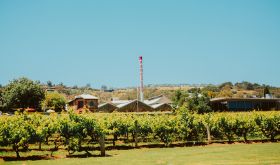
I had what I considered to be an ingenious idea for Montalcino, but it was seen as too whacky for words. There is a group of us organic winemakers called Montalcino Bio – now more than 50% of winemakers in Montalcino are organic certified, only recently but they are now a great force! I suggested that we apply for EU green funding (it exists in abundance) as a territory, under the conceptual template of mycelium. Perhaps you don’t know but Montalcino is extremely rich in protected woodland, possibly more of its territory is forested than not. There is an abundance of wildlife, even wolves, and eye-popping amounts of mushrooms. The woodlands are healthy and ALIVE!
The only criterion for involvement in this project would be a connection to funghi (really that means practically anyone!), in whatever form. We would form a loose network of beekeepers, winemakers, beer-makers, myco-tourists, bakers, restaurateurs etc. The local agrarian school could learn to make alternatives to Styrofoam (just an idea) by growing mycelium for which we would send out metaphorical hyphae and request consultancies from companies in other EU companies doing the same thing and prepared to help. Local people would forage mushrooms, using local taxonomy, and even write guidebooks. It would be fun, collaborative, remunerative, raise awareness of local flora and fauna, life cycles, woodlands and viticultural ecology next to ancient woodlands.
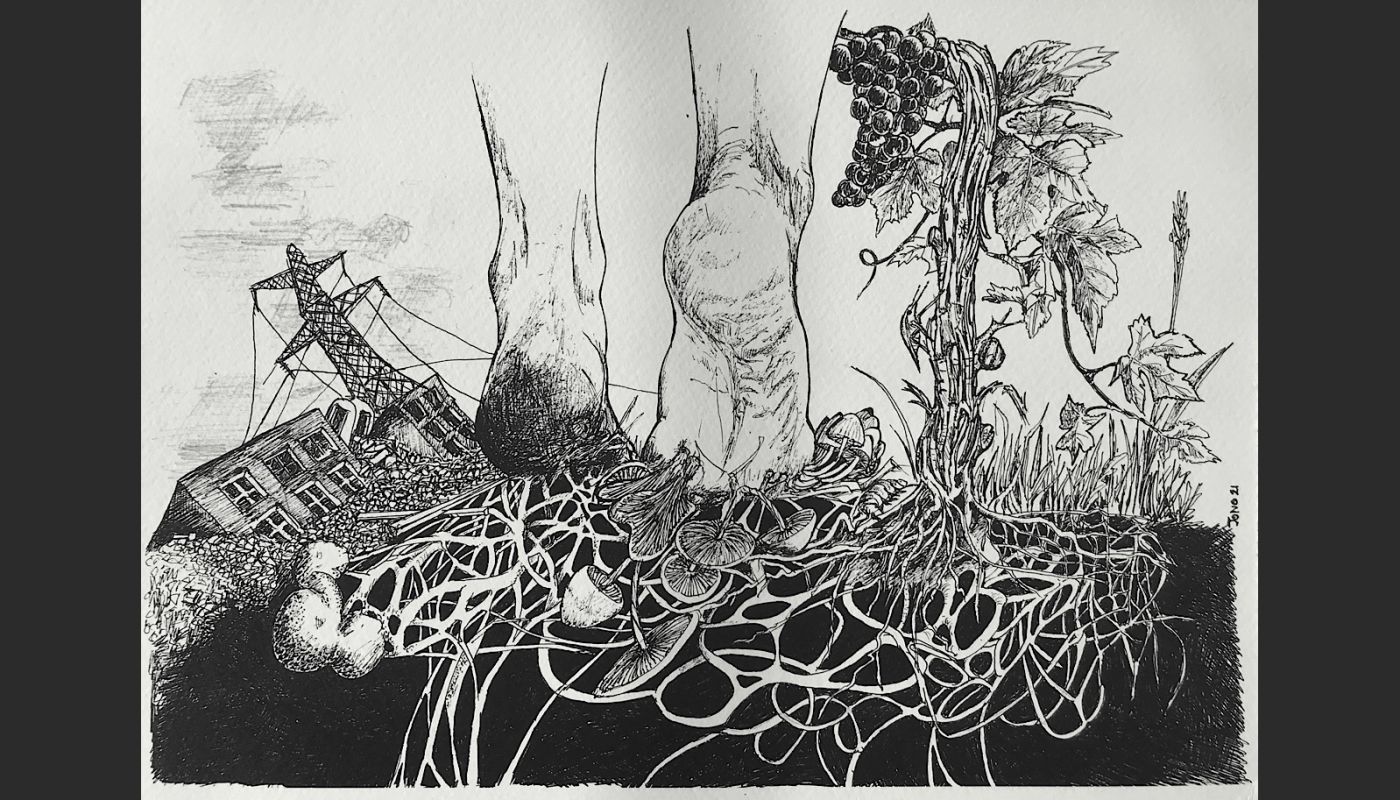
The metaphor/template of mycelium means a lack of hierarchy, inclusiveness and indeterminate fluid connections between the visible (eg established wineries) and invisible (eg old mushroom foragers, women who know the woodland ‘lore’ and recipes to cook from, school kids etc, the list goes on). The reality would be soil microecology and the interrelationships between local and non-local populations, the local natural environment, businesses; mutual advantage to all and the dialectic of communication between humans and nature
I thought everyone would love the idea. Instead, everyone thought I was nuts. Perhaps so…
The fact, or the way I understand things, is that Matter does not change in itself ever, yet as our shaping and interpretation of it does, so too this transforms our experience of reality. This perceived transformation in turn changes us. We become changed as people. And this change is what we need so vitally.
But I think this idea was too strange for the organic group. It’s a pity and frustrating, but I suppose also to be expected. Things take time to change, but we can start here at San Polino. On our side lies the indisputably wondrous logic of a list of wise thinkers: including Tsing, Kohn, the grandiose Foucault, Wohlleben in his writings about forests, Suzanne Simard (tree communication), Stefano Mancuso, just to name a few.
And the wonderful scientific discoveries of the role of the sun, photosynthesis, roots, mycorrhizae, soil bacteria, sedimentary rocks, the whole loop and the total entangled complexity of the natural world, us humans included.
The ideas of Kohn expressed in How Forests Think can be transformed into ‘how vineyards think’ or ‘how terroir thinks’, how vineyards and terroir signal one to the other, and how they both signal to the surrounding forests. It’s high time to investigate such issues. We will have to move fast to get ahead of the changes and challenges that lie ahead of us. There is so much to do and be done.
I will leave you in peace now but thank you for your communication, it helps us a lot with our work here. At any time, I will look forward to your feedback.
Illustration by Jono Nussbaum.