Katia writes I have just read the article by Chris Howard and I LOVE IT. I would so like contact him, if possible. What an interesting man!
My own training (in prehistory practically!) was in social anthropology and, honestly, I do believe that the stuff he is writing about is extremely important.
I use the analytical tools of Foucault in practically all the work I have been doing in the vineyard, the better to understand how the limits of our conceptual world restrict our ability to see connections that could be vital for the development of an in-depth move towards sustainability in viticultural approaches. In particular, I wonder to what extent our vision of what entails nature and its separation from culture bring us to the very heart of issues relating to renewable/sustainable agricultural practices.
Hence the misnomer ‘natural wine’, or the conservative aspects of biodynamics, as it could perhaps be more useful to see how our idea of nature is a cultural construct.
I am more and more convinced that our old 17th-, 18th- and 19th-century taxonomical systems have a lot to answer for in our static understanding of how (a) the natural world functions, (b) how we as humans fit into this ‘natural world’ and (c) how they stymie any chance of placing ourselves within the Venn diagrams of our classificatory systems. We create worlds which we then ‘objectively’ analyse as if they are the only truth.
Bringing this back to the world of viticulture and winemaking, I feel a pressing need to reframe our outlook and understand the connections between ourselves and the world.
For example, that Saccharomyces cerevisiae developed in a symbiosis of evolutionary biology (from the dawn of sedentary society) with humans. We needed it as much as it needed us, as seems may be the case for certain key microorganisms found in agricultural soils. They are systems of mutual advantage and interconnections through definition.
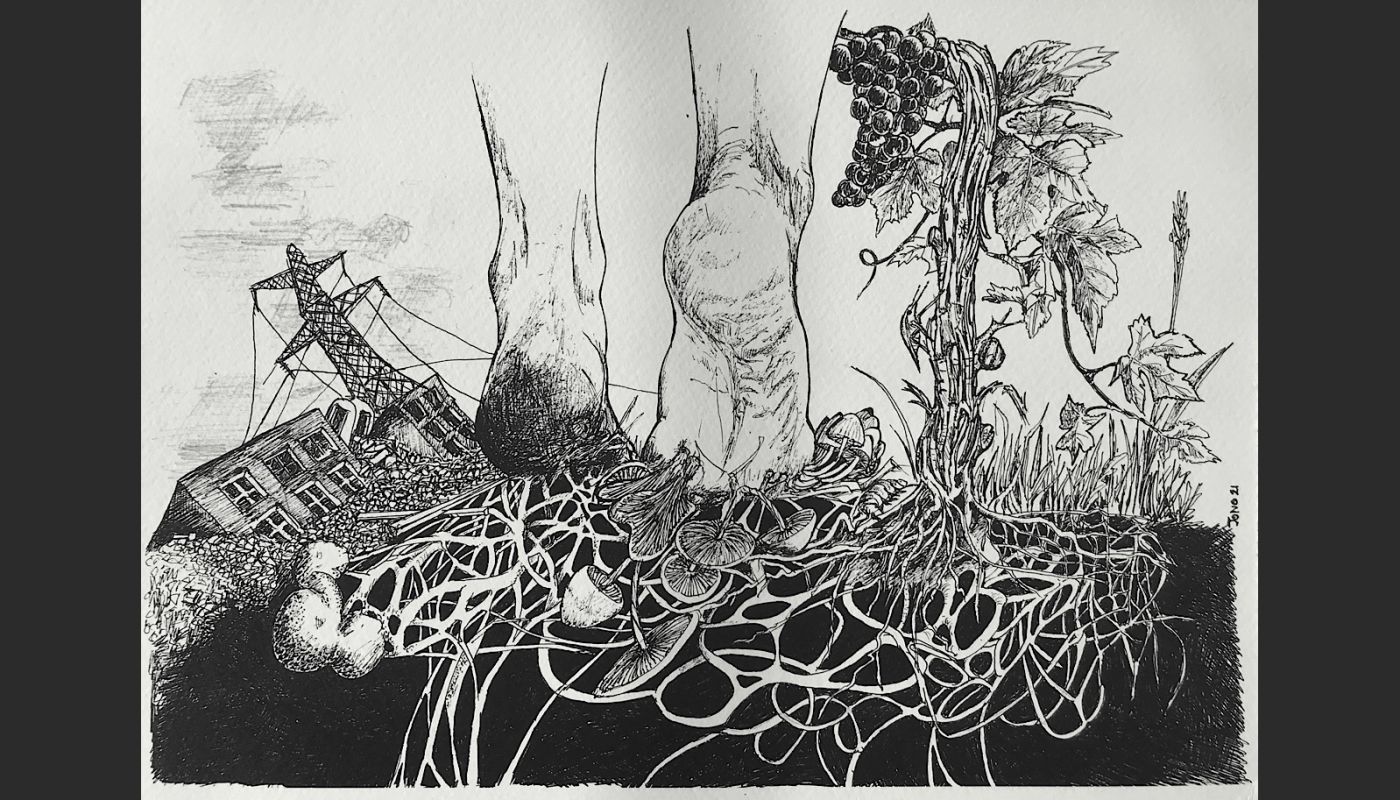
Hence my obsession with the previously underrated role of mycelium as the invisible connector.
It is all very fascinating and I would love to hear what Chris Howard says on the subject. I am sure he will have thought about it. Would it be possible to have his email?
Please excuse this intense email, but I found his article very stimulating indeed.
Chris writes So lovely to hear from you, Katia, and I much appreciate your taking the time to share your thoughtful and resonating response to my Evangelho article, especially in the midst of harvest demands! If I have it right, I believe you wrote a coronadiary that I read and was very moved by last year.
Indeed, I have A LOT of thoughts about all the matters you raise! It’s wonderful to see people like yourself making those connections to issues underpinning the article: the modern divide between nature and culture, social stratification and winegrowing as a multispecies affair. These are themes I’ve written about in academic contexts, but it’s been fascinating to explore their application to wine worlds. I have a busy few days ahead at work, but please allow me to respond in more detail later this week.
…
Hello again Katia, thanks again for your engaging response to my Evangelho article. Having now read several of your pieces on Jancis’s site and given your background in anthropology, I can see how it clearly struck a chord.
I had great fun writing the piece, exploring different angles and storytelling possibilities. At one point I was writing from the perspective of a 130-year-old vine observing the Bay Area’s urban expansion and its relationships with humans and other species. The idea was to explore how the life of a vine might guide attention to more-than-human nature. Of course we can never fully escape our human positionality (as Kant observed three centuries ago), but we can reflect on the knowledge tools we use for understanding human as well as non-human social relations. It was a fascinating exercise, but still felt like I was personifying the vine too much. Nevertheless, it inspired me to think about alternative ways of writing about the vineyards as multispecies life-worlds. Maybe I’ll return to the ‘Testimony of an old vine’ when I find the right language.
The trick with Evangelho was keeping the article contained because the place is so layered and the anthropological perspective is so expansive, especially now that the discipline has moved beyond a purely human focus. Being such an assemblage of social, historical and environmental forces, the site lent itself so well to the type of ‘posthuman anthropology’ I’m interested in. I’ve attached a chapter on the subject, which I was actually writing at the same time as the old-vine articles if you’re interested. There’s a long section on the anthropology of mushrooms, so I suspect you might be! And the chapter points to a qualified post-anthropocentric perspective, which I sense you might resonate with.
It’s very interesting to hear that you apply Foucauldian thinking to your viticultural work! I hadn’t thought of it, but I can see the connection. His archaeology of knowledge, inspired by Nietzsche, is indeed a powerful tool for understanding how knowledge is never purely objective, but is a contingent product of social and historical circumstances. This realisation opens space for ‘epistemic breaks’ that allow us to see our prejudices and notions of truth as relative, in turn creating possibilities for thinking and acting otherwise. Foucault’s writings on bio-politics are perhaps more relevant than ever in light of the pandemic and the acceleration of anthropogenic climate change.
Deconstructing the Great Divide between nature and culture is, in my view, the most important task of our times. Undoing these binaries implies reinserting ourselves into a lateral web of life rather than a hierarchical great chain of being with humans at the top. Many positive social and environmental possibilities flow from this shift in thinking. As I tried to show in the article, reality is relational and always more layered and complex than it appears. Complicated in the literal sense of being ‘folded together’ – from the Latin com ‘together’ plus plicare ‘to fold’. It seems appropriate that ‘complex’ is a key wine term!
I went with Foucault’s concept of ‘heterotopia’ because it points away from over-simplistic binaries (eg utopia/dystopia, beautiful/ugly, urban/rural). The Anthropocene is an era of reckoning, calling for more-nuanced concepts that speak to complexity. The romantic celebration of nature is no longer adequate if it ignores the violence inflicted on the earth by humans. Similarly, our notions of democracy and civil society come under question as we reckon with racism and structural violence against certain groups. We are facing the fact that Homo sapiens (wise humans) also have the very real capacity to be Homo demens (evil humans). But there’s a choice. We have to decide, warned the philosopher Hannah Arendt, ‘whether we love the world enough to assume responsibility for it’.
It’s heartening to see this critical reckoning in many spheres, from politics to academia to local communities and the wine sector. In fact, I think the wine world can play an important role here because wine is the perfect synthesis of nature and culture. And it brings people together to celebrate what is good in life. It symbolises conviviality in the best and broadest sense of the term.
By the way, I’m with you on ‘natural wine’ being a misnomer. I know invoking ‘nature’ is well intentioned and used as a contrast concept (ie not industrial wine), but it’s misleading and ironically reinforces Great Divide thinking. Wine is cultured through and through. I’m currently writing an essay on the origins of wine, tracing its genesis to Africa and proper origins back to the Palaeolithic period. In the forests of modern Lebanon, wild grapes were foraged and placed in primitive baskets, the juice at the bottom spontaneously fermenting after a couple of days in the open. Voila … the world’s first grape wine and très naturale (nothing added, nothing taken away and no shelf life)! Not so fast… baskets are a food-storage technology; it took human cooperation to gather and bring the grapes back to camp. And once these stone-age oenophiles developed a taste for it, deliberate basket pressing and wine-drinking developed as a ritual practice, becoming ever more culturally and technologically sophisticated since.
It’s not a big deal, but I find it mildly amusing and frustrating how advocates of ‘natural wine’ overlook its ‘cultured nature’. I’ve visited some natural-wine producers whose wineries are more scientific laboratory than artisan workshop. Often, they’re a hybrid, making them absolutely modern. But it’s good to see the debate evolving, with both sides becoming more critically reflective. I’d like to write more about this, but alas, I’m time-poor these days. I’m a full-time researcher at the New Zealand Ministry of Economics and a part-time lecturer in anthropology. Wine writing happens on the side, though I’d like to do it in a fuller capacity. I’d also like to spend more time in vineyards, having worked a couple harvests in my native Sonoma County and pondered a winemaking career before going the academic route. I admire and envy you for tending your vines under the sun, living your philosophy in the modus vita activa rather than a vita contemplativa.
I hope the grapes are ripening well and you’re enjoying this very special time of year. I look forward to further conversations.
















