Would you rather buy wine from a family-owned enterprise or one made by a corporation? I wouldn't mind betting that most wine lovers would instinctively choose the former. We all have an image in our mind of the horny-handed smallholder, toiling away in vineyard and cellar, helped and inspired by spouse and progeny. Corporations mean big business, endless meetings, faceless accountants and the many supposed evils that all those entail.
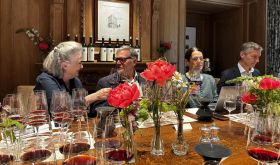
Yes, there is a big difference between a mom-and-pop business and that of a multinational corporation. But the more general model of a family business, especially in Europe, where wine businesses tend to have been around long enough to have been dispersed between several different branches of a family, is very far removed from one family unit. Just ask, for example, Anne-Claude Leflaive (pictured), the member of the Leflaive clan and daughter of the redoubtable Vincent who today just happens to be the Leflaive in charge of running Puligny-Montrachet's most famous domaine day to day. She has to coddle and answer to no fewer than 28 family shareholders, many of whom have little practical interest in wine but who presumably have a considerable interest in their dividends.
As Christian Seely, who runs the wine division of insurance giant AXA, put it somewhat caustically at a discussion of families v corporations at the Masters of Wine Symposium in Bordeaux earlier this year, 'Corporations are usually accused of being too profits-orientated, but in my experience these cuddly families occasionally overcome their romantic opposition to profits.'
I must say that having observed the behaviour of extended families running wine companies for several decades, I would agree that many members of such families can be just as driven by the bottom line as corporate shareholders – even if the CEO of a family enterprise enjoys the great advantage of being rather more difficult to dislodge than an executive for hire. But dislodged they are from some family wine estates, even from some of the highest profile ones. Remember when in the early 1990s Madame Bize-Leroy was effectively ousted from running the most famous Burgundy domaine of all, Domaine de la Romanée-Conti? Perhaps having one domaine owned by two families, as DRC is, is a particularly toxic formula, but it is by no means uncommon.
And family strife is by no means the preserve of Europeans. For any American who thinks it is, I have but one word: Mondavi. Shall we just leave it at that? We could, although it is worth pointing out that California in general and the Napa Valley in particular has a very particular 'problem'. Winery assets tend to have seen such staggering inflation between founding generations and the next, that there have been quite remarkably few examples of successful inter-generational transitions of ownership and management there. A higher-than-Burgundian divorce rate has not helped things either.
But in terms of how they are run day to day, there can be very positive benefits for employees in family-run companies. Jérôme Philipon worked for nine years for Coca Cola, and 11 years for Nestlé before that, before taking over as head of Champagne Bollinger. He was not a complete outsider, having grown up in the Champagne region and gone to school with a couple of Bizots, members of the family that owns Bollinger (and, now, Ayala).
What he loves about his new employer is that 'hardly any time is spent on presentations. I just do a plan and a budget and tell them about it. Power point is very new to them. And whereas in American corporations you always have to make a budget presentation in mid August, at Bollinger we close down for the entire month. There are no shipments. The vineyards are reasonably quiet. We can all just go off on holiday – although I do take my blackberry.' Corporate habits obviously die hard.
May 2009 was when the difference between a family company and a corporation really hit him. Champagne shipments in early 2009 had been disastrous for everyone, and down 55% for Bollinger. Their board meeting was scheduled for early May. And Philipon had arrived only the previous year and felt hugely responsible. 'What should we do?' he said, 'in a corporation you had better have a plan in such circumstances… I was terrified. But [head of the family] Arnaud d'Hautefeuille just put his arm round my shoulders. "Jérôme, don't worry," he said. "We've seen this sort of thing before." And they were right. A corporation requires quarterly results. A family can afford to take a long term view.'
Perhaps the most dramatic recent example of disastrous corporate short-termism has been the entrance into and on-again-off-again exit from the wine business of Australian brewers Foster's. In a few short years the crème de la crème of Australian wine – the likes of Rosemount, Penfolds, Lindemans, Seppelts, Wynns, Tollana, Seaview, Coldstream Hills, Devils Lair – together with a dynamic southern French brand James Herrick, went from being some of the most successful wine brands on the planet to being actually rather difficult to find on any shelf anywhere. Foster's began with Mildara Blass, then grafted on Beringer in California to establish quite how few synergies there are between California and Australia. Then in 2005 they gobbled up Australia's dominant wine company Southcorp, by then owner of all the wine brands above, with apparently about as much thought about what to do with them as Bush and Blair had had about what to do with Iraq once they'd invaded it. Although presumably some of the blame, as has so often been the case, was due to over-enthusiastic bankers.
From my vantage point I can see hundreds of well-run family wine businesses and some inspiring examples of corporations which have invested in wine and seem (so far) to have done an excellent job in terms of wine quality. AXA Millésimes with its properties in Bordeaux, Languedoc, Portugal and Hungary, most famously Ch Pichon Longueville and Quinta do Noval, springs to mind. And so, perhaps surprisingly to some, does Suntory, the Japanese spirits company. Its three principal wine investments – Robert Weil in the Rheingau, Ch Lagrange in Bordeaux and Suntory winery in Yamanashi prefecture in Japan – all seem to me to be impeccably run, with real long termism.
Perhaps that really is the key to successful management of a product that is as long term itself as wine.