I left home at 5.30 am for the dinner I had been eagerly anticipating. By noon I was standing outside Trondheim airport, the interchange for the Norwegian oil industry, looking out for a yellow taxi from Björn Olssons, as instructed.
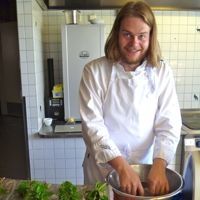
There wasn't one, and when a local taxi driver responded to my question by asking whether I was expecting a driver from New York, I decided to head back into the terminal. As I did so, someone stopped me and asked 'Are you Nick?' Behind the long brown hair, thick beard and Rayban sunglasses was the smiling face of Swedish chef, Magnus Nilsson.
Wearing black trousers tucked into green wellingtons and a white chef's jacket, Nilsson explained that my arrival had coincided with a fish delivery via Trondheim fish market so that he was combining the roles of deliveryman and taxi driver. We piled into his Land Cruiser and set off.
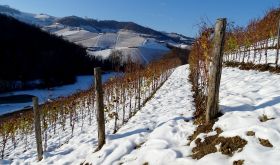
Our destination was Fäviken, 160 kilometres due east, close to the town of Åre, one of Sweden's most popular ski resorts. Fäviken is a 9,000-hectare estate that was bought in 2003 by Swedish businessman Patrik Brummer as an expression of his love of nature, hunting and the great outdoors.
Nilsson, 28, took over the restaurant there in November 2008 and has already become the chef most talked about by those who are constantly on the look out for the next rising star. The news of all that he has accomplished in this short time has already spread far and wide. Later in the year he is to talk at a green summit on business and the sustainable environment in New York. There will be a second appearance at the annual 'Cook It Raw' convention in Tokyo, and he has been invited to cook at the Sydney Food Festival. All this from a restaurant that seats no more than 12, is open only from Wednesday to Saturday and is at its busiest in the winter when the outside temperature can get down to minus 30 ºC. Last winter, one of the coldest on record, it reached minus 40 ºC.
As we crossed the border from Norway into Sweden, the mountains looked steeper, the snow thicker and Nilsson accelerated, explaining that the speed limits were slightly more relaxed in his home country. And he began to explain how he had turned to the stoves.
'I was born close to Fäviken and trained as a chef. I went south and then to Paris for five years cooking at two of the city's most respected restaurants, L'Astrance and L'Arpège.' As he recalled this period, the memories brought a smile to his face. 'But when I came back to Sweden I grew disillusioned with cooking. I never thought I would be able to work with such high-quality ingredients, to cook to the same standard.' He decided to enroll in a sommeliers' school in Stockholm and it was wine that initially brought him to Fäviken.
'There had been a restaurant here for 20 years but it specialised in moose fondue for corporate parties and was only really busy during the ski season. I worked there for a while, it wasn't prospering and it didn't match Patrik's vision for Fäviken. He asked me to make him a proposal, to establish something that would reflect what was growing wild on the estate, or being grown, bred or produced locally.' A partnership was soon entered into that now has Nilsson and his partner and restaurant manager, Johan Agrell, paying Brummer a fee for the use of the restaurant.
And while the speed with which his and Fäviken's names have swept through restaurant circles has surprised Nilsson, what he seems most pleased about is the the speed with which he has established such close connections between his restaurant and the land.
Today, Nilsson relies on suppliers for only four different ingredients on his menu: salt from France, sugar from Denmark, fish from Trondheim, and alcoholic vinegar from the south of Sweden. And wine, of course, for which Agrell has an excellent palate.
I was to witness three fine examples of how he has achieved this symbiosis so quickly.
The first was on a tour of the vegetable garden Nilsson has established close to a small lake where they keep any fish surplus to requirements until they need them. The garden is not large and only the tops of the garlic shoots were evident at the end of May. But by the end of September, thanks to the uninterrupted sunshine at this latitude, this will have produced over 2,000 kilos of vegetables, more than enough to supply the kitchen through the colder months.
Five kilometres away, close to a much larger lake that during the winter freezes over to become a road, is a farm belonging to Pieter Blombergsson, whose surname literally translated means 'son of flower mountain'. There could not be a more suitable name for a man with the gentlest of faces and an obvious friendship for the ducks, chickens and geese he breeds for Nilsson and René Redzepi, the chef at Noma, Copenhagen, on a farm that is very, very free range. All these animals, as well as the snails he is trying to breed, meander through a swathe of birch trees which Blombergsson taps every spring for their sap, which he then reduces over an open fire to produce birch syrup .100 litres of birch sap produce one litre of syrup, which I tasted from a spoon. Dark and tangy like balsamic vinegar, it has the consistency of unctuous Pedro Ximenez sherry. (Nilsson serves it with root vegetables or eggs and herb salt at breakfast.)
I was to play a part in the element of cooking in this environment that gives Nilsson the greatest pleasure. Three hours before dinner started we set off up a path from the back of the kitchen that led to yet another forest and on the way picked fiddleheads, fireweed, redder and thinner but with a taste similar to asparagus, dandelion leaves, stinging nettles and red clover. These would be cleaned, steamed for five seconds and served with sheep's cream. 'They cost nothing and taste wonderful', Nilsson added, 'and in the autumn the same paths yield berries and wild mushrooms.'

Brummer has spent sensitively on the conversion of the four buildings that formed the original farm when Fäviken was established in the early 1880s – including one that is the Brummer family home complete with underground cinema. A small building next door leads to a sauna and steam room and next to that the building that once taught dairy skills to young Swedish girls is now home to seven extremely comfortable bedrooms. The much larger wooden building 20 metres away, once a barley store, is now the bar and restaurant and houses one room that would not look out of place in a Scottish baronial home. In it a snooker table is overlooked by the stuffed heads of moose and numerous other game which can still be hunted here, including a large black capercaillie, a rare and large member of the grouse family.
Dinner is at 7 pm and we were escorted into the bar, where our table of six was joined by two tables of two. The wooden interior was lifted by a century-old, full-length wolfskin coat hanging on one wall and the first of four small first courses made moments earlier in the kitchen next door. 
These included cubes of Arctic char with sour cream; wild trout roe served in a circle of warm, dried pig's blood; and crisp lichen, also from the hedgerows, topped with shavings of egg (pictured), served with a gin and rhubarb cocktail.
At 7.30 pm Agrell led us upstairs to a series of wooden tables decorated with wild flowers. The room was distinguished by a series of hams and parcels of cod roe hanging from the rafters, small windows through which it was possible to see the bright blue sky outside. The centre of the room was occupied by a chopping board on legs that was to feature significantly in one of the courses. Service was certainly distinctive, as Nilsson and two other chefs carried the heavy wooden trays of food up the steep steps, delivered it to our tables and explained each course. Not surprisingly, their footsteps grew heavier with each course.
Two of the first three dishes, all of which came via the Land Cruiser and Trondheim's fish market, were stunning. An enormous scallop had been cleaned, cooked with its juices and was then served over burning juniper berries. A langoustine was simply roasted and served with sprouting barley and a burnt cream sauce. The cod with turnips and green juniper berries that followed was good but lacked the intensity of the shellfish.
The first foraged vegetables of the season, which I had helped pick, followed; and then, in a piece of high drama, Nilsson appeared at the top of the steps carrying a large cow's leg, looking every inch the Viking. This was placed on the chopping block and sawed open to reveal the bone marrow that was scooped out and served with diced cow's heart and grated carrot. This ritual is repeated in the autumn with an even longer and thicker moose's leg.
A more mundane rib of beef from a very mature cow followed and then a series of desserts took up the wild theme with a vengeance: wild raspberry ice with fermented lingonberries; a sorbet of milk and whisked duck eggs; and slices of cake made from the bark of pine trees dipped into buttermilk. The entire meal was executed to a very high standard.
And it was unusual for two other reasons. The first and more irritating was the constant Swedish folk music that may well be in keeping with what Nilsson has in mind but I found wearisome. Far more agreeably exceptional was the experience of looking out through the small windows at a sky that, as the meal progressed, only seemed to get brighter. As the wind had dropped, it was warmer drinking coffee on the verandah at 11 pm than it had been walking to the restaurant at 7 pm.
Magnus Nilsson, thanks to his talents and the far-sighted patronage of Patrick Brummer, has created something very special at Fäviken. Few chefs will ever be in a similar location but there is plenty to learn from and a great deal for any visitor to enjoy. Even if it means a 5.30 am start.
Fäviken www.faviken.com
Visit Sweden www.visitsweden.com