9 November 2015 See also our compilation of German and Austrian tasting notes.
Since the turn of the millennium the term ‘vintage of the century’ has been bandied about in Germany with free abandon several times already (for 2005, 2007 and 2009), only for flies to be found in the ointment some time later. But 2015 may well turn out to be the real thing.
In nine out of ten vintages you will find some regional variation due to localised vagaries of the weather: hail in the Mosel, frost in Franken, floods in the Pfalz or the cherry vinegar fly in Württemberg, to name just a few inconsistencies of recent years.
No such complaints were heard in 2015. The usual suspects of poor flowering, spring frost, mildew, rot and bad botrytis were conspicuous by their absence across the country. German growers have learned not to make rash judgements during the growing season and always live with the worry that some unexpected event or hitherto unknown enemy of the vine may turn up to spoil what looked like a promising vintage. Even dry and hot weather is viewed with suspicion in case it lasts too long, and while still welcome in June and July, this year its persistence right throughout August began to cause concern about water stress for younger vines and eventually an imbalance between acidity and alcohol in the finished wine.
When the rains eventually came, some in early September, some towards the middle of October, they were plentiful, but with temperatures remaining low during the wettest periods, the dreaded consequences of rot or mildew did not occur. By the end of the harvest furrowed brows gave way to smiles of content as none of any fears had materialised.
Cornelius Dönnhoff from the famous Nahe estate Hermann Dönnhoff reports that in his and his father Helmut’s lifetimes, weather conditions had never been better than in 2015. It started with an early and perfect flowering leading to a steady development of the vines. He did not deny that towards the latter days of the prolonged hot and dry summer they were on a knife edge about a possible arrest of the metabolism of the fruit, but were bailed out by just the right amount of rain when it was needed.
Measurement of the degree of ripeness at the end of August revealed excellent acidity and, contrary to developments in autumns of comparable seasons, this acidity did not drop rapidly but very gradually. There was never any pressure on the harvest, leaving them to pick the grapes for the various types of wine from Gutswein to Grosses Gewächs and Kabinett to Trockenbeerenauslese between mid September and late October, all at perfect pitch. The icing on the cake was provided by the appearance of a small but perfectly healthy amount of botrytis.
Friedrich Groebe, a modest grower not prone to exaggeration, expects 2015 to become one of the all-time greats of his Rheinhessen region. August did have its moments of fear when must weights threatened to stall as a consequence of the prolonged dry heat, but rain in early September compensated for this delay by an accelerated accumulation of grape sugars. Acidity levels always remained healthy. Grapes for the Gutsweine were picked from mid September, the main harvest beginning on 8 October conducted with relative speed to prevent Oechsle weights soaring out of control. Although alcohol levels are expected to be slightly higher than in previous years, they will be balanced by healthy fruit and excellent acidity. If Friedrich Groebe has any regret, it’s that due to the substantial must weights there will be no Kabinett in 2015, but he expects the rest of the range from the dry Grosse Gewächse to noble Beerenauslesen to be of outstanding quality.
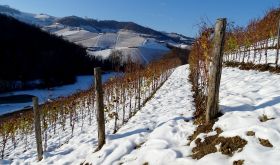
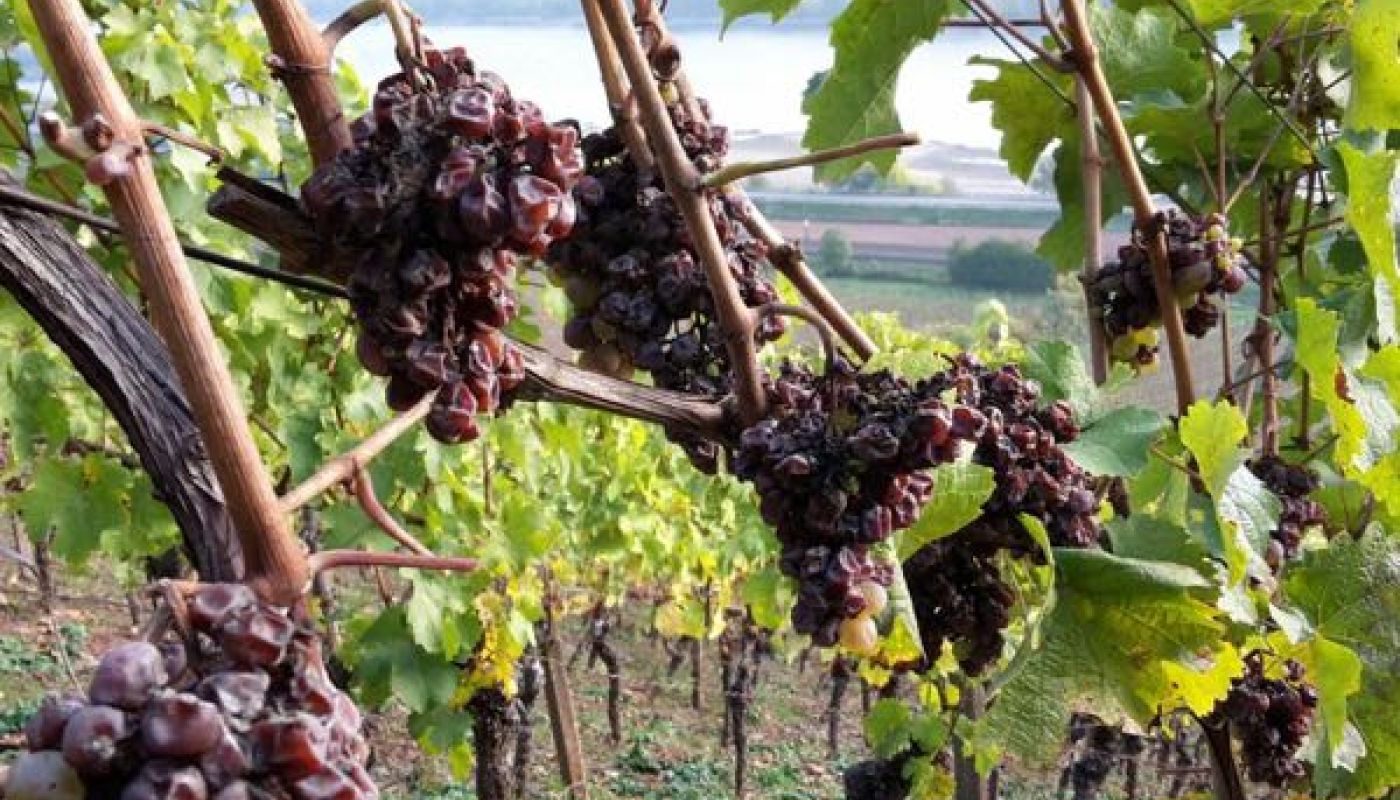
Our image above shows Klaus Peter Keller's vines in the Rheinhessen's Pettenthal vineyard, which is 73% steep (you can just see the Rhine in the background). He describes these 2015 grapes as having 'the most beautiful botrytis and natural shrivelled quality' and he will make the first-ever TBA from Hipping and Pettenthal fruit this year. And below is another promising example from Keller's healthy, often small-berried crop. [See Julia's report on a tasting of Keller's 2015s, published in May 2015 – JR]

Gerd Bernhart from the Bernhart estate at Schweigen on the border with Alsace is another producer not given to ostentatious statements, but he too speaks optimistically about the prospects for wines from the 2015 vintage. In his judgement 2015 does not compare with 2003, despite their joint legacy of a prolonged hot and dry summer since, unlike 2003, this time round photosynthesis did not stall. Many of his colleagues in the southern Pfalz had already finished harvesting by the end of September, but with an eventual average must weight of 90 to 95 degrees Oechsle and sound acid levels, Herr Bernhart did not feel pressurised to pick quite that early and concluded his harvest on 8 October. Although the main strength of the southern Pfalz tends to be Pinot in all its variants and Gerd Bernhart’s Weisserburgunder and Spätburgunder are always among the best of the region, he believes that this year Riesling will have one of its Cinderella moments.
‘Satisfied all round’ was the pronouncement from the estate of Hans-Peter Ziereisen in Baden. Despite the long, hot and dry summer, they did not observe any signs of stress due to drought and, after a short interval of rain in early September, were able to pick perfectly healthy grapes with relatively high must weights. While in years such as 2010, 2013 and 2014 careful selection of fruit was the order of the day, in 2015 the crop could almost be picked blindfold due to the uniformly sound state of the grapes. Not being Riesling producers but protagonists of outstanding Pinots, the Ziereisens were totally happy with the complete absence of botrytis. Initial concern about a potential loss of acidity did not materialise but the higher must weights are expected to yield wines of between 12.5 and 13% alcohol.
Although one of Germany’s major regions in terms of output, Württemberg is little known outside the home market, Rainer Schnaitmann being one of only a handful of producers with international representation. He believes that if 2015 should really turn out to become a vintage of the century, it is because of the lessons learned from the similarly hot, dry summer of 2003. Leaf reduction was kept to a minimum, just enough to allow for air circulation, but with plenty of foliage to protect the grapes from sunburn. He was particularly pleased with the quality of his Riesling and Spätburgunder grapes, both very small-berried in 2015, healthy, and with good concentration of fruit and acidity. Even his most fickle of varieties, the late-ripening Lemberger, did not require any special selection or sorting of the crop. Quantities turned out slightly lower than desired, except for the bread-and-butter variety Trollinger, which was generously bolstered by the autumn rains. In the absence of any botrytis, most of his whites will be dry. He put in a particular plea for his Riesling, which he feels will compete with the best of other regions in terms of freshness and fruit.
The Mosel’s Annegret Reh-Gartner from the Reichsgraf von Kesselstatt estate has issued a comprehensive vintage report, which also includes their holdings in the Saar and Ruwer. All given facts relate to Riesling, the only variety they grow:
‘The growing season began with little moisture in the soil, followed by a dry spring and a hot, dry summer. It wasn’t until August and September that there were any significant quantities of rainfall. Yet by then, growth was basically completed. The result: small, golden-yellow berries with extremely little juice.
'Based on the experience of recent years, we began picking earlier than usual this year too. We started on 28 September 2015. Our experienced harvest team was able to select grapes according to degrees of ripeness for the various designations from dry to noble sweet throughout the entire autumn. We picked the grapes from our top sites using three separate buckets, whereby the shrivelled berries were sorted again at the vat. These efforts enabled us to achieve top levels of ripeness of up to 181 degrees Oechsle.
'Thanks to very cool and primarily dry weather, we were able to harvest at a relaxed pace. For the most part, musts ranged between 85 and 95° Oechsle, with 9 to 10 g/l of acidity. Healthy, ripe, fruity aromas and fine, yeasty notes of spontaneous fermentation are already perceptible in our cellar.
‘The harvest of the grapes destined for our Grosse Gewächse was really rewarding. In the GG sites we began reducing individual shoots very early and continued before and during blooming. After flowering, the remaining clusters were divided and in August foliage was removed from the vines. The result: healthy, golden-yellow berries with Oechsle readings between 92 and 100° and sensational fruit aromas. The fermenting musts are already showing enormous concentration and a wealth of fruit. In short: you can already look forward to an outstanding vintage! The only disappointment is the small size of the harvest – yet, this contributed to the high quality of the crop.’
On one of my inspections of the Ahr vineyards towards the end of October I bumped into Dörthe Näkel from the Dernau estate of Meyer-Näkel, who told me that they had just brought in their last grapes and were extremely satisfied with the quality of the crop. For the best of Spätburgunder, most of the top growers had left their grapes on the vines until at least mid October. Three days of rain right towards the end did no damage, as cool temperatures at night not only prevented any development of rot, but served to aid concentration of fruit. The jury is still out on Frühburgunder, as the early-ripening grape attracted the attention of a wasp population that was still very active in September.
I am also able to provide first-hand information on the quality of the crop in the vineyards of Würzburg and Randersacker in the region of Franken where I visited the venerable Bürgerspital during harvest time in the last week of September. A guided tour through 120 hectares of vineyards allowed me to check on the quality and ripeness of Silvaner and Riesling grapes destined for grand cru production, their appearance and taste convincing me of their outstanding prospects. Estate manager Robert Haller did not fail to point out to me that all their Pinot varieties were of equal quality, and in the case of Pinot Noir I was able to ascertain their pedigree as they were awaiting processing in the vinery: small berries, healthy and shiny, great concentration of fruit, but above all with the juicy acidity that no fine Spätburgunder should be without.
In the Rheingau the famous Robert Weil estate at Kiedrich already showed some cautious optimism in late June, being able to report on the successful conclusion of early flowering. In July they took first measures to reduce both yields and foliage, but stressed the need for precipitation. In August vine growth was two weeks ahead of the long-term average, but the lack of rain still gave cause for concern about water stress, a sentiment shared by the director of the nearby state domaine Kloster Eberbach, Dieter Greiner. Some plantings of young vines may have suffered, but the grapes from mature vines destined for the top selections continued to develop well and were able to recharge their batteries from the rainfall in early September.
After a pre-selection the harvest got into full swing in the first days of October. By 25 October all the fruit for the dry Riesling wines had been picked in a perfect state of health and with a fine balance between fruit and acidity. Robert Weil is also a producer of some of the world’s finest noble sweet Riesling wines and expectations are high for some true greats.