
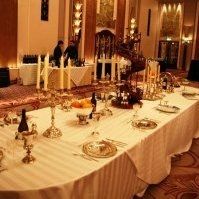
See tasting notes made at the event described below and pictured on the left.
Last Monday night, Seder night, Jewish children the world over were served wine as a fundamental part of the religious Passover ritual rather than being encouraged to see it as a naughty, adult stimulant. For generations the sort of wine typically served at Seders was sweet, red, strong – and disgusting enough to get kosher wine a bad name.
But kosher wine has changed. New York lawyer Keith Berman, whose wine collection is virtually all kosher, reports delightedly that 'kosher wines are now indistinguishable from equivalent non kosher wines'. Diana Finn and her husband of Bowden outside Manchester have for 40 years drunk only kosher wine at home. She observes, 'there was a time when you could only get sacramental wine, but now there's definitely more choice. Kosher wine comes from all over the world now, and it's much more drinkable and more sophisticated.' Her local Tesco in Altrincham has a substantial kosher wine section with Clarksburg Chenin Blanc from California at £8 a bottle and Barkan Israeli Cabernets some of her favourites. So, I asked, has she noticed more of her friends actively choosing to drink only kosher wine at home as she does? She chose her words carefully. 'More of our friends are not turning down kosher wine.'
Although kosher wine is no longer a cheap joke, it will never be cheap. For a wine to be kosher it must be handled exclusively by observant Jews throughout the production process, which tends to involve another layer of costs. In fact to outsiders, the whole business of making and serving kosher wine seems an extreme palaver.
I went to what I can only describe as a wine-tasting extravaganza in the ballroom of the Park Lane Hotel, London, recently, laid on by a leading kosher wine importer, Kedem Europe. Unlike the usual businesslike, unadorned professional wine tasting, this was a full evening's entertainment with music, lavish buffet, and lashings of room between each kosher producer's table. The tables were manned by very young, neatly dressed men in skullcaps who very carefully and insistently rinsed my glass out with water between each taste. Because we wine professionals view tap water with its usual heavy chlorination as a possible contaminant of wine, I spent some time vainly trying to stop this practice. Only afterwards did I realise that the ritual was necessary so that my Gentile saliva did not contaminate the next sample.
The only way of transforming a kosher wine into a liquid that can be freely handled by non-Jews is by making it mevushal, with a rather different spiritual status, by subjecting it to flash pasteurisation – a brutal procedure that perhaps did little harm to the traditional sweet red likes of Manischevitz and Palwin, but one that would rob the new generation of sophisticated, dry kosher wines of any ability to mature in bottle.
This would be a great shame for a great number of kosher wines being made today. There are special kosher (cacher in French) cuvées of such famous names as Château Pontet-Canet of Pauillac, Château Léoville Poyferré of St-Julien, Château Malartic Lagravière of Pessac-Leognan and the prototype 'garage wine' Château Valandraud of St-Émilion, for example, all of them tasting remarkably similar to the non-kosher version.
But at least two of these Bordeaux producers have abandoned kosher wine production already. Algerian-born Jean-Luc Thunevin made kosher cuvées of Château Valandraud in 2001–2005 inclusive at the suggestion of a Jewish merchant's enthusiasm for the American kosher wine market. 'I thought having the endorsement of the New York Jewish diaspora for the best kosher wine ever produced would have been a way to challenge the predominance of Bordeaux's traditional 1855 classification'. But, having made the mistake of trying to distribute these kosher wines himself, he has now abandoned kosher winemaking, finding the rules just too constricting on the vinifcation process and the kosher market much more crowded nowadays.
Across the Gironde in Pauillac, Alfred Tesseron of Château Pontet-Canet was persuaded by a Bordeaux merchant to produce a kosher cuvée in 2002, 2003 and 2005. But, he reports, 'in making them, it became too complicated for us as there were many constraints. For that reason, I decided not to do it any more. I have asked many people about kosher wines and it seems that if they enjoy my wine, they will buy it even if it is not kosher.'
At the Kedem event I also tasted kosher wines carrying other grand French appellations such as Puligny-Montrachet, Corton-Charlemagne, Beaune and Champagne, at a price – as well as a range of wines from a smallish Spanish producer whose fortunes were completely transformed by the decision to produce kosher wine.
Capçanes is a small, Catholic village in the hills above Tarragona that used to produce wine in bulk for the likes of Torres. But when that large producer began to develop its own substantial vineyard in nearby Priorat, those running the Cellar de Capçanes realised that they would probably need a new market, so accepted an invitation from Barcelona's Jewish community to produce kosher wine. This necessitated new equipment and introduced them to specialised winemaking and today they make a wide range of highly regarded wines, of which only about five per cent are kosher. Capçanes' Geisenheim-trained winemaker Jürgen Wagner told me that it costs them an extra 1.35 euros a bottle to make a kosher wine, what with the extra processing and the special seal.
It is difficult for outsiders fully to grasp the detail of kosher rules. Kedem Europe is run by Morris Herzog, whose cousin runs the Royal Wine Corporation, the US's leading producer and distributor of kosher wine. Royal have their own vast modern winery in Oxnard, California, which produces such labels as Herzog and is heavily dependent on bought-in grapes. I asked how this squared with the kosher requirement that vineyards lie fallow every seven years, only to be told that this requirement applies only in Israel – and even there the land is 'sold' every seventh year to a non-Jew to allow production to continue.
Mirroring the dramatic improvement in the range and quality of kosher wine made elsewhere around the world has been a similar revolution in winemaking in Israel, which now has dozens of extremely ambitious, often highly successful wine producers. But many of the newer ones don't see the need to produce kosher wine, so secular are many of those who constitute their local market. And such a highly respected older producer as Castel makes both kosher and non-kosher wines. Thirsty Israelis tend to keep exports relatively low and, again, prices relatively high.
FAVOURITE KOSHER WINES
Note that this refers specifically to the kosher cuvées of the wines below.
Ch Léoville Poyferré 2005 St-Julien
Ch Pontet-Canet 2004 Pauillac
Ch Malartic Lagravière 2004 Pessac-Léognan
Ch Valandraud 2003 St-Émilion
Capçanes, Peraj Habib 2006 Montsant
Segal's, Unfiltered Cabernet Sauvignon 2007 Galilee
Castel, Grand Vin 2007 Judean Hills
SPECIALIST KOSHER WINE SHOPS IN LONDON
Sussers
15 Hallswelle Parade
Temple Fortune
London NW11 0DL
Tel 020 8455 4336
The Grapevine,
90 Oldhill Street
London N16 6NA
Tel 020 8880 8080
The Grapevine
20 Bell Lane
London NW4 2AD
Tel 020 8202 2631
See tasting notes on kosher and Israeli wines in this list of tasting articles by region.













