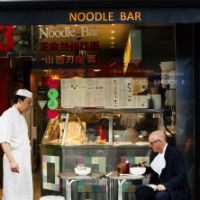
This noodle bar looks just like one of the many that dot every street of every city, town and village across China.
Its frontage is no more than five metres wide with its front window almost invariably coated in the steam that rises from the range of woks in the kitchen just inside the front door.
The pavement is home to a few plastic stools and to two small round tables, each of which sports a container of fiery Shanghai red bean curd sauce. The front window contains a list of the vast number of dishes the tiny kitchen produces as well as a sign that is common to all such eating establishments. ‘Cash Only’ it reads.
But this is not China, as the presence of a Caffe Nero to one side and the entrance to Leicester Square tube station on the other clearly reveal. This is the Lanzhou Noodle Bar at 33 Cranbourn Street, one of the few places in London still home to the exhausting art of hand pulling Chinese noodles.
 China gave noodles to the world. The earliest definitive record of their popularity is almost 2,000 years old and from China they have spread to Japan (whose ramen noodle stores seem to be opening with great regularity in London and New York at the moment) before spreading throughout the rest of Asia. Whether Marco Polo was the personal conduit for their introduction into Italy cannot now be proved definitively but the connection is obvious. Children everywhere owe a huge vote of thanks to China’s original noodle puller.
Longevity, ubiquity and the fact that Chinese noodles can be produced so inexpensively has meant that over the intervening years noodles have acquired extra layers of meaning in Chinese culture. Long noodles have come to signify a long life, so they are invariably served as one of the final dishes at an important banquet. They also can also form one of the gifts at a burial.
This particular noodle bar in shares several of the physical characteristics common to noodle bars in China.
It is compact and not terribly comfortable. The ground floor comprises two communal wooden, tables that seat six each plus a couple of ledges where one can also perch. There are a few even more cramped tables downstairs. The only decorations on the wall are Chinese cartoon characters, eating noodles naturally, alongside, and again very typically, photos of the many dishes on offer, all covered in plastic.
The waitresses, dressed in black with red aprons, are firmly in control. Here however, unlike so many places in Chinatown itself, they are unfailingly polite and smile. Their role ranges from taking orders and serving hefty bowls of steaming noodles to squeezing as many customers in as possible and, unashamedly, stepping across the front door to cajole the undecided to come in.
Noodle bars such as this one excite me professionally for several different reasons.
The first is quite how such a tiny kitchen can produce so many dishes so swiftly. At the corner of the front counter stands chef/proprietor Liangming Qiu, 36, born in southern China but trained in Lanzhou, the capital of Gansu province, home to the finest hand pulled noodles, many believe.
Behind him is the bank of woks and pans of hot stock overseen by three cooks who produce the more than 200 dishes listed on the coloured paper menu. These range from soups to dim sum; a few meat dishes; a long list of vegetable dishes; and, finally, a matrix of noodle dishes. There are two different varieties, La-Mian, the thin hand-pulled variety, and Dao Xiao Mian, which are shaved from the dough straight into the steaming stock. These are served in soup, dry or fried, then topped with beef, pork, chicken, duck, vegetables, seafood or various combinations thereof.
These dishes are more than simply bowls of very good value food – the most expensive noodle dish is £7.50 – and are, in essence, fuel for the working body. The cooks are there to feed anyone in need of nourishment at any time, which is one reason why this noodle bar is open continually from ten am every morning until two am Sunday to Thursday and until five am at the weekend.
There is also the hope, as I sit noisily slopping my bowl of noodles, that one day I will eat this dish quite as elegantly as someone who has grown up eating them. Eating noodles does require considerable dexterity. One’s principal hand holds the chopsticks to hook the noodles while the spoon in the other hand scoops up the protein, a process that is facilitated by lowering one’s mouth to the bowl. I watched in admiration as one Chinese woman in a Burberry raincoat ate swiftly and silently, her hands rising and falling with almost automatic regularity and she paused, only for a second or two, to push her long hair behind her neck. Great noodle style, indeed.
Any meal on the ground floor resounds to the thud of Qiu’s transformation of the large pieces of raw dough into the thinnest noodles.
This process starts in the basement as a wiry chef kneads the flour, water and salt into a vast mound of dough. This then comes upstairs where it is torn into thick strips before Qiu begins his culinary gymnastic performance. This includes stretching the dough; whirling it about; laying it out; letting it rest; folding it; and finally refolding it as it becomes thin strips of pale noodles which, with a nonchalant turn of his shoulders, Qiu then drops into a bowl of hot stock just to his left.
A few minutes later another nourishing bowl of noodles is on its way to a hungry customer.
Lanzhou Lamian Noodle Bar, 33 Cranbourn Street, London WC2H 7AD +44 (0)20 7836 4399.
Photography by Greg Funnell, reproduced by kind permission of the FT.