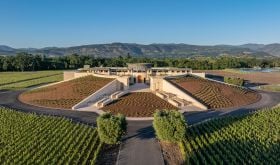
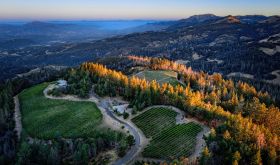
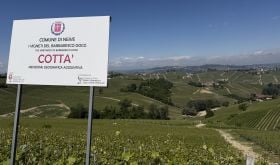
Last year however I had the chance to visit the world's greatest concentration of high-altitude vineyards, in Argentina, with Donald Hess of Napa Valley's Hess Collection making some of the most exciting waves in the clouds.
Argentina's dominant wine province Mendoza is the same distance from the equator as Baghdad, so you would expect the sort of heavy, clumsy wines that Argentina produced for its thirsty domestic market for decades. Since the early 1990s however Argentines and incomers are planting vineyards at ever higher altitudes in an attempt to extend the growing season and increase levels of both natural acidity and flavour. Much is made of the beneficial effect of the cool nights this far up the Andean foothills, and of the higher radiation that can make photosynthesis more efficient and plants healthier.
Certainly the vines I saw in the new, higher subregions of Mendoza such as Tupungato and Vista Flores in the Uco Valley (all of them vertically trained rather than the old-style overhead trellises designed to maximise yield) all looked impressively healthy. A substantial proportion of grower- producers routinely cut off excess bunches to concentrate the remaining crop and pursue the fashionable goal of super-ripe tannins. Argentina is no longer a vinous backwater.
With unlimited good-quality irrigation water thanks to melted snows off the Andes and no shortage of suitably poor soils, the only major viticultural problem Mendoza's grape growers have is hail, a perennial summer hazard that is particularly acute in some areas. Many growers have decided it is worth investing up to 4000 dollars an acre in specially strong protective netting.
The major problem Argentine wine producers now have of course – like all Argentines – is economic. A specific problem for wine producers is simply a shortage of cash, not just to pay for imported luxuries such as French oak barrels and corks, but simply to pay pickers and cellar workers. The minute the peso was devalued last year the government substituted an export tax for export credits on wine (on the same day as announcing that it could not afford to pay that vast proportion of the population who are civil servants their salaries that month).
One thing Argentina is not short of however, particularly compared to Chile over the Andes, is variety. There is a huge variety of grapes, with red Bonarda and Malbec the most planted vines but no shortage of Cabernet Sauvignon, Syrah/Shiraz, Tempranillo, Sangiovese, Merlot, Chardonnay, Semillon and all sorts of interesting oddballs, particularly the fragrant pale-skinned Torrontés grape, thanks to the rich multicultural mix of immigrants that made up the Argentine population. And now there is a variety of different environments in which wine is produced.
Altitude has become the big status symbol among Mendoza's wine producers, each daring to plant slightly higher than his neighbour (there is hardly a female presence in this macho wine country). Vineyards are commonly higher than 3300 feet (in much of Europe 1600 feet is thought of as an upper limit to reliable ripening) and many vines are now being planted as high as 5000 feet. Precise altitudes are given on the labels of many a fine Argentine wine, and have even formed part of the names of the concentrated reds made by the LVMH/Chandon still wine subsidiary in Mendoza and sold as, for example, 'Terrazas de los Andes Gran Malbec 1997 Las Compuertos Vineyard 1076 metres' (3550 feet).
Other international investors in the new, high wine country of Mendoza include Kendall Jackson; multinationals Allied Domecq and Pernod Ricard; Concha y Toro of Chile; Jacques and François Lurton and Michel Rolland of Bordeaux; Sogrape of Portugal; a Spanish olive magnate; a Dutch motor distributor; and, reputedly, a bunch of Walt Disney executives.
They can't all be wrong – and indeed the respective debut releases from this area of top Bordeaux winemakers Michel Rolland of Pomerol and Pierre Lurton of first growth Château Cheval Blanc, Clos de los Siete 2002 and Cheval des Andes 2001, show the potential here is massive. And it's not just for ultra-smart reds. Argentine marketing genius Nicolas Catena has been making unexpectedly fine budget-priced Chardonnay from this region for at least five years.
But the vineyards of the Uco Valley are all low, almost foothills, compared with the highest vineyards of Salta province to the north, in the extraordinary north-west corner of Argentina closest to Bolivia. Salta's main wine town Cafayate, a popular Argentine summer holiday resort, is itself at 7000 feet and many of the vineyards that surround it (typically being converted from the once-popular white grape Torrontés to Cabernet and Merlot) are considerably higher.
But none compare with my visit to two neighbouring wine estates two hours' drive further north and west into the mountains. This foray was remarkable not just because high altitudes bring with them physical changes (shortness of breath, the need to cook everything twice as long as at sea level) but because of the landscape and the people who live there.
In just an hour or two's drive, mainly on tortuous unpaved mountain roads, you can go from lush green subtropical sugar cane and tobacco country, up through jungle to green lakes and pastures looking for all the world like Scotland, to puna, the local word for high desert scrub punctuated by cardones, a prehistoric plant like a one-fingered cactus, to altiplano, the vast, deserted plateaux inhabited only by llama and desert rats. They feel like the top of the world, but can't be because they're bounded by the Andes, their towering, colourful folds looking for all the world like melting icecream.
The great majority of this land is uncultivated – indeed even in relatively overcrowded Mendoza to the south 95 per cent of the land is still desert – but here and there are oases, green fincas representing one owner and his many dependents. Each of the two wine-producing estates, in a long valley reaching far into the Andes from the eerily quiet (no cars, few trucks) town of Molinos, provide homes and a living for hundreds of locals. (And with girls encouraged to procreate as soon and as frequently as they can by the local priests, those hundreds are fast becoming thousands.)
One of these vineyards, Donald Hess's Colomé where he has opened a boutique hotel too, is at more than 7500 feet. His first vintage Colomé 2002 will be released in October. The man who sold Colomé to Hess lives just up the valley on the Tacuil estate, overlooked by a ruined Inca fort if you please, with vines planted at 8570 feet. But Hess, determined to own the highest vineyard in the world, or at least in the western world, has now planted another small vineyard even higher, at 9892 feet.
The Colomé wines, still work in progress during my visit, have an amazing purity of fruit – a frankness akin to the character evident in the best wines made from vines grown biodynamically. The trick will be to find the optimum altitude for wine quality while not compromising the vines' ability to ripen reliably every year.