This week the Institute of Masters of Wine celebrates its 60th anniversary. In the post-war years a few London wine merchants decided to instil a little rigour into wine trade education – which then entailed teaching young men in cellars the difference between an adze and a bung-tinner since most wine was imported in barrels then. Twenty-one hopefuls took the first exam in 1953 and six 'MWs' were the result.
Scroll forward 31 years and I sat the MW exams, now a full four days of them with both theoretical and practical (blind tasting) papers and held every May, thereby becoming the first of these rarefied beasts to have been recruited from outside the trade. The first woman, Sarah Morphew Stephen, had passed in 1970 but even the addition of women – I was the eleventh and almost a third of all MWs now are women – was clearly not going to be enough to make up for the fact that MWs, however respected in the world of wine, were mortal. The Institute clearly had to recruit more members and in 1988 further relaxed the rules to allow in foreigners. Michael Hill Smith of Australia was the first non-Brit MW.
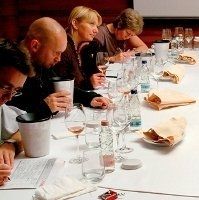
The exams were already strictly for masochists when I took them – not just requiring candidates to assess and identify a dozen mystery wines three times over but also plumbing the depths of oenology, viticulture, wine marketing and regulations as well as requiring unusual literacy. But as the wine world has broadened and deepened, the exams have become increasingly challenging. In my day, California wines tasted unmistakably Californian. Not so today. Wines served blind to this year's MW candidates included a Gavi, an Assyrtiko from Santorini and a Grenache from each of the Rhône, Australia and California. Questions on written papers (which always look much easier than the detail expected in answers) included 'Why, when and how do enzymes work in the winemaking process?', 'How have the recent fluctuations in grape harvest size changed the global supply and demand of wine? How do you see this affecting the wine market in the next 24 months?' and 'Is the golden age for fine wine investment over?'
What is really stunning, however, is how popular this particular form of torture, of which the average graduation rate is a shockingly low 10%, is today. There are now almost as many MW students as there are MWs in total. Just over 300 people worldwide can call themselves Masters of Wine with the greatest number, 194, in the UK but the greatest concentration of students is in the US. A total of 280 wannabe MWs around the world are currently swotting, slurping and generally making their families' lives hell. About 100 wine lovers apply for the course – which can easily cost more than £8,000 in total – each year but between 15 and 40% of them are rejected as not having sufficient knowledge or experience. Despite this rigorous triage, a recent student reports the emergence of a new phenomenon, 'MW tourists – students who apparently have no intention of taking the exams, but are there for the professional contacts.'
Others just seem to like taking exams. Eleven MWs have no professional connection with wine whatsoever. Some are motivated by the dream of becoming their country's first Master of Wine. There is one Latvian, for example, but no Indian or Chinese MW. Yet.. The Institute is engaged in a recruitment drive in those parts of the world where their numbers are most sparse: Italy, for example. Alessandro Torcoli has a demanding young family in Milan and is the hardworking editor of the wine trade review Civiltà del Bere, but he is so intent on being an MW that he has been known to fly to London for a particularly instructive tasting.
One of his study mates is Lorenzo Zonin of the prominent Italian wine family. His reasons for trying to climb this particular mountain are rather touching: 'I met some MWs and noticed that all of them were humble yet extremely knowledgeable. So I think that the MW programme will help me not only to grow professionally, which I'm never tired of since I'm a wine freak, but also humanely. And most of all I would like to become a Master of Wine for my family. It would be a honour.'
For others, the MW summit is seen as validation of a career change. Annette Scarfe MW was CFO of a major international bank in Singapore but, inspired by the early demise of her father, promised herself a second, midlife career in a world that had always intrigued her. 'It has been one of the most fascinating, fun and delightful journeys of my life,' she says. 'I have met so many wonderful people on my journey.'
I for one am particularly delighted by Lorenzo's comments because in the early days, when the MW total was only two digits, they tended to travel together to up-and-coming wine regions in lordly packs slightly patronising the local wine producers. And there used to be complaints that those who managed to earn the magic initials treated their students like an irredeemably inferior breed. Today the ethos of the Institute is moving towards something much more inclusive, recognising that, as the wine world rapidly evolves, we all need to continue to learn and can hardly afford to sit on our laurels.
This evolution has much to do with the fact that Institute is no longer run by and for the British wine trade. The last two chairmen were, respectively, Austrian and South African, and the current one is Jean-Michel Valette MW, a successful businessman who commutes between the Bay Area and the Rhône valley.
As he welcomes 150 MWs from as far afield as Hong Kong and New Zealand to the anniversary celebrations in London next week, his one big headache is the dissertation, a third and highly controversial requirement imposed since 1994 on those who pass the theory and practical papers before they are allowed to use the magic initials. That something is wrong with is clear. More than 30 people have passed all the exams but may not call themselves MWs yet. This third requirement is being overhauled (see Diary of an MW student – Part 51 and a half) and is expected to be a hot topic, yet again, at Wednesday's AGM.
WINES MADE BY MWs
The most common profession for MWs is consultant, and many of these are involved tangentially with winemaking, but all of the following producers have a Master of Wine as their chief, hands-on, full-time winemaker.
Betz Family Winery, Washington State
Craggy Range, NZ
Escocés Volante, Spain
Glenguin, New South Wales
Richard Kershaw Wines, South Africa
Kumeu River, NZ
Noon, South Australia
Villa Maria, NZ
Weingut Jürgen von der Mark, Germany
Zind-Humbrecht, Alsace
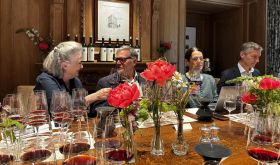
Learn more about the Institute and its educational programme, illustrated above, at www.mastersofwine.org