Overall, I would have to say that I do not think this collection of tens of thousands of bottles is an unremitting treasure trove. Many of the wines are a long way past their prime – as of course one would expect of wines of this age.
The styles of the wines are also very unlike most of the wines on the international marketplace today. None of the table wines is even as strong as 12% alcohol, with most of them between 10 and 11%. Nevertheless it is pretty impressive that some of these delicate, dry, unfortified wines have lasted as well as they have.
Perhaps the single most impressive wine of the tasting was a 1954 dry 'Riesling' vinified in a state winery in the Black Sea resort of Anapa on a site that is now a water park, apparently. I was told that most wines made and sold as Riesling in the Kuban region are made from a field blend of both proper Rhine Riesling and the eastern European Welschriesling. Whatever the proportions in this blend, it tasted very convincingly of Riesling and still has an amazing amount of life left in it.
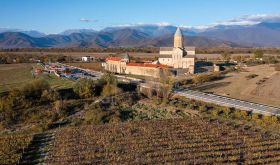
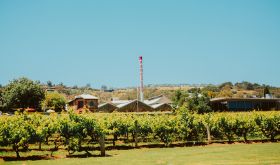
It is not known where the grapes for this wine were grown but it is perhaps significant that the new owners of the Sauk Dere winery, which houses the museum, recognise that their vineyards are cool enough to produce fine Riesling and are devoting half of their new plantings to this variety.
Among international white wine grapes, Chardonnay and Sauvignon Blanc are more recent arrivals in the ex-Soviet Union and we did not taste any examples, but we did taste a number of examples of 'Burgundy's other white grape' Aligoté, some of which had held up pretty well, though perhaps not quite as well as examples of the Georgian white wine grape Rkatsiteli. The one Semillon we tasted, a 1963 from Dagestan in Russia, was surprisingly good – and did actually taste of Semillon. Pinot Gris was often cited, but usually for fortified wines.
Ukraine's table wines were pretty dismal, but Moldova showed its early embrace of Cabernet Sauvignon by dominating the small range of red table wines that were shown. A Moldavian 1975 Negru de Pukar made from Cabernet blended with Rara Niagra and Saperavi had survived pretty well. Georgia's Saperavi was probably the most widely planted red wine grape in the Soviet Union, although a number of wines contained Morrastel, a grape seen only rarely in the west, usually in Rioja and called Graciano.
There were fewer grape varieties of which I had never heard than I expected. You can find some in Soviet wine archive – the tasting notes, but it's quite possible that there are more written in the Cyrillic script on the tasting sheet that have passed me by.
With the exception of one, vinegary varietal Matrasa from Azerbaijan, all the table wines were made in either Russia, Ukraine or Moldova.The range of origins of the fortified wines also included a wide range of the more southerly ex-Soviet republics: Armenia, Chechnya, Turkmenistan, Uzbekistan and Kazakhstan. But we tasted nothing from Kyrgyzstan, Tajikistan nor, much more surprisingly, from that cradle of wine Georgia. This last was presumably omitted for political reasons for surely this collection of the best Soviet wines originally contained a significant proportion of Georgian wine – unless the Georgians were truculent enough even in the 1950s not to obey state instructions to send samples of their best to the Soviet wine museum? There were however a couple of wines from Chechnya, including quite the creditable Terek dessert wine made in 1966 from Rkatsiteli.
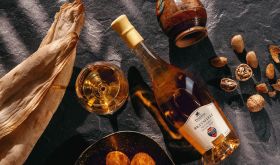
If tasting the 40 table wines was an exercise in searching for the fruit, the 80 fortified wines presented a far greater physical challenge for, not only were they very strong – from 16% but mainly 20% – but almost all of them were extremely sweet, with an average of almost 200 g/l residual sugar. They came in all sorts of styles, from that curiosity of the Russian Orthodox church sacrament called 'Cahors' (but nothing like the French original) via sherry, Malaga, Madeira and, especially, port styles with many a Muscat along the way. What let so many of them down was their unappetisingly 'cooked' smell, presumably a result of clumsy heat treatments. The typical method, I believe, was to ferment the base wine to just 2% alcohol and then to add spirit. Far too many of them smelt unappetisingly baked and then tasted of molten brown sugar without nearly enough acidity. Many of them also seemed to have very marked rancio character, and some of them tasted as though they had been kept in wood for too long. [20 Mar - this was what I was referring to when I noted a 'Russian' note in an Ormes de Pez 2004 red bordeaux recently! See this thread in our Members' forum.]
There were exceptions, however. Most of the wines from the Massandra collection made in the Crimea, and auctioned by Sotheby's in the early 1990s, were superior. (It seems strange to outsiders that so many of those living in the Crimea are ethnically Russian yet Crimea is part of Ukraine, while many of those in Kuban across the Black Sea to the east are ethnically Ukrainian yet live in Russia. [20 Mar – please note]) A 1966 Madeira style from Dagestan was quite a convincing copy of Madeira, as was a 1967 example from Rostov-on-Don. The best fortified wines from Moldova were 1976 sherries, one of them quite dry and the other eerily reminiscent of Harveys Bristol Cream. Uzbekistan is now generally too Islamic to be a wine producer but its 1965 dessert wine made from a blend of Saperavi, Morrastel and Cabernet Sauvignon was one of the better ones. And as for Turkmenistan, another country that is difficult to find in most wine books, I was very taken by two 1964 fair copies of stickies made in Rutherglen, Australia, but from Terbash grapes.
Truly, this was one of the most exhausting and extraordinary tastings I have ever taken part in, but it was also one of the most educational.