
If you want to know about volcanic wine, the place to start is Hungary. The country is a vulcanologist’s dream, pockmarked with volcanoes from one side to the other, an arc that starts in Styria and ends some 1,000 km (c 620 miles) east in Romania.
What’s more, the volcanoes are relatively young, the youngest in Balaton estimated at just 2.3–3 million years old. While other regions camouflage their volcanic origins under millennia of erosion, Hungary’s volcanoes are very much on the surface. As Szabolcs Harangi (a member of the MTA-ELTE Volcanology Research Group in Budapest) writes in ‘Volcanic heritage of the Carpathian-Pannonian region in Eastern-Central Europe’:
There are many opportunities to start a volcano discovery tour in this region. One can begin with an amazing walk observing different types of pumiceous pyroclastic flow deposits, ie ignimbrites and the fabulous conical fairy chimneys or beehive stones as the local people call them. Then, the visitors can take a path along one of the most destructive volcanic deposits, formed during nuée ardente events. These valley-fill block-and-ash flow deposits are now in an inverted position and build mysterious cliff towers. Next, they could see also the scar remained after the huge sector collapse of an andesitic composite volcano …
A wine lover might write with the same sort of excitement about a volcanic wine tour. You could start on the north edge of Lake Balaton, a region that’s on the UNESCO tentative list for recognition as a World Heritage site. A wild landscape of basalt volcanoes, geyser cones and thermal waters, this warm, sunny area has been a major wine-production centre for two thousand years; this is where you’ll find the cluster of regions that begin with ‘Balaton’ as well as Badacsony (see the map below), rising right off the north shore of the lake, and Tihany, a tiny volcanic peninsula sticking right into the lake (Hungary’s smallest appellation, and also the source of a salty, lip-smacking Kékfrankos among the gold medallists below). Káli, the source of a couple of medal-winning wines below, is also in Balaton, a basalt lava-rich area in its north specialising in Olaszrizling (aka Welschriesling).
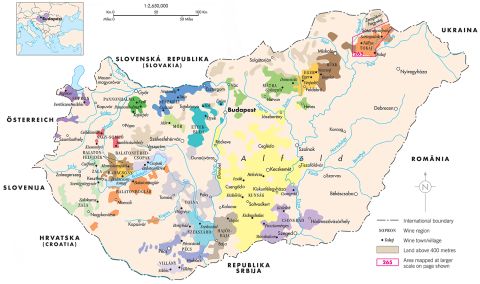
A little farther north there’s Somló, a wine region just 500 ha (1,235 acres) in total that’s nearly limited to a single 435-m (1,427-ft) volcano (there are a few hectares planted on neighbouring Ság hegy, part of the Nagy-Somló PDO). The slopes, covered in crumbled basalt, particularly excel in Juhfark, a white grape unique to the area (though if pressed to compare it to another more widely known variety, you might look to Chenin Blanc for its ability to balance extreme ripeness with extreme acidity, its slightly lanolin-like flavour and its ability to channel place in its taste – definitely a grape worth exploring).
There are more volcanoes to the north and east, with a particularly wine-famous cluster on the other side of Budapest, where the wine regions of Matra and Eger meet. Largely cool and continental in climate, although protected from the north winds by the Matra mountains (themselves formed by Miocene volcanic activity), Matra is largely a region of white wines, though as you’ll see below they also produce nervy, juicy reds.
Eger, just to the east, was also a region of white wines until the 1800s, when Kadarka was introduced and embraced. Kékfrankos later joined it, the two fighting for primacy in the famous Egri Bikaver blend, Kékfrankos eventually establishing its supremacy as the base of the blend. Since 2011, Eger has also had a white-wine blend: Egri Csillag (‘star of Eger’), a blend based on Hárslevelű and Olaszrizling.
And of course if you keep following the southern edge of the mountains to the east, you’ll come to Tokaj, a landscape defined by its volcanic fields, some 500 eroded cones pockmarking the plain as it tilts down toward the Tisza and Bodrog rivers. It’s a crazy patchwork of vineyards (see the detailed World Atlas of Wine map here) with a chaos of volcanic soils, the differences from parcel to parcel or even row to row easily visible to the eye – red rhyolite, white tuffs, shiny black obsidian and rough chunks of andesite, and a whole lot more. That chaos, however, gives rise to a spectacular range of wine styles, from fine, floral Hárslevelű to firm, bone-dry Furmint to honeyed elixirs that last for decades.
Below you’ll find wines from all these regions, plus a few wines from just over the border with Austria, in Vulkanland Steiermark. All of them were shown at the Volcanic Wine Awards tastings, which we ran in collaboration with Volcanic Wines International in February of this year. You can read more about the competition’s origins in co-founder John Szabo MS’s introduction to the 2026 Volcanic Wine Awards.
For this tasting, all the wines were presented blind, grouped by country, to a panel of wine experts headed by Szabo, our own Sam Cole-Johnson or me. The wines below are those the panel deemed medal-worthy or worth an honourable mention.
Gold
Barcza, Borsa 2021 PGI Balatonmelléki
Béres, Aszú 6 Puttonyos 2017 Tokaj
Grand Tokaj, Szarvas Aszú 6 Puttonyos 2014 Tokaj
Holdvölgy, Expression Becsek Hárslevelű 2021 Tokaj
Káli Kövek, Köveskál Olaszrizling 2024 Káli
Kreinbacher, Prestige Brut NV Wine of Hungary
Krispel, Hochstrandl Grauburgunder-Pinot Grigio 2022 Vulkanland Steiermark
Krispel, Hochstrandl Sauvignon Blanc 2018 Vulkanland Steiermark
Krispel, Neusetzberg Weissburgunder 2021 Vulkanland Steiermark
Lenkey, Holdvölgy Betsek Furmint 2017 Tokaj
Oremus, Aszú 5 Puttonyos 2017 Tokaj
Patricius, Aszú 6 Puttonyos 2021 Tokaj
Pelle, Aszú 6 Puttonyos 2019 Tokaj
Royal Tokaji, Betsek Aszú 6 Puttonyos 2018 Tokaj
Sauska, Aszú 6 Puttonyos 2019 Tokaj
Sauska, Medve Furmint 2022 Tokaj
St Donat, Magma Kékfrankos 2023 Tihany
Tornai, Grofi Selection Hárslevelű 2022 Somló
Préselő, Mondoha Cuvée 2021 Tokaj
Zsirai, Szent Tamás Furmint 2020 Tokaj
Silver
Balassa Rajnai Rizling 2024 Tokaj
Borbély, Karós 2021 Badacsony
Centurio, Liberty 2024 Mátra
Figula, Köves 2023 Wine of Hungary
Gilvesy, George 2023 Badacsony
Holdvölgy, Culture Aszú 6 Puttonyos 2016 Tokaj
Jakab Kéknyelű 2021 Badacsony
Krispel, Hochstrandl Sauvignon Blanc 2022 Vulkanland Steiermark
Mariasy Furmint 2021 Tokaj
Préselő, Aszú 2016 Tokaj
Somlói Vándor, Öregtőkék Juhfark 2024 Somló
St Andrea, Boldogságos Egri Csillag Grand Superior 2023 Eger
St Andrea, Hangács Egri Bikavér Grand Superior 2022 Eger
Szarka, Juharos Furmint 2024 Tokaj
Villa Tolnay Rajnai Rizling 2022 PGI Balaton
Bronze
Balassa, Szent Tamás Furmint 2021 Tokaj
Éliás, Gótika 2022 Badacsony
Figula Kékfrankos 2023 Wine of Hungary
Kardos, Nyulászó Furmint 2023 Tokaj
Krispel, B1 2019 Steirerland Landwein
Laposa Olaszrizling 2024 Badacsony
Pálffy, Fekete-hegy Királyi NV Káli
Sanzon, Rány Vineyard Furmint 2022 Tokaj
Spiegelberg Chardonnay 2023 Somló
Válibor Kéknyelű 2021 Badacsony
Veszprémi Érseki, 1277 Rajnai Rizling 2023 PGI Balatonmelléki
Honorable mention
Barta, Öreg Király Dűlő Mád Furmint Szamorodni 2023 Tokaj
Illés Pinot Noir 2023 Badacsony
TR Wines, Palota Furmint 2022 Tokaj
You can find reviews of all the wines tasted, as well as the scores assigned by the JancisRobinson.com editor who tasted the wines (noted in the review). Many of these wines will also be shown at the International Volcanic Wines Conference in NYC on 10 June 2026.