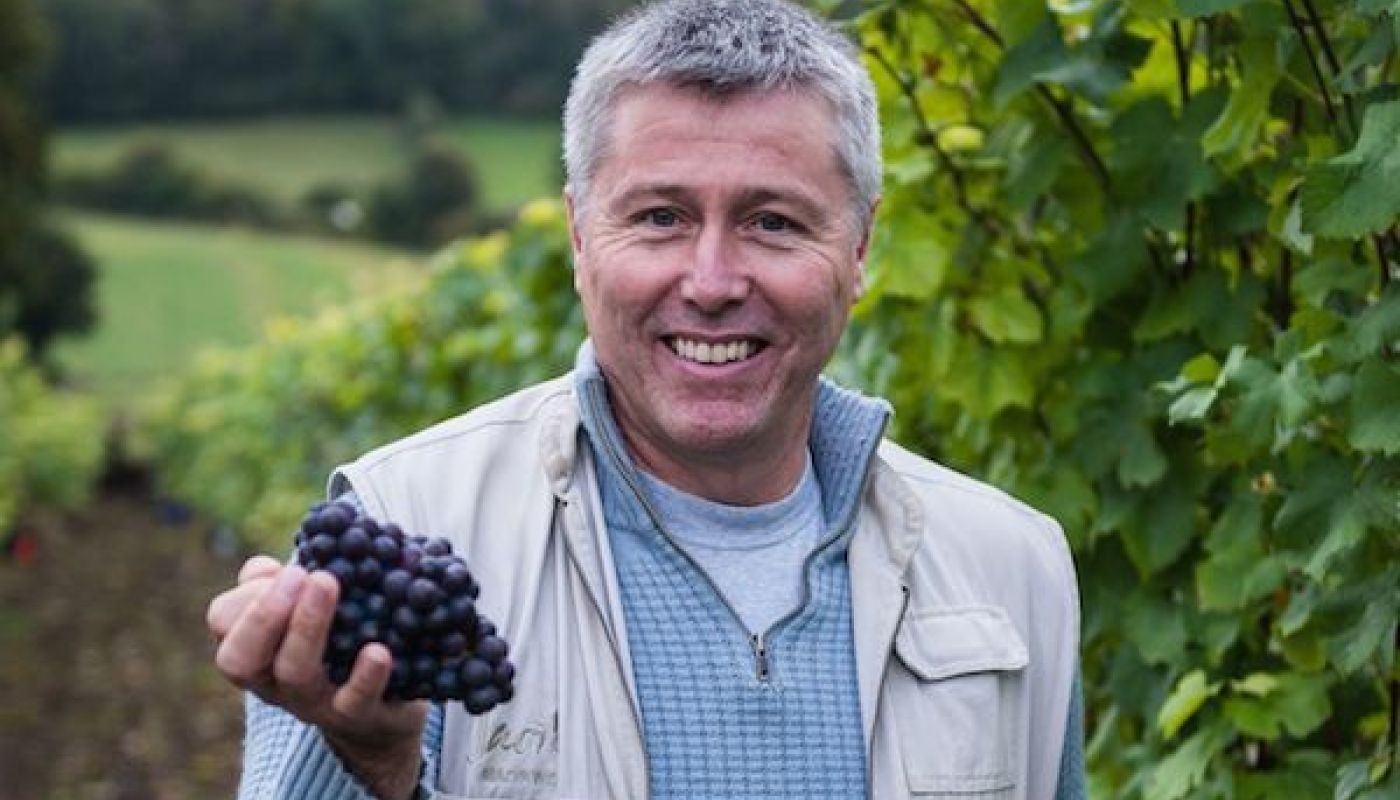
‘Champagne sales are going to decline here and English sparkling wine will probably eventually take half of champagne’s share', predicts Ian Kellett (pictured), once managing director at Dresdner Kleinwort Benson and now a particularly engaged, and Plumpton-qualified, owner of Hambledon Vineyard. He’s convinced that England’s great advantage is its very much lower land costs than Champagne’s 0.9 to 2.1 million euros a hectare (2.47 acres) and maintains there is no shortage of suitable land – ‘if the farmers will sell it’. He also expects champagne prices to continue to rise as the debt burden of maturing their stock does.
According to Frazer Thompson, chief executive of Chapel Down, currently one of the biggest producers of English fizz, no less a champagne expert than Richard Geoffroy, the man responsible for making Dom Pérignon, envies his counterparts in England because they are not bound by rules and are free to innovate and experiment.
England’s burgeoning army of vignerons are certainly bullish at the moment, so much so that Thompson cites ‘a gold rush on the North and South Downs’. The total area of Britain under vine has doubled in the last seven years so that there is now more than 5,000 acres (2,000 ha) of vineyard, farmed by 470 vine growers with the grapes vinified in 135 wineries.
For Thompson, 2012 may have been a terrible vintage, but it was the year when ‘it stopped feeling as though we were pushing a snowball uphill’. William and Kate’s wedding breakfast and the Olympic Games in London both played their part.
The flood of new entrants on the English wine scene has largely been made up of people with successful careers in another field and considerable funds to invest in what looks like an increasingly credible new adventure. Ian Kellett is a typical example. Simon Robinson was a senior partner at corporate lawyers Slaughter & May before planting his first vines at Hattingley in 2008. Both Hambledon and Hattingley Valley have already proved they can make excellent sparkling wine – using the same grapes and methods as in Champagne but with often crisper results in a distinctively English style.
Mark and Sarah Driver of Rathfinny Estate, ex hedge-fund manager and lawyer respectively, are partners in the most lavish new investment, on 600 acres (240 ha) of South Downs between Brighton and Eastbourne, of which they plan to plant 400 acres with vines producing a million bottles of sparkling wine a year by the early 2020s. They admit to spending more than £10 million so far and will eventually have 36 full-time employees with about 200 at harvest time. They have made themselves extremely popular by a combination of charm and generous sponsorship. The research lab at nearby Plumpton, England’s increasingly respected centre of wine academe, carries Rathfinny’s name. The Drivers’ less popular move, particularly in Kent and Hampshire, is to suggest that Sussex should become a controlled appellation like, well, Champagne.
Another couple who have decided to invest in English wine fairly recently are Ruth and Charles Simpson, who have already established a solid business in the Languedoc, Domaine Sainte Rose. In 2012 they bought two parcels of chalky land in Kent and have also invested in buildings that will become their winery, near Barham. Ruth, a member of the William Grant whisky family, explained, 'During our years at Sainte Rose we had been keeping an eye on developments in England, believing there to be an enormous opportunity to create top-quality sparkling wine, but realising that the industry was still extremely young and required time for the viticultural and oenological suppliers and services to become established and provide the support that would be required. By 2012 we felt that the industry in England had reached a critical mass to support new entrants and that we were ready for a new challenge!' Their English sparkling wine will be called simply Simpsons.
Two-thirds of all English wine (British wine refers to much less delicious stuff made from imported grape concentrate), and all of England’s best wine, is sparkling. In Britain’s relatively cool climate, the challenge is ripening grapes that tend to cling fiercely to their initial high acidity – but at least high acid is a positive attribute in sparkling wine and some in Champagne are beginning to worry about falling acid levels there as climate change takes effect.
The long-standing rumours of Champenois investment in English wine finally came to fruition at the end of last year when Taittinger, after two and half years’ prospecting, announced a joint venture in Kent with their UK importers Hatch Mansfield not far from the Simpsons. The first of their vines will go into the chalky ground in May next year and more investment from Champagne is rumoured. Kellett is particularly keen to encourage this, on the basis that it will then feed English fizz into the global distribution networks built up by the Champenois.
Chalk, common in Champagne, is closely associated with good-quality sparkling wine from the Champagne grapes Chardonnay, Pinot Noir and Pinot Meunier and can be found in parts, but only in parts, of Kent, Sussex, Hampshire and Dorset. A number of high-profile producers have been acquiring new vineyards on chalk.
But according to Emma Rice, Plumpton-trained winemaker at Hattingley, they are constantly being approached by wannabe vignerons with no clue about the realities. She cited as typical a retired well-heeled gentleman who wants to plant vines on his south-facing slope ‘because his wife fancies looking out over a vineyard. They don’t realise it’s not easy growing grapes in England. Our vineyard managers aren’t allowed to take holidays in summer; you have to watch the vines all the time.’ Thanks to the capricious climate, English grape harvests vary enormously. The nightmare year was cool, wet 2012 when Hattingley expected to pick 200 tons of grapes and ended up with 11. Nyetimber, the pioneer producer of top-quality English sparking wine, made no wine at all in 2012.
Everyone agrees that site selection is absolutely critical to success in English wine. Many a potential vineyard has been planted somewhere too high (elevations above 125 m/210 ft are generally hazardous) or too windy (sea breezes can have a disastrous effect on Chardonnay yields) to ripen grapes reliably. This is where English wine specialist since 1973 and Master of Wine Stephen Skelton steps in. But, as Emma Rice observes, the price of land tends to double from a basic £10,000 an acre for regular agricultural land ‘once they get a sniff that Stephen’s involved’. Farmers know that would-be vignerons tend to have deep pockets.
But, as Thompson observes, ‘wine is patience and people with capital tend not to have it'. Wine production, and particularly sparkling wine production, is an extremely long-term business. It takes at least three years before vines produce a crop, then another three while the wine ages in bottle. Patrick McGrath MW of Hatch Mansfield knows ‘it’s easy to lose lots of money very quickly, particularly if you build a winery’. Hattingley expects to move into profit this year, eight years in, but then their cash flow is bolstered by considerable contract winemaking for other growers. When I asked AXA’s wine man Christian Seely about his sideline Coates & Seely English sparkling wine and when he expects to make a profit, he emailed back immediately with ‘Good Lord, profit?’
One man who seems to be rather enjoying the spectacle of all these tyros moving into his business and throwing large amounts of money into holes in the ground – chalky or not – is Frazer Thompson of Chapel Down. He has been there for 15 years and says ‘margins are extremely good at the end of the cycle, and mature businesses like ours took the pain many years ago, but you’ve got the likes of Lord Ashcroft at Gusbourne who’s seven years behind us and is burning cash furiously'.
Gusbourne is now, like Chapel Down, a public company, unusually for an English wine business. Chapel Down has been listed since 2004 and early investors include Nigel Wray, ‘Britain’s Buffet’. But the company needed more cash to invest in, inter alia, a new, chalky vineyard and was particularly successful with crowd funding, the crowd of 2,250 new investors having been attracted by a discount of 33% on their Chapel Down wine purchases. According to Thompson, they have become ‘passionate sales people’ for Chapel Down in particular and English sparkling wine in general.
Of course the crucial question is the selling price of all this fizz. Total production of English wine reached 6.3 million bottles in 2014. In the same year we imported 32.7 million bottles of champagne. As production volumes increase, will English producers be able to maintain the current standard price of £25-30 a bottle?
Emma Rice has no qualms. She says they cannot satisfy demand for their £65 barrel-fermented wine. Frazer Thompson is more cautious. He points out that the average selling price of champagne is probably much lower than we tend to think, given all the supermarket special offers. He reckons the future of Chapel Down lies in selling 200,000 bottles of a non-vintage blend at £15-20. ‘I keep hearing about new producers whose main aim is “to be the best”. That’s not a business plan. They’re going to be bitterly disappointed.’
With all these new producers, Chapel Down are clearly expecting consolidation down the track, and hoping to pick up some valuable pieces.
SOME RECOMMENDED ENGLISH SPARKLING WINE PRODUCERS
These are producers who have already made some seriously impressive wines, listed in alphabetical order.
Bride Valley
Camel Valley
Chapel Down
Coates & Seely
Court Garden
Digby
Furleigh
Gusbourne
Hambledon
Hart of Gold
Hattingley Valley
Hush Heath
Nyetimber
Ridgeview
Wiston
See tasting notes on a recent blind tasting of English sparkling wine and also on a blind comparative tasting of English fizz with champagne last September.