
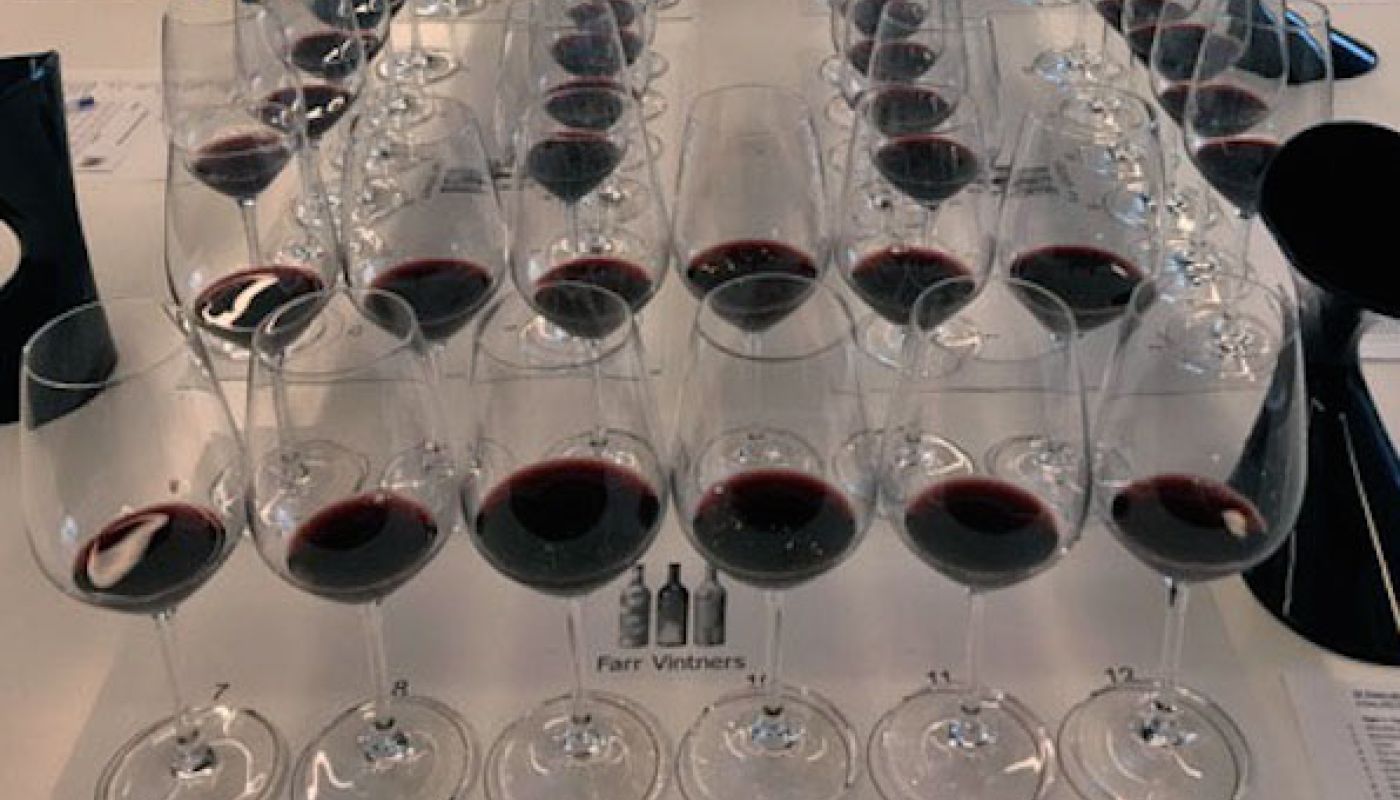
Tastings of mature and maturing bordeaux are surely much more useful than tasting carefully groomed barrel samples such as the 2016 ones I am scheduled to try in Bordeaux in early April. And when the tasting is comparative and blind, it is even more instructive.
I was delighted at the end of last month therefore to join the usual crew of British fine-wine merchants and wine writers at Farr Vintners’ Thames-side quarters to examine the progress of the highly touted 2005 vintage. (Most years we ‘look at’ the 10-year-old vintage but because 2005s are famous for their high tannin content and therefore backwardness, we swapped the early-maturing 2007s for the 2005s two years ago to give the latter an extra two years in bottle before examining them.)
The merchants are a curmudgeonly bunch. A wine has to be absolutely stunning for them to inch their scores past 16 out of 20. After the tasting, as usual when we meet, we were all asked to rate our top three vintages this century and for many people 2005 fell from its previous top spot to third place behind 2009 and 2010. The general feeling was that, although the best wines are truly glorious, some of them tasted as though they will not shed their tannic load until after the fruit has faded.
This was particularly true of some of the first wines we tasted, the St-Émilions, many of them made in the somewhat exaggeratedly concentrated modernistic style that was popular in the last decade of the last century when the St-Émilionnais took it to the (sometimes distinctly unappetising) limit. This may have slightly coloured the merchants’ less-than-rapturous response to our review of the 2005s. My fellow scribes and I tended to be more tolerant of this vintage’s sheer drama, and less mean with our scores. They may not have the easy ripeness and unusual consistency of 2009, nor the fluid classicism and freshness of 2010, but there are dozens of 2005s that offer, or will offer in most cases, a great combination of full ripeness and impressive structure. They were not priced as excessively as the 2009s and 2010s, and some of them can offer relative value (see below).
But there is no doubt that in 2005 wines, particularly red wines, were made differently, and with very different ambitions, to how they are made in Bordeaux today. Sheer mass and, in some quarters, high alcohol was seen as a virtue, as was ripeness at any cost. The result was that harvest dates were pushed to a late extreme, without the much more precise practice today of analysing and picking individual plots of vines according to their individual characteristics. Merlot grapes were more fashionable than now. New oak was still highly valued in 2005 and 100% new barrels were used without question by those who could afford them, rather than the proportion closer to 70 to 80% today.
Over the last few years grape sorting has become almost a fetish in Bordeaux so that every imperfect or less-than-fully-ripe grape is eliminated, even though some argue that in a very ripe vintage, some underripe berries can add freshness, a quality lacking in some 2005s. And nowadays only the very best barrels go into any property’s top wine, while second and even third wines have been proliferating to soak up the rest. Most Bordeaux producers would say that they are making much fresher, less extracted wines today than they were in 2005.
In general the Pomerols showed much, much better than the St-Émilions and on the left bank, many of the Pessac-Léognans are ready to enjoy. Value as usual is to be found in the better wines of the Haut-Médoc while too many of the Margaux wines were still trying too hard in 2005 to be concentrated rather than relying on their natural fragrance. The wines of St-Julien, Pauillac and St-Estèphe were much more classical and, with their distinctly dry (as opposed to sweet) Cabernet Sauvignon fruit, are just starting to provide drinking pleasure.
As well as 156 of the most important red bordeaux 2005s, we tasted nine of the more significant dry white bordeaux (though neither one from the Haut-Brion stable unfortunately) and 21 sweet white bordeaux including all the big names. The dry whites were for the most part past it – perhaps not surprisingly in a vintage without particularly high acid levels – although Ch Bouscaut Blanc continued its winning streak in these horizontal tastings.
The two flights (never more than a dozen wines at a time and always ‘single blind’, knowing which wines were in there but not which was which) devoted to Sauternes were two of the more pleasurable, with Suduiraut being the preferred wine, trumping Yquem, both at this tasting and in Southwold in 2009 when we tasted most of these wines at four years old. (The tradition is to taste the samples at four years old and then the back-up bottles at 10 years.)
One thing that rather shocked me throughout this tasting was how many bottles were out of condition – often because of some spoilage with TCA, the compound most commonly associated with mouldy corks, sometimes because the wine was too oxidised to be refreshing and sometimes because of other off-odours such as excessive volatile acidity. A grand total of 14 bottles out of the 186 were affected by one of these faults, most commonly TCA. A 7.5% failure rate is pretty poor for any product, and those too mouldy to mark are selling for up to £250 a bottle.
Whenever I publish detailed notes on horizontal tastings of bordeaux such as this one I am often asked to explain any glaring disparities between my scores this time and those from previous tastings of a similar set of wines, such as my account of a smaller collection of 2005s at 10 years old organised by Farr’s rivals BI two years ago. May I draw to your attention the observation of Marielle Cazaux, particularly clued-up winemaker at La Conseillante in Pomerol. She reports that it has been only since bottling the 2014 vintage when they took advantage of the special new process offered by cork producers whereby individual corks are analysed for purity that she has seen absolute consistency between bottles from the same case.
MY FAVOURITE 2005 BORDEAUX
I gave all these at least 18 out of 20. Some of the more backward wines I scored 17.5+++. I have cited the average price per bottle ex-tax suggested by Winesearcher.com, the global search engine that can suggest sources for these wines.
Angélus, St-Émilion £390
Ausone, St-Émilion £1,415
Bon Pasteur, Pomerol £87
Cheval Blanc, St-Émilion £693
Evangile, Pomerol £241
Haut-Brion, Pessac-Léognan £704
Lafite, Pauillac £917
Lafleur, Pomerol £1,191
Montrose, St-Estèphe £126
Mouton-Rothschild, Pauillac £587
Petit Mouton, Pauillac £203
Petrus, Pomerol £3,276
La Tour Blanche, Sauternes £54
SOME 2005 BORDEAUX BEST BUYS
I gave these at least 16.5 out of 20 and several of them 17. They are hardly bargain-basement prices but these are wines that are delicious to drink already and have benefitted from 10 years in bottle.
Bernadotte, Haut-Médoc (£153.36 a dozen in bond, Lay & Wheeler)
Cos Labory, St-Estèphe (£30 Jake’s Food & Wine)
Lynch Moussas, Pauillac (£34.79 Amathus)
Meyney, St-Estèphe (£34.17 Millésima UK)
Montviel, Pomerol (£36 average price but no current UK stockists)
Ormes de Pez, St-Estèphe (£32.99 Sandhams, Lincs)
Phelan Ségur, St-Estèphe (£35 The Wine Society)
Ségla, Margaux (£300 a dozen in bond, Farr Vintners)
And all Sauternes













