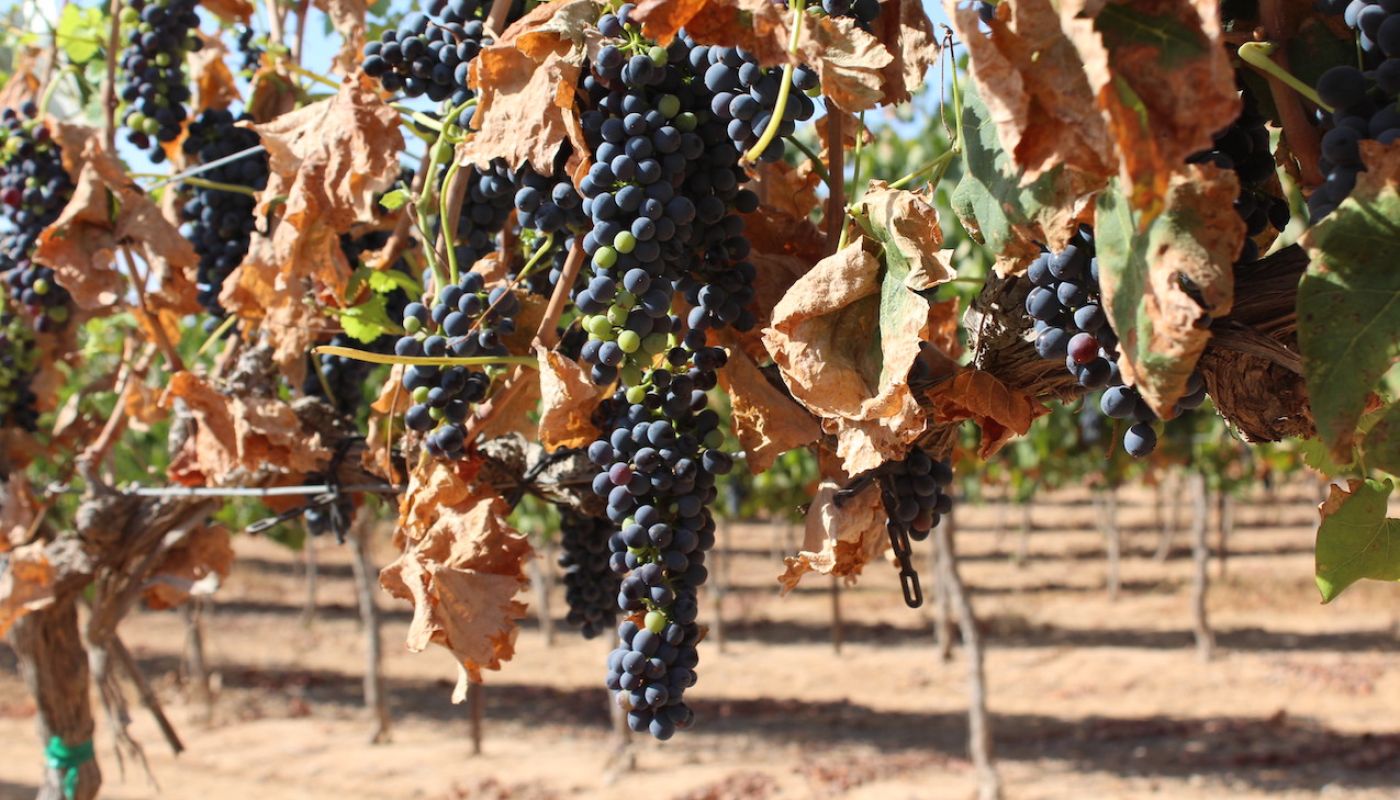
2 August 2022 Irrigation is largely banned in European vineyards. Dr Yishai Netzer and Eran Pick MW argue that it's high time to change the rules. Above, super-stressed vines in an unirrigated vineyard in Israel. See also Water, water, not quite everywhere.
This year for the first time vignerons in Pomerol have 'exceptionally' been allowed to irrigate in the face of record high temperatures in Europe and their adverse effect on vines. This is the third year in a row that irrigation has been allowed in Pessac-Léognan (see this report in Vitisphere). Scientists predict that we will experience similar heatwaves and drought more often in the near future. Climate change is here and now.
Winegrowers around the world know the changes in the vineyards all too well. Climate change affects everyone, as witness the Po River drying up; major heatwaves in France, Spain and Portugal; huge wildfires in California and Australia; and winters with almost no chill in eastern Mediterranean coastal areas.
How will these changes in climate affect the terroir of the classic wines we love so much?
Terroir is a term that describes a set of environmental conditions for agricultural growth including not only the nature of the soil (composition, minerals, its absorption capacity, etc) but also climate parameters.
In their 2004 study on terroir of Bordeaux vineyards, Professor Cornelis van Leeuwen from Bordeaux University and colleagues wrote, 'The impacts of climate and soil were greater than that of cultivar. Many of the variables correlated with the intensity of vine water stress. It is likely that the effects of climate and soil on fruit quality are mediated through their influence on vine water status.' Hence, the soil's water availability to the plant during the different stages of the growing season is one of the most significant aspects of terroir.
As in humans, water is life for plants. Water is also essential for plants to transpire, photosynthesise and to produce secondary metabolites (flavour). Each stage of the growing season could in theory have an optimal water status for the plant and for fruit quality (not necessarily the same water status). Water availability has an effect on quality, quantity and character of the wines made.
It is quite clear today that many of the elements that make up terroir are included and expressed within the physiological measurement of the plant's water potential. For example, a vineyard planted on a steep slope facing south will likely suffer significant water stress due to increased exposure to radiation while erosion lessens the availability of water for the vine. High water availability (and less negative water potential) at the beginning of the season (especially from flowering to bunch closure) will lead to improved differentiation of more clusters and an increase in potential yield. Moderate water availability during the last part of the growing season could help improve quality of the wine, while extreme water stress may cause a decrease in yields as well as inferior wine.
One of the problems with heatwaves is the fact that when the vine encounters temperatures above 30 °C (86 °F) it closes its stomata in order to protect itself, which greatly slows the flow of water in the plant. When transpiration stops, the leaves heat up. The first stage of this damage is the death of tissues at the edges of the leaves, causing leaves to fall and expose bunches to direct sunlight and increased temperatures, which changes the character of the fruit. Irrigation before, during and after heatwaves could decrease their harmful effects on vines. Without enough water in the soil for the plant, the quality of wines produced will decrease significantly.
How do we know exactly how much water availability is optimal for each vineyard in terms of wine quality?
In order to evaluate the level of water availability or stress of the plant, there are many scientific tools: direct measurements of gas exchange between the plant and its environment, measurements of changes in the dimensions of the fruit, trunk and the thickness of the leaf, sensors designed to measure turgidity and sap flow systems. In the developing field of remote sensing, there are many ways of estimating plants' stress levels through the temperature of the foliage or through various spectral measurements. However, despite all these scientific developments, the most reliable and accepted tool in plant physiology and eco-physiology is the Scholander pressure chamber, which has worked well since 1965. With the help of this tool, the stem- or leaf-water potential of the plant can be measured at noon (when the stress is maximal), pre-dawn (when the stress is minimal) and/or at any other time of the day.
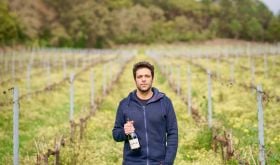
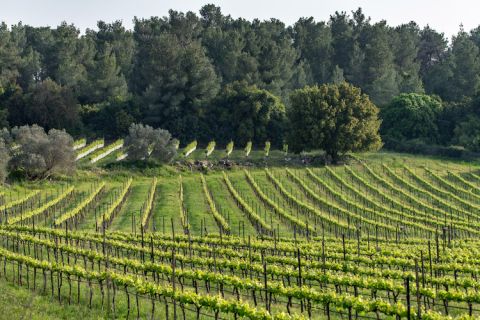
The amount of water needed for a satisfactory growing season of course depends on the soil type, climatic conditions and cultivar planted among other parameters. Below is the drip-irrigated Shoresh vineyard in Israel's Judean Hills.
Climate change is affecting the amount of water available for vines. The good news is that through skilled and thoughtful irrigation, extreme water stress can be significantly mitigated. There are very advanced tools to calculate the plant's maximum irrigation needs (classical linear methods or even machine-learning methods) based on changes in foliage area and meteorological conditions. It is also possible to adjust dynamic irrigation coefficients to quantitative, premium and super-premium wine production.
Those who oppose irrigation in vineyards claim that irrigation could mask terroir, the different quality and character of specific plots. We have used irrigation in our vineyards in Israel for decades and can attest that by irrigating thoughtfully, the terroir of each plot is still apparent. Consistency of character can even be improved. Opponents also claim that irrigation alters terroir. In our opinion, irrigation does not change terroir any more than composting, heating the vineyard to avoid frost, or even winter pruning and other standard vineyard operations.
In wine areas such as Bordeaux and Burgundy irrigation was not needed; enough water fell from the sky during the growing season. It is time to understand that there are new climatic conditions in most wine regions and we must adapt in order to maintain quality and economic sustainability. The current EU policy whereby the authorities allow irrigation only sporadically on an emergency basis is far from optimal. Irrigation must be allowed in all wine regions, with regulatory limits that ensure growers do not misuse official permission to irrigate.
The adoption of skilled irrigation would be a life preserver for vineyards, the wine industry and the concept of terroir.
Dr Yishai Netzer (Ariel University, Eastern R&D Centre) is a plant physiologist specialising in irrigation studies. Eran Pick MW is a winegrower in the Judean Hills, Israel.