
For years champagne ran the most sophisticated and effective public relations machine in the world of wine. Consumers were convinced that champagne and only champagne was the socially acceptable lubricant for celebrations and smart dinner parties.
But all that has changed. A vast army of enthusiastic wine buyers regard Prosecco as their drink of choice rather than second best – even though it is made by a much more industrial process than champagne or any of the other wines made sparkling inside individual bottles rather than in big tanks. I have to admit that Prosecco seems to disagree with me. I find too many of them too sweet for my taste, and for reasons I don’t understand, a mouthful or two of Prosecco often seems to precipitate a headache. But it’s obviously not genetic; my daughters adore the stuff.
Fake news has hardly impinged on the world of wine but I honestly thought it had last January when I read that Prosecco producers were applying for UNESCO world heritage status for their growing area, 35,000 acres (14,154 ha) of vineyards in virtually the whole of north east Italy. It was doubled overnight in 2009 when they cunningly renamed the eponymous grape responsible for their wine Glera and registered Prosecco as a protected geographical indication instead. (It hasn’t stopped the odd Australian using the P word, so popular has the wine style become.)

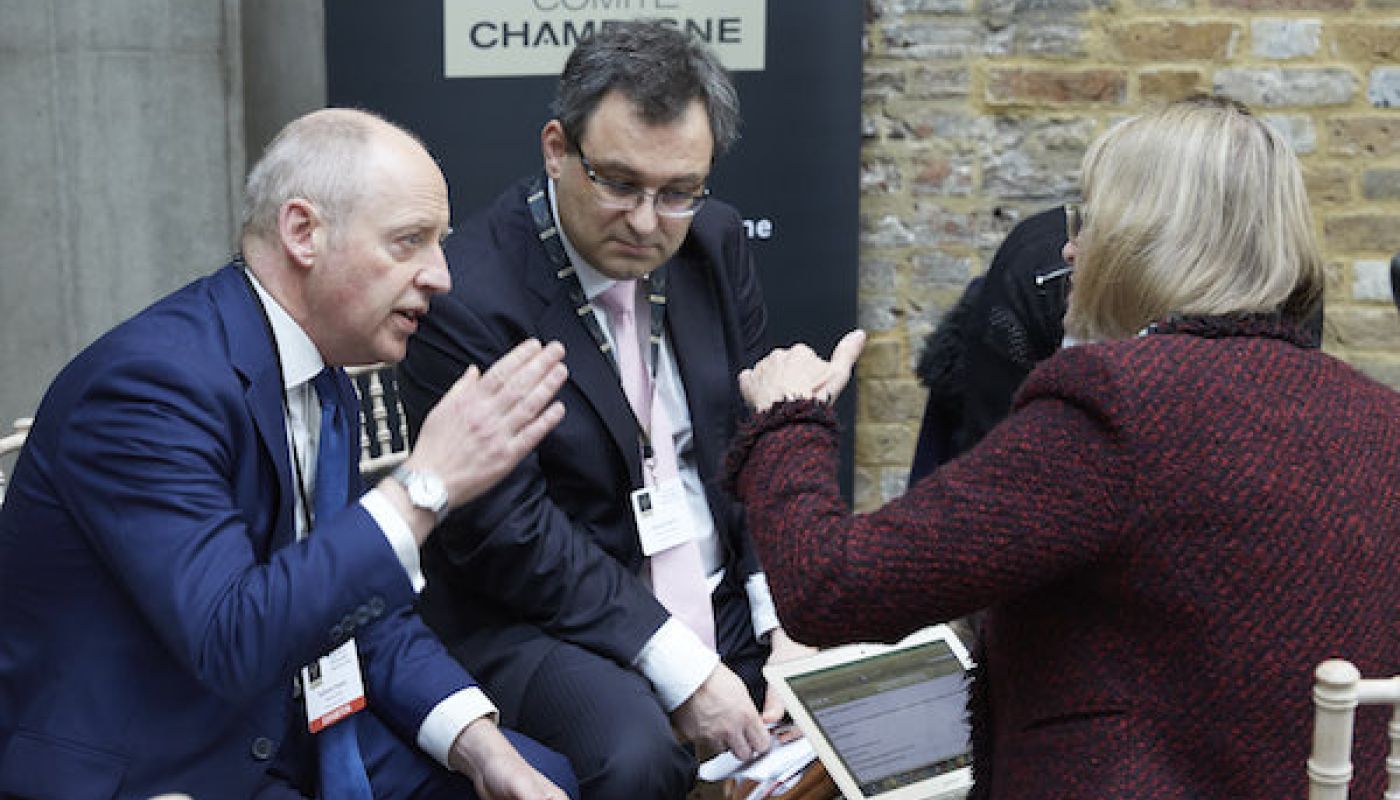
The Champenois were out in force in London last month, showing their wares to the UK wine trade in the cavernous foyer of London's University of the Arts in King's Cross. I had a chance to quiz Vincent Perrin, director general of the CIVC, the generic body that has the delicate job of representing both the growers and the brands, about the rather disappointing recent champagne shipment figures. The two biggest markets, France and the UK, had both shrunk but he was putting a brave face on it. He said he had been expecting a decrease in the UK thanks to the post-Brexit fall of the pound, and that this would mean more visitors to the UK that would therefore act as a fine shop window for champagne. I thought this was a bit of a stretch but certainly accept his assertion that rosé and prestige cuvées (the posh bottlings) are doing well compared with standard non-vintage Brut.
Andrew Hawes, head of the company that imports Bollinger and chairman of the UK champagne agents association, was also putting a positive spin on it all. He claimed it was good news overall, evidence that there is now much less discounting of cheap champagne by British supermarkets. Pointing out that global champagne shipments reached a peak in 2007, he claimed, ‘I’m just surprised that the market didn’t correct itself as fast as I expected after the financial crisis of 2008.’ (The picture top right shows Hawes, on the left, and Perrin in full exposition.)
It is certainly true that the dire quality of most supermarket own-label champagnes that are sold for a song in both France and the UK constitutes the greatest threat to the image of champagne (far more than some of the more obscure battles fought by the CIVC’s extremely litigious protection division such as the damaging, and ultimately fruitless, three-year pursuit of an Australian wine writer who styled herself Champagne Jayne).
Interestingly, when discussing the fortunes of champagne with Messrs Perrin and Hawes, there was no mention of the P word, nor of the C word. When I raised the question of ‘competition’, thinking of Cava, Prosecco and Italy’s rather accomplished bottle-fermented sparkling wines such as Franciacorta and TrentoDoc, the lady representing Champagne’s growers (small farmers whose shipments reached a peak of more than a quarter of the total in 2009 and have fallen back to less than 20%) sniggered a little. Vincent Perrin pointed out defensively that champagne sales continue to grow in both Spain and Italy. Andrew Hawes valiantly argued that any growth in these categories is represented by Brits switching from still to the vibrant sparkling wine category adding, ‘people coming in to the base of the pyramid has got to be a good thing'.
And then there is the red, white and blue elephant in the room: English sparkling wine, whose quality is now beyond doubt and whose sterling prices must add some competitive edge in relation to all these imported fizzes. A giggle and a blush is all I got in response. When I asked Vincent Perrin how often he tasted non-champagne sparkling wine, his exact response was, ‘In Japan I had a bottle.’
He claimed to be setting great store by being more open about the considerable amount of research that the CIVC undertakes in order to stay technically ahead of the pack. At this recent tasting they prided themselves on a number of innovative presentations from CIVC scientists called ‘round tables’. But I fear the tables were not all that round. I attended an excellent discourse on the role of oxygen in champagne production by the youthful but highly competent researcher Delphine Goffette, who explained how champagne styles can be dictated by the permeability of the crown cork used in the ageing process. When Nick Baker of specialist champagne retailer The Finest Bubble asked to reproduce one or two of her slides on his website he was told, ‘we do not communicate our documents and presentations’.
I know I am being extremely mean with all these snide comments and am doing it only because champagne is so obviously top of the sparkling wine tree. More than 99% of all the greatest blends of wine and carbon dioixide I have ever tasted have been champagnes, either prestige cuvées or the most blessed vintage-dated wines. I have tasted memorably fine examples from Brazil, England, Italy and Spain, and practically all countries capable of making good still wine have produced some decent fizz too but top-quality champagne beats them all.
Tasting it is one of the great rewards of being a professional wine writer and those of us who enjoy it have to be grateful for the fact that, like the Bordelais, the Champenois are engaged in constant research and development in an effort to make better and better wine every year. Some houses such as Roederer are even moving towards genuinely sustainable viticulture. Warmer summers mean that grapes can now be picked when deemed at perfect ripeness rather than when rain threatens – though acid levels have been falling. The good effect of all this is that sweet and sour champagne in which too much sugar is added to compensate for too tart a wine is becoming rarer. In general champagne is becoming drier but riper.
And, in another development of which I approve, an increasing proportion of champagne is deliberately being made less aggressively fizzy than of old. (The winemaker can determine this by adjusting what is added to cause the second fermentation in bottle.) Overall, and ironically in view of its lessened status, champagne is better quality now than it has ever been.
FAVOURITE VINTAGE CHAMPAGNES
At the recent tasting in London I concentrated on current vintage-dated champagnes because it can be so difficult to identify exact non-vintage blends. 2008 is clearly a superlative vintage. See my tasting notes on these wines and many more.
Bollinger, La Grande Année 2007
Bollinger RD 2002
Le Brun de Neuville 2006
Deutz Blanc de Blancs 2009
Drappier, Grande Sendrée 2008
Gosset, Grand Millésime 2006
Charles Heidsieck 2005
Janisson Grand Cru 2006
Lallier Grand Cru 2008
A R Lenoble Blanc de Blancs 2008
Henri Mandois, Victor Mandois Vieilles Vignes 2007
Bruno Paillard Blanc de Blancs 2006
Philipponnat Blanc de Noirs 2009
Pol Roger 2008
Louis Roederer 2009
Vazart-Coquart, Spécial Club Blanc de Blancs Grand Cru 2008
Veuve Clicquot 2008













