
For all other articles related to the appealing 2012 vintage in the Rhône, see this guide to our coverage.
France's wine officials are generally cautiously, often infuriatingly, diplomatic when speaking in public. Not so Michel Chapoutier, vice president of the generic wine organisation Inter-Rhône and head of the eponymous wine producer with tentacles that stretch as far as Australia. When presenting his company's top 2012s in London last year he was asked by the buyer for the widely respected UK retailer The Wine Society whether he really thought the future of Châteauneuf-du-Pape could lie with the Grenache grape when it makes such high-alcohol wines. Chapoutier impishly suggested the best course would be to allow producers to add water to their wines.
Pausing briefly to consider the signature grape of the northern Rhône, he volunteered, 'The southern Rhône is too warm for Syrah. Of course we don't want to reduce the alcohol by physical means. If you use reverse osmosis to reduce the alcohol, you sacrifice some of the aromas. When you physically concentrate the grape must, you concentrate everything – including less desirable aspects. So how about simply adding back the water lost by evaporation? If you harvest on the basis of the ripeness of tannins in Grenache you risk having wines at 15.5 or 16% alcohol at least. We experimented and found that adding water did actually result in better wines.'
There was an audible gasp in the room full of wine professionals for this is, strictly, against the law. And indeed Chapoutier added, referring to the overarching French wine organisation in Paris, of which he is the Rhône representative, 'but the INAO said "What will the wine writers say?". Wines with 17% alcohol just don't make sense though. I'm the only one to actually talk about it. Lots of winemakers do it, and I think we should make it legal and bring it out in the open. It's the future of wine. We can't make Châteauneuf with 16% alcohol. We must have the courage to defend this point of view.' He went on mischievously to cite the most famous heatwave vintage of this century. 'I love to make a tasting of 2003s, adding a little water to them – they're much better.'
And this, in a nutshell, is the problem for Châteauneuf-du-Pape, the southern Rhône's most famous wine by far. Being made so far south and being made substantially from a late-ripening grape whose phenolic ripening is often blocked by summer heatwaves nowadays, so that sugars soar and acids plummet while tannins and other important phenolics ripen, it is in the vanguard of climate-change effects on French wine. (We provide the sometimes jaw-dropping stated alcohol levels in many of the hundreds of wines described in Rhône 2012 – Châteauneuf-du-Pape reds and Rhône 2012 – other southern reds.)
The regulations for Châteauneuf may not (yet?) permit adding water but they do allow a dazzling cocktail of different grape varieties and many thoughtful producers such as Vincent Avril of Clos des Papes have been deliberately choosing to increase the proportion of Mourvèdre in the blend because it ripens at lower alcohol levels, and can help the wine taste fresher. His final blend for Clos des Papes 2012 will be 65% Grenache, 30% Mourvèdre and 15% Syrah – and he somehow manages to produce a wine that is nearly 16% alcohol but tastes beautifully balanced. Avril has a demonstration cask in which the Syrah component is deliberately increased to show how much less successful it is than the high-Mourvèdre blend. The rather tough Syrah somehow suppresses the sweet delicacy of the Grenache while the Mourvèdre (known as Monastrell in Spain) complements it with a sweet, lively aroma of blackberries and bonfires. But, says Avril, Mourvèdre vines have to be at least 20 years old before they produce really exciting wine. Viticulture is a very long term proposition and the vine growers of Châteauneuf, who have for decades been principally dependent on Grenache grapes, cannot simply switch to other varieties according to whim.
Besides, Grenache is an integral part of the pale sweetness of a great Châteauneuf such as those made by Clos des Papes and Château Rayas, whose Emmanuel Reynaud picks even later than Avril, apparently waiting until the tannins of his Grenache grapes have ripened to such an extent they are almost imperceptible when his wines are drawn from the apparently prehistoric grey casks in which they are aged in his primitive winery.
Châteauneuf producers may be worried in the long term about ever hotter summers – in very high temperatures the ripening process can simply and inconveniently stop altogether, pushing harvest dates into October and obviously encouraging some growers to pick while tannins are still uncomfortably drying and underripe – but most of them are particularly pleased with the 2012 vintage. It may be a little low in acidity but 2012 has brighter fruit than in 2011, more freshness than 2009 and riper tannins than the truly long-term vintage of 2010. According to Avril, '2012 has the potential of 2010 with the finesse of 2005.'
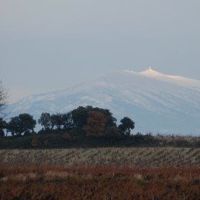
But whereas in cooler times the outlying areas of the southern Rhône on ground higher than Châteauneuf used to be at a disadvantage, making much thinner, lighter wines, today some of them are feeling rather smug. Ventoux, on the slopes of the often snow-covered cone of Mont Ventoux (pictured above) east of Châteauneuf, is a relatively new appellation but top producers there such as Fondrèche and Pesquié, growing vines at up to 450 m altitude, hundreds of metres above the varied soils of Châteauneuf, see their cooler climate as a positive advantage.
For Frédéric Chaudière of Pesquié, 2012 was 'very, very good in Ventoux, with the finesse of 2010 and the power of 2009'. The Ventoux wines made today are almost unrecognisably different from the pale ferments made in the last century. As in Châteauneuf, Grenache is the most planted grape variety but at these altitudes, Syrah can also thrive. This may be France's southernmost point for successful Syrah but the cool nights help mitigate overripeness in this temperamental variety.
Similarly, many of the cooler, higher villages around Châteauneuf making Côtes du Rhône-Villages are making better wines than ever, whereas some of the wines from the hotter, lower-lying ones are producing some rather soupy reds. Cairanne seems a notable beneficiary of warmer summers. Some Cairanne 2012s nudged 15% alcohol but still tasted agreeably fresh. I tasted a number of excellent 2012s from the villages of Vinsobres and Chusclan, too.
But these outlying villages share a characteristic with Châteauneuf-du-Pape: their Grenache-based blends are no great friend of small, new oak barrels, responding far better to larger, generally older, oak casks. Most of these wines have so much intensity of fruit and structure that new oak can sit rather uneasily on top like badly applied make-up.
2012 SOUTHERN RHÔNE BARGAINS Of the 535 southern Rhône 2012 reds we tasted, a total of 109 Châteauneufs and 21 wines from other appellations scored at least 17 out of 20. These are the ones offered by UK merchants that seemed best value. Prices are per case of 12 bottles in bond.
Clos du Caillou, Les Safres, Châteauneuf-du-Pape
£250 H2Vin
Tardieu-Laurent, Vieilles Vignes, Gigondas
£175 Corney & Barrow
La Ligière, Vacqueyras
£99 H2Vin
D & D Alary, La Font d'Estevenas, Côtes du Rhône-Villages, Cairanne
£98 H2Vin
D & D Alary, La Jean de Verde, Côtes du Rhône-Villages, Cairanne
£115 H2Vin
Tardieu-Laurent, Vieilles Vignes, Vacqueyras
£160 Corney & Barrow
Dom de Mourchon, Grande Réserve, Côtes du Rhône-Villages, Séguret
£126 Averys













