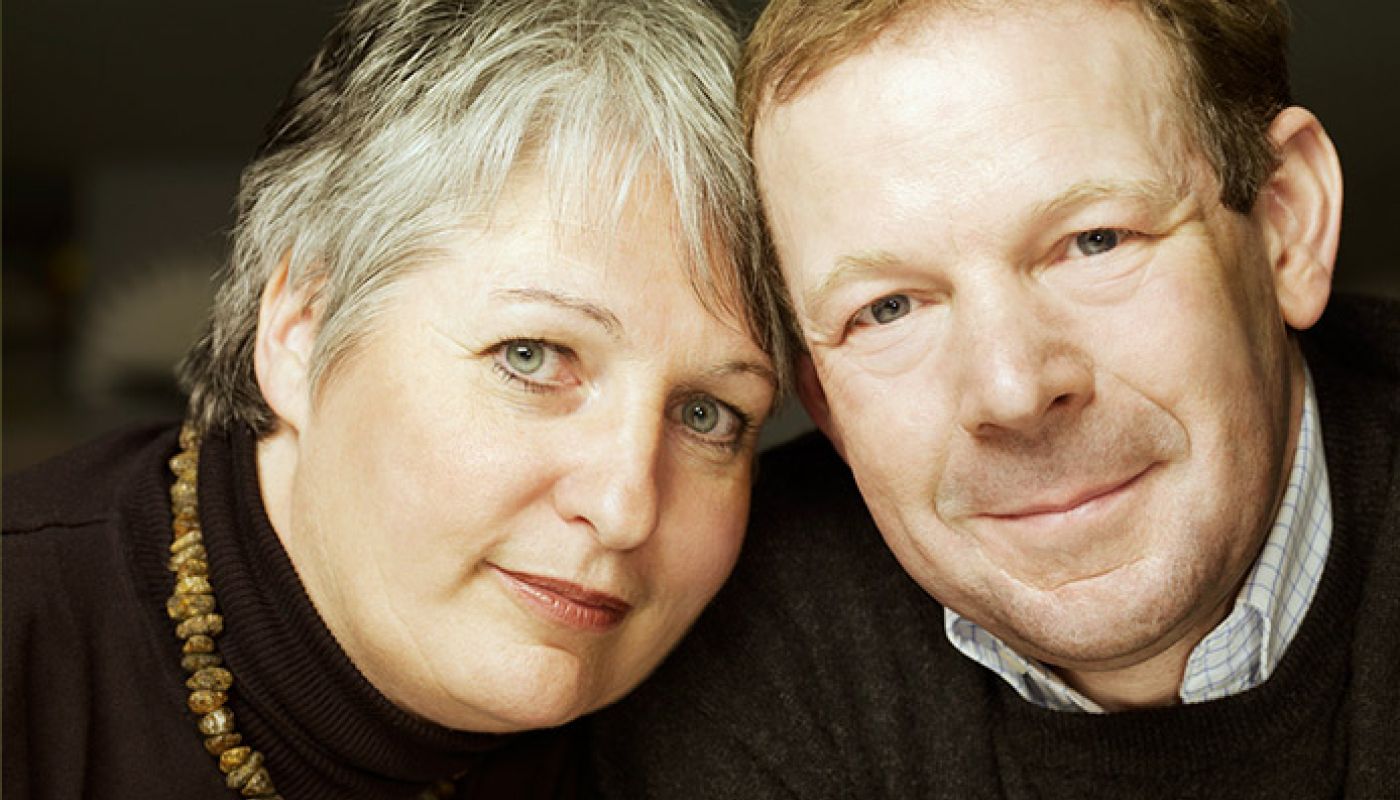
‘In the 1990s all the scientists and advisors were telling us to pull out our Riesling vines and plant French varieties', Friedrich Groebe (pictured here with his wife Manuela) told me recently over potato salad and sausage on the banks of the Rhine.
I had gone to Wiesbaden for the annual showing of Grosse Gewächse, the top dry wines from members of the VDP, Germany’s association of top estates. Both Groebe and I were relaxing at a small evening gathering at the recently renovated Hans Lang winery in Hattenheim, but Groebe had decided not to show his 2015s in Wiesbaden. His highly regarded wines come round slowly, often showing in youth the whiff of spontaneous fermentation with ambient yeast, which he prefers to the practice of adding cultured yeasts to achieve a more predictable and faster fermentation.
Groebe seemed wary of chatter between the tasting tables, served every year with singular efficiency by a team of aspiring young vintners in Wiesbaden’s elegant old spa buildings. The suggestion of a certain herd mentality among tasters in the past hung in the air.
He hardly need worry. He has forged an enviable reputation from the Weingut in the village of Westhofen in the far south of Rheinhessen where his family have been based since 1763. But he must be extremely glad that this long history gave him the confidence to ignore the advice of the 1990s. His estate still comprises 70% Riesling vines and nowadays the supremacy of Germany’s emblematic grape is beyond question. Indeed, the only two varieties permitted by the VDP for Grosses Gewächs in the Rheinhessen are Riesling and Pinot Noir, or Spätburgunder as it is known in German. And my main conclusion about the heavily touted 2015 vintage in Germany was that the growing conditions hugely favoured the slow-ripening Riesling grape.
In the 1990s the entire world of wine went through a period of believing that the future lay in planting the same small handful of familiar ‘international varieties’ everywhere – the likes of Chardonnay, Cabernet and Merlot. This was palpable nonsense for a country like Germany that at that stage – pre global warming – still had difficulty ripening red wine grapes other than the most precocious ones. But still there was the idea abroad then that to sell wine, you had to have the name of an international grape on the label.
Today, international varieties are having their time in the shade and those in the sun are the ones deemed ‘indigenous’, the more obscure and local the better in the eyes of many. The indigenous German variety that is obviously the most successful is Riesling, producing Grosse Gewächse in virtually all of Germany’s wine regions, and the most glorious range of fruitier, sweet versions too – unlike the other white wine grapes grown in Germany.
Germany’s other white wine grape speciality is Silvaner (written Sylvaner in Alsace), whose origins may well be Austrian. Silvaner really comes into its own in the thoroughly continental central region of Franken with its squat flask bottles. I tasted my way through the range of 20 Franken Silvaner Grosse Gewächse shown and found that 2015 did not particularly favour this rather low-acid grape.
The summer of 2015 was so warm and dry that towards the end of August many vintners were worried that the vines would ‘shut down’ and the ripening process stall in protest at the drought, as can happen from Napa Valley to Bordeaux. It is certainly true that some grapes other than Riesling notched up extremely high alcohol levels in 2015 so that the wines ended up tasting rather hot and lacking the refreshment element that characterises Germany’s best whites.
Many of these 2015 Franken Silvaners were over 14% alcohol – Schmitt’s Kinder’s Pfülben as much as 14.8% – which sometimes tasted excessive. One of the joys of my job is to discover new genius, however, and it was a wine from a producer I had not previous encountered, Weltner’s Küchenmeister Hoheleite, that really stood out from the crowd. At 13.5% alcohol, it was also one of the least potent of this group.
The greats in 2015 seem to be the Rieslings from the most northerly Mosel (especially Saar), Nahe and Rheingau regions, this last region finally back on track after a rather desultory period. And some (though not all) Rieslings from the finest Rheinhessen producers are stellar, with Keller as usual a standout.
Rieslings in the more southerly regions are more variable but my focus on the first day of this three-day tasting was on the Burgundian white wine grapes in the southern German wine region of Baden just across the Rhine from Alsace: Grauburgunder (Pinot Gris), Weissburgunder (Pinot Blanc) and, nowadays, quite a lot of Chardonnay – presumably inspired by the international varieties craze of the 1990s.
It had been some time since I had tasted a group of these wines en masse and I was delighted to note that the excessive oak that was for a while a common fault in these wines is now extremely rare in the exalted reaches of the Grosse Gewächse. But here again, alcohols were often a bit intrusive, especially in these relatively low-acid grapes. Apparently, alcohol levels in 2015 tended to rise extremely fast towards the end of the ripening period, so picking dates were critical. I am assured that acid levels were normal, but alcohol levels were higher than usual so tended to overwhelm them.
The Grauburgunders definitely had more personality than the Weissburgunders, two of them actually quite a deep pink, presumably from extended contact with this variety’s pink skins. They may overall have been a little simple but the best had some spice and character and displayed the haunting, sometimes smoky, perfume of Alsace’s finest Pinot Gris and Friuli’s finest Pinot Grigio – and were absolutely nothing like basic Pinot Grigio.
As for the classic white burgundy grape Chardonnay, one can safely say that the German version, or at least these top Grosse Gewächse from Baden, are not at all like white burgundy. These examples seemed pleasantly round and sweet but without much obvious terroir expression or savour. Unlike the nervy, concentrated, expressive 2015 Rieslings, these other grape varieties just seemed a bit monotone. (See a discussion of this point on our Members' forum.)
After a hot Sunday afternoon tasting these slightly heavy Burgundian grapes I found myself arriving at the Hans Lang winery, rudely declining the proffered glass of Sekt and panting, ‘Riesling, please.’ What a good thing that Friedrich Groebe ignored that 1990s advice.
See 2015 GGs – whites other than Rieslings for my notes on these wines. Stockists should eventually emerge on wine-searcher.com but these Grosse Gewächse have only just been released.
GERMAN NON-RIESLING WHITE GGS TO LOOK FOR
(though the names require perseverance)
Bürgerspital, Stein Silvaner 2015 Franken
Bürgerspital, Stein-Harfe Silvaner 2015 Franken
Ludwig Knoll, Stein Silvaner 2015 Franken
Rudolf May, Langenberg Himmelspfad Silvaner 2015 Franken
Horst Sauer, Am Lumpen 1655 Silvaner 2015 Franken
Weltner, Küchenmeister Hoheleite Silvaner 2015 Franken
Zehntof Luckert, Maustal Silvaner 2015 Franken
Bercher, Feuerberg Haslen Weissburgunder 2015 Baden
Bercher, Feuerberg Haslen Grauburgunder 2015 Baden
Dr Heger, Schlossberg Grauburgunder 2015 Baden
Stadt Lahr, Chardonnay 2015 Baden
Stigler, Winklerberg Pagode Grauburgunder 2014 Baden
Stigler, Winklerberg Pagode Chardonnay 2015 Baden
and also a particularly good non Grosses Gewächs: Alexander Laible, Chara dry Grauburgunder 2014 Baden (£258 a dozen, which may be mixed, The Wine Barn)