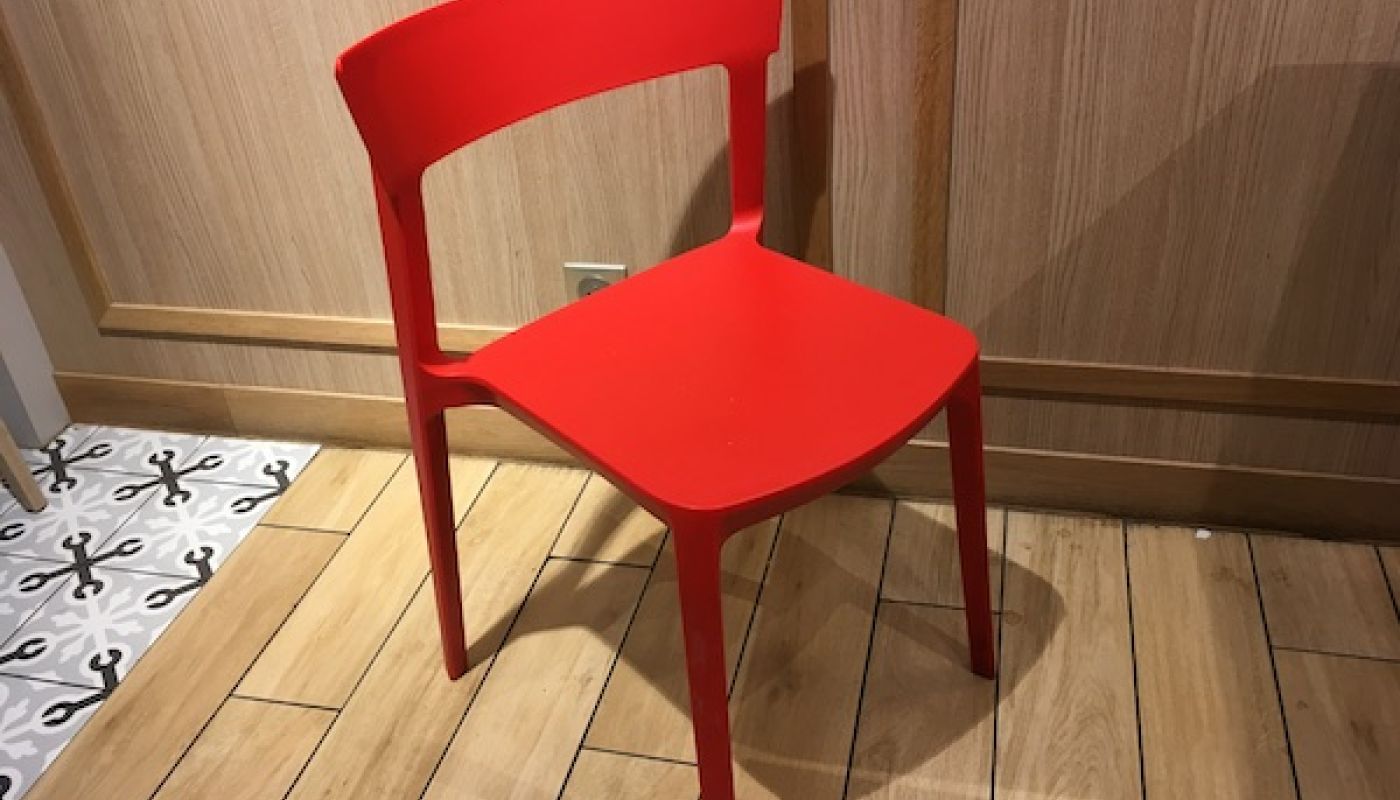
The legs of the chair next to me are made of red polypropylene and have the form of triangular prisms. I do not, incidentally, find their triangularity to be miraculous – but what did Aldous Huxley have to say on the subject?
The legs, for example, of that chair – how miraculous their tubularity, how supernatural their polished smoothness! I spent several minutes – or was it several centuries? – not merely gazing at those bamboo legs, but actually being them – or rather being myself in them; or, to be still more accurate (for ‘I’ was not involved in the case, nor in a certain sense were ‘they’) being my Not-self in the Not-self which was the chair.
To be fair, he was tripping his Not-self’s nuts off at the time, having scoffed 400 mg of the hallucinogen mescaline in order to compose the interminable bollocks that is 1954’s The Doors of Perception. If ever proof were needed of how execrably boring and unforgivably egomaniacal people become on drugs, this book is it.
Such a self-indulgent exercise would be equivalent to me scoffing an entire magnum of Amarone while I write this article. No doubt that would render the red chair leg infinitely more engrossing, and my writing infinitely more boring.
Alcohol is no less potent a drug than many of its illegal counterparts. Yet its effects are almost never discussed within the world of wine, as if its inebriating power is somehow taboo. Quite literally, in the case of the eponymous classic blend of white wine, vodka and fruit juice, a delicious mainstay of juvenile drinking in the 1980s. Ah, memories.
In fairness, the difference between most recreational drugs and wine is that the former are taken solely for their psychotropic impact on the user, whereas wine is primarily appreciated for its gustatory qualities.
Or is it? Surely it would be disingenuous to pretend that the intoxicating effect of wine is irrelevant to its appreciation. After all, most wine drinkers enjoy the effects of drinking – even though it may seem crass to admit it. How we react to alcohol varies according to the individual, but the bottom line is that as the wine goes down, drunkenness goes up.
Furthermore, most of the wine drinkers I know consume more than the current UK government guidelines for alcohol consumption, which is inconveniently less than one magnum of Amarone per day. (In fact, it’s less than one medium-sized glass of wine per day.)
Would wine still be as compelling if contained no intoxicants whatsoever? The paltry success of alcohol-free wines might answer that question, but what if it were possible to have any fine wine you wanted with zero per cent ethanol?
Maybe it’s the Amarone talking, but it doesn’t seem beyond the realm of possibility to imagine a domestic appliance that could remove the alcohol from any wine without compromising its flavour. Let’s call it the Sober-Aid™ BuzzKiller. If such a thing were to be invented, and it genuinely didn’t diminish the sensory appreciation of the wine, would you use it?
My guess is that most of us would say no. But in that case, wine seems to be no more than a pretentious conduit for alcohol, serving the same function as super-strength lager but with fancier names and higher prices. Furthermore, in that case, all the cultural, historical and societal value that wine carries is an artifice, established by successive generations of wine professionals attempting to justify their preferred method of inebriation.
The truth lies somewhere in between. There is demonstrable diversity and complexity in wine, where the combination of grape variety, terroir, climate (and sometimes vodka and fruit juice) conspires to create an infinite variety of flavour and style.
This is a large part of what makes wine so compelling. But another part of what attracts us to wine – let’s say generally between 12% and 15% of it, in fact – is alcohol, and it would be naive to deny this. The communal experience of drinking wine is unquestionably enhanced by the effects of alcohol – it relieves anxiety, facilitates intimacy (conversationally, I mean) and promotes a feeling of happiness and positivity.
With the usual provisos about avoiding overindulgence – tip: if you catch yourself boring on about chair legs, you've had too much – getting drunk on wine is nothing to be ashamed of.