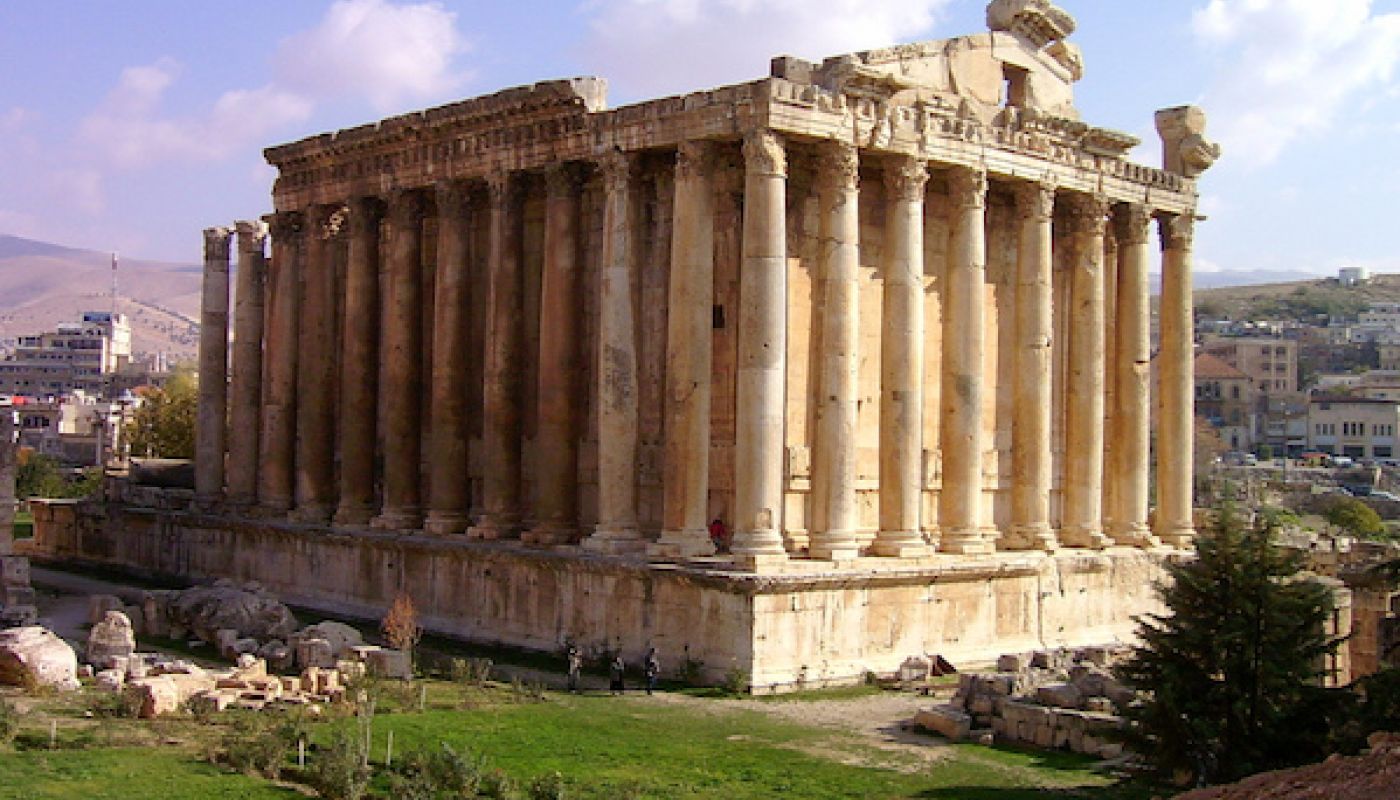
Refugee camps, Hezbollah hideouts, cannabis farms, Bedouin tribes, and one of the most beautiful and best-preserved classical Greek temples in the world. This seems like a heady mix, and an unlikely setting for a dynamic wine culture.
But the god to whom this temple in the Bekaa Valley was dedicated, in the second century AD, is Bacchus, the god of wine. The reasons Lebanon features in modern news stories, many of them tragic, must seem evanescent to the vines that have for millennia been a major crop on this dry, windswept plateau between two mountain ranges.
The most famous man of Lebanese wine, Serge Hochar of Chateau Musar, who died suddenly while swimming on holiday in Mexico three years ago, had a strong grasp of where wine sat in his country’s history. He was one of the most spiritual of modern wine producers. Ever philosophical about the latest horrors, continuing to make wine throughout the civil war that tore Lebanon apart between 1975 and 1990, he clearly believed that Lebanon would be in a constant state of strife and that the best course of action was to continue along the path he had chosen of making highly individual wines there.
Chateau Musar is also quite exceptional in how long it hangs on to its wines before selling them. It is still possible to buy red and white Musar back to the 1950s. I had the pleasure of tasting 20 vintages of Chateau Musar back to 1961, including whites back to 1989, and they were all still going strong. Indeed the current vintage of Chateau Musar red, 2011, still seems too young.
So widely did Hochar travel and so strong an impression did he create when he did, that for many years Chateau Musar was the only Lebanese wine producer with an international reputation. But, despite constant audible reminders of the war in Syria only a few miles from the Bekaa Valley vineyards, there has been an explosion of another sort: in fine-wine production. As Lebanon’s leading wine writer Michael Karam reports, there are now 50 Lebanese wine producers – some with vines well north of the Bekaa Valley – when there were only 14 at the beginning of the century.
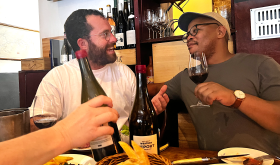
Chateau Musar continues in the safe hands of Hochar’s family and their long-standing winemaker but there are signs that a new spokesman for Lebanese wine is emerging. Doubt doth not assail 34-year-old Faouzi Issa of Domaine des Tourelles. In London recently to celebrate the 150th anniversary of Lebanon’s second oldest winery after Chateau Ksara, he (pictured below) declaimed, ‘I’m not modest; I’m known as the next Serge Hochar. I’m the youngest wine producer and yet I’m the president of the technical committee of the wineries association.’

For the last 20 years Issa’s family (with another Lebanese family) have co-owned Tourelles, founded by a Frenchman whose name lives on in the country’s favourite aniseed-flavoured spirit, Arak Brun. While learning how to make wine, Issa worked for quite a while at Château Margaux in Bordeaux and René Rostaing in the Rhône and was thrilled to see smart French wine producers reverting from stainless steel to concrete for fermentation vessels. He claims Tourelles’ unlined concrete fermenters are the oldest in the world (he also claims to be the fifth generation at Tourelles which can’t, strictly, be correct).
On his return from France as a 24-year-old, Faouzi insisted on taking over winemaking from the French incumbent and has been on a crusade to make lighter, fresher, more truly Lebanese wines instead of the heavy versions of international varietals that, according to Karam, have been revered by Lebanese consumers. Karam is a big supporter of this trend, reporting in an email what he calls ‘a gradual but positive move to make more "thoughtful" wines that reflect a genuine sense of place, using grapes – Cinsault, Carignan and Grenache in particular – that can deliver personality and not simply status. The late Serge Hochar knew this instinctively. He only used his Cab[ernet] for structure.
‘The good news is that these wines are infinitely more affordable – and therefore more accessible – than the pricey, and musclebound but ultimately international reds around which Lebanese have tried to build a reputation.’
Chateau Musar red has long been a blend of Cabernet Sauvignon with the much less lauded southern French varieties Cinsault and Carignan. Issa is a major proponent of Cinsault, a grape dismissed in some quarters as fit only for rosés to be drunk relatively young. But at his 150th anniversary lunch in London (in the clock tower of St Pancras, also built in 1868) he served Domaine des Tourelles reds based on Cinsault that had been made in 1989 and 1976 – the former still sweetly rose-scented, the latter by no means decrepit.
Cinsault, brought to the Bekaa along with other southern French grapes Grenache and Carignan by the Jesuits in the mid nineteenth century, was for long the most planted wine grape in Lebanon until the 1990s craze for international varieties encouraged growers to replace it with Cabernet, Merlot and the like. But for Michael Karam, Cinsault is the essence of the Bekaa, pictured below.

This fashion for concentrated international varietals, followed by increasing reverence for more refreshing and locally expressive wines, incidentally, mirrors almost exactly what has been happening to the immediate south of Lebanon in Israel. In both countries white wines – some of them based on rare, indigenous grape varieties – have been dramatically improved in recent years, and elevation is a fine substitute for their relatively low latitudes. Quality-conscious Israeli winemakers may be seeking out higher locations for vineyards, while in Lebanon the Bekaa Valley’s 1000 m (3,280 ft) elevation is a boon, imbuing the wines grown there with perceptible freshness.
Bekaa grapes are effectively grown organically – so dry is the climate – and are all hand picked, by Bedouins and some of the million-plus Syrian refugees currently in Lebanon. The sight of colourful Bedouins in the vineyards was just one of many memorable spectacles during my last visit there, in war-ravaged 1980. Others included Baalbek, my host Serge Hochar’s Leonidas chocolate boutique, pockmarked apartment blocks, and seriously scary checkpoints. (You can see pages one and two of an article I wrote as a result of this visit for the December 1980 edition of Harper's & Queen.)
Faouzi told us airily, ‘I was born in the war. I have the genes of war in my rootstock. I’m used to it.’
For Michael Karam, ‘the main feature of Lebanese wine culture is resilience, the ability to function in a crisis’.
MUSAR
I would recommend multiple mature vintages of Chateau Musar red, which seems to be very well distributed in the UK. Below I list some of the better deals. Divine Fine Wines of Solihull have a wide range of vintages. US importer is Broadbent Selections. Prices are remarkably low considering the age of the wines.
1961 £410 a half, Wine Raks, Scotland
1969 (low fill) £280 The Wine Cru, Scotland
1970 £449 Hedonism, London
1980 (low fill) £138 Barber Wines, Devon
1994 £92.60 Lay & Wheeler (collect at Majestic)
1998 £33 Roberson, London
1999 £32.05 Excel Wines, Scotland
2003 £28.49 Martinez Wines, Yorkshire, and at £18.74 (25% off) at Waitrose
2006 £23 The Wine Society, and at £18.74 (25% off) at Waitrose
2007 £23.99 Whitebridge Wines, Staffordshire
2008 £30 Lebanese Fine Wines, London
TOURELLES
2014 Domaine des Tourelles: about £12.50 various retailers
2015 Domaine des Tourelles, Cinsault Vieilles Vignes: about £17.50 various retailers