9 February 2013 This is a longer version of an article also published in the Financial Times. See also my tasting notes on north Rhône 2011s and this guide to our coverage of Rhône 2011.
As usual I spent time in the Rhône Valley at the end of last year tasting the vintage that was about 15 months old. Most of the whites were in bottle. Only the more modest reds were. The southern Rhône, which admittedly produces three times more wine than the narrow northern half, is awash with efficiently organised generic organisations and their kind staff who go to great lengths to organise blind tastings for visiting wine writers such as me. I felt guilty this time that I could not summon up widespread enthusiasm for the 2011 vintage in the southern Rhône. I suspect in appellations such as Châteauneuf-du-Pape, Gigondas, Vacqueyras and so on, 2011 will be forgotten long before the best 2010s and 2012s reach their peak. Not that there weren't some attractive southern Rhône reds and whites (I will be writing about them) but this is not in general a thrilling vintage in the south.
In the north things are different. As in the south, yields were much higher than in 2010 and 2012 – and the weather was distinctly odd. As in Burgundy, the growers experienced summer weather in spring (which helped encourage a generous flowering) and then a July that was cooler and wetter than usual. Particularly fine weather in late August promised to set the growers up for yet another very successful vintage, but rains in early September diluted prospects, especially with such relatively heavy crop loads on the vines. There were some rain-swollen grapes and even a bit of rot, especially in less well-drained sites.
Northern Rhône white-wine grapes started to shrivel in the late August heat so some were picked before the rains and made some particularly successful, if very full-bodied, wines. The best Condrieus and the top St-Joseph whites such as Chapoutier's Granits and Guigal's Lieu Dit 2011 are already looking lovely. And the northern Rhône reds are certainly 'correct' even if generally lighter and softer than the 2009s and 2010s. According to Jean-Paul Jamet, who makes particularly refined Côte Rôtie, the 2011 reds are very silky and fruity and should drink well in youth, 'though they will age too'. I loved the pure silkiness of his simple northern all-Syrah Côtes du Rhône 2011 which is already drinking beautifully.
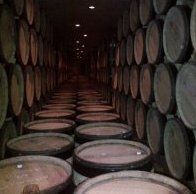
It takes just 15 minutes and about 20 hairpin bends to descend from the Jamet family compound on the plateau above Ampuis (in a whiteout when I visited, it looked like nothing more than the top of a ski lift) to the quite different headquarters of the most powerful wine family in the northern Rhône, the Guigals. Squeezed in premises between the railway line and the busy main road, they have of course extended, as one would expect, by burrowing a set of tunnels and caves that surely extends as far as the Château d'Ampuis to the south (which they now own) and the other Ampuis négociant house of Vidal Fleury to the north (ditto). A small section of the forest of barrels hidden underground is pictured above.
According to Marcel's son Philippe Guigal, father of twin baby boys (thereby ensuring succession?), the market can't get enough Condrieu, the northern Rhône's prototype Viognier and so much more savoury and interesting than most varietal Viogniers now made around the world. It is extraordinary to think that the world's total plantings of Viognier had shrunk to just 14 hectares in Condrieu and its neighbour Château-Grillet by the 1960s, but that now there are more than 11,000 hectares planted around the world.) Apparently the generic organisation Inter Rhône, one of the many who set up a tasting for me, did an audit of each appellation's stocks and found that Condrieu had the least when compared with sales: just 11 months' worth.
Philippe Guigal has somehow to find enough wine to fill 90,000 bottles of their basic Condrieu nowadays – quite a challenge. Their superior Doriane bottling, which, unusually for a Condrieu, seems to last as well as Georges Vernay's top bottlings, is supplied by their own top holdings in the appellation, which grew to 4.5 hectares last year thanks to a new half hectare. The talented Condrieu vigneron Yves Gangloff has also been expanding his holdings. You need deep pockets to buy prized land in the northern Rhône's Viognier country; which is perhaps why it was François Pinault (owner, inter alia, of Château Latour in Bordeaux) who acquired the famous Château-Grillet recently. See the new label on the left of the old label in the picture below. 
Guigal also reported strong demand for white St-Joseph, much more so than for white Crozes-Hermitage, the equivalent of St-Joseph in the other important cluster of vineyards in the northern Rhône, around the famous hill of Hermitage well south of Ampuis. According to Guigal, the market also, strangely to me, seems to prefer Condrieu to one of the greatest and most complex white wines on earth, white Hermitage itself. As Jean-Louis Chave was to remind me later that same day, it was for its white wines that the granitic hill of Hermitage was once so celebrated. Chave and Chapoutier both make stunning examples of white Hermitage.
Even red Hermitage sales are 'not as high as they should be – it's bizarre', according to Philippe Guigal, although since his family firm's reputation is built on Côte Rôtie, the 'other' famous wine of the northern Rhône, he may be slightly biased. Why is Hermitage not as celebrated today as it should be? It may be partly due to the high prices and small quantities of Chapoutier's top bottlings, the natural reticence of Jean-Louis Chave, and uncertainty over the wines of Paul Jaboulet Aîné, whose Hermitage La Chapelle was once seen around the world as the lodestar of the appellation. Since 2006, when the Jaboulet family sold the company and its vineyards to the Swiss family Frey, who also own Château La Lagune, the new owners have not yet clearly established their style. This is not surprising since the Jaboulet wines were far from irreproachable in the final years of the Jaboulet family's reign, and the Freys had zero experience of Rhône viticulture and vinification. But I think we are all impatient for a really brilliant vintage from the new regime.
Alas 2011 will not be it. The 2011 reds are charmingly scented, are relatively soft and have no shortage of fruit. I will be buying some myself. But it is not a banner year. As Jean-Louis Chave explained, it was a year that favoured rather simple fruit, and the job of a master winemaker like him was to imbue the wines with as much structure possible.
These are my top wines from each producer
M Chapoutier
Ermitage L'Ermite white
Ermitage Le Méal red
Ermitage Le Pavillon red
Château-Grillet
Château Grillet
J L Chave
Hermitage red and white
St-Joseph red
Clusel Roch
Les Grandes Places Côte Rôtie
Dom du Colombier
Hermitage red
Pierre Gaillard
Rose Pourpre Côte Rotie
Alain Graillot
Crozes-Hermitage white
Guigal
La Landonne Côte Rôtie
Ex Voto Hermitage red
Jamet
Côte Rôtie
Côtes du Rhône red
André Perret
Clos Chanson Condrieu
Les Grisières St-Joseph red
René Rostaing
La Landonne Côte Rôtie
Côte Blonde Côte Rôtie
Marc Sorrel
Le Gréal Hermitage red
Les Rocoules Condrieu
Tardieu Laurent
Hermitage red
Vieilles Vignes Cornas
See my tasting notes on north Rhône 2011s.
For retailers see Wine-Searcher.com.