
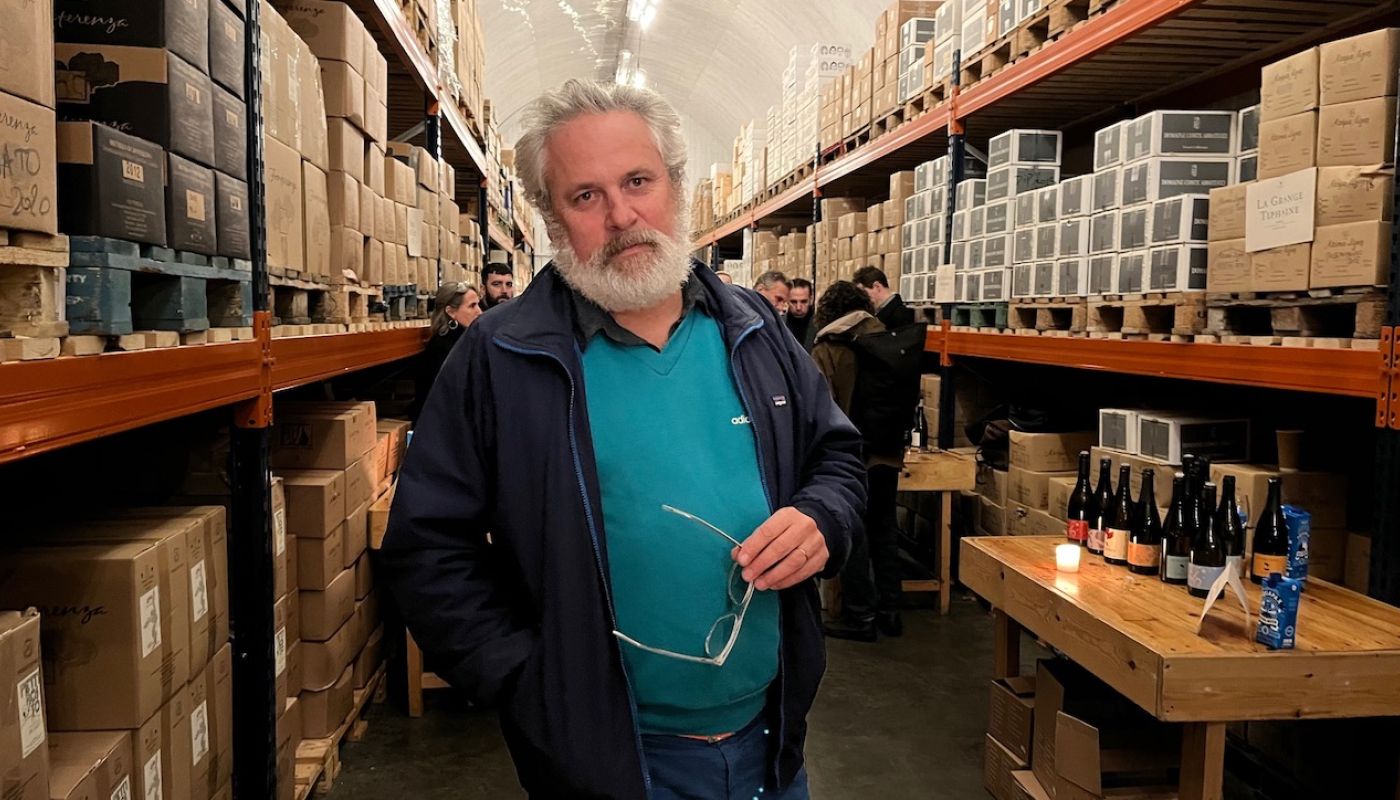
‘Don’t filter your wine. Filter your customers.’ This is clearly the most valuable bit of advice received by artist Fabrice Domercq, since he quoted it to me each time we met recently – once at a tasting of his no-additive wines organised by their UK importer Dynamic Vines (see above) and then at a subsequent meeting I arranged because I was so intrigued by his story and its relevance to Bordeaux’s current crisis whereby all but the top layer of châteaux are running at a loss because demand for basic bordeaux has fallen to such an extent. The French government recently agreed to pay growers to distill surplus wine into alcohol and to pull out vines in uneconomic locations.
Domercq was born in Paris in 1965 and as a young adult making his way in the world of art and design was drawn to Italy, where he spent 15 formative years ‘discovering love, food and wine’. He decided in the 1990s that ‘the best way to do industrial design was not to do any design. I started to do things with my hands and some people decided it was art – so it was a good period for me as an artist.’ His work has been exhibited, inter alia, at the Musée des Arts Décoratifs and Fondation Cartier in Paris and he continues to create at home in Brussels, where he now lives with this Belgian wife and family, ‘not in a studio but always at the kitchen table. An onion skin can be as rich as marble – it’s just a matter of scale’.
What turned him into a vintner was his mother’s purchase in 2006 of a house on the banks of the Dordogne on the northern edge of Bordeaux’s Entre-Deux-Mers wine region. ‘It was a very beautiful old wine house, very isolated’, he says, and it came with four hectares (10 acres) of vineyards whose produce had until then been sent straight to the local co-op.
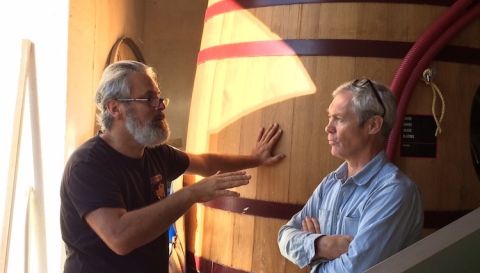
‘So then I thought, “why not try to create wine?”’, recounts Domercq. His first reaction was to call one of the best friends he made in Milan in the 1980s, the industrial designer Jasper Morrison, seen on the right above. ‘We’re both a bit crazy and love to do things together.’ (Domercq went to stay with Morrison for a few days after the Dynamic Vines tasting.)
They started with a plot of just 0.6 ha (1.5 acres) of vines. ‘We knew nothing about wine except drinking it. That was a good thing because if I’d known what was involved in producing wine, I’d never have started. But it all came very naturally.’
He was helped initially by an older friend, Béarn vintner Paul Bordes, who would come to Bordeaux to consult informally with some other wine producers. At the end of a long day visiting châteaux, Bordes would drop in on Domercq to taste his young juices. ‘As I knew nothing, I was a very good pupil’, Domercq says now.
A name was chosen for the business – Ormiale – apparently an amalgam of the names of Domercq’s sons Igor, Alexandre and Achille and Morrison’s son Milo.
Morrison moved to Japan early on in the enterprise so became less involved but Domercq stuck with it, and found himself commuting more than 900 km (560 miles) from Brussels to oversee this new project solo, for he still does an astonishing amount himself, even wrapping each bottle in tissue paper. ‘It’s a way for me to create something from A to Z.’
His customer filtration came into effect as early as 2009 when he had made only a handful of vintages. Bordeaux négociant Jeffrey Davies, who specialised in promoting ‘garage wines’ (small-production discoveries), not least to American wine guru Robert Parker, became aware of Domercq’s work. They met in a car park in St-Émilion where Davies stuffed Domercq’s wine samples into the paniers of his Harley-Davidson. Having tasted the wines and agreed a price, Davies offered to take the wines on board and sell them to the rising tide of Chinese fine-wine buyers. Domercq declined, having doubts about the négociant’s motivation. ‘Coming from the art world’, he explained, tapping his nose enigmatically, ‘I have a nose.’
Despite this he slowly built up an international network of importers, in Belgium of course, but also the UK, US, Canada, Brazil, Australia, Singapore, Thailand, Japan, Korea, Austria, Switzerland, Germany, Greece, Ireland, Italy, Luxembourg, Norway and Sweden, according to the Ormiale website – though how he manages to service all these markets with an annual production of only about 6,000 bottles of the wines shown below, I cannot imagine.
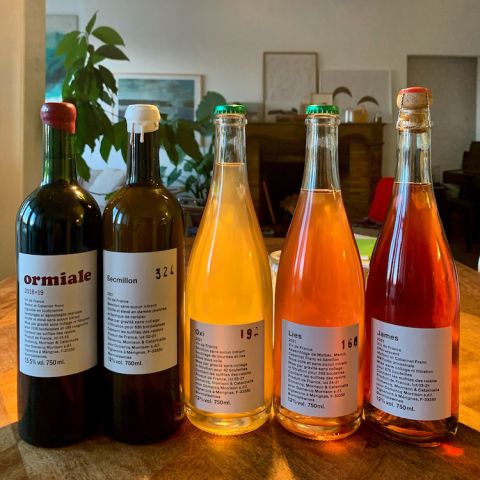
What is clear is that he sells less than 10% of his production in France itself, which may be why so few French people seem to have heard of Ormiale. ‘I never felt involved in the Bordeaux wine scene’, he told me with some pride. And indeed when I asked around fellow wine producers in Bordeaux, none of them had heard of either him or the wine.
His professional life changed entirely in 2013 when a truly terrible growing season (as proved by my recent ‘ten years on’ tasting) drove him to a nervous breakdown. He decided he wanted to divest himself of the responsibilities involved in managing a vineyard from more than 900 km away. ‘I don’t see the vigneron as a mythic figure. I don’t want to be chained to the vineyard, not having holidays. So I put together an approach for myself. All the grapes from the family vineyard would go to the co-op and I decided I would just make sure to get fantastic biodynamically grown grapes, wherever they come from. It could be five minutes or an hour away. So now I’m very much free. In 2020 for instance I decided not to make any wine because I could see some juices were going to make 17% alcohol wines, even if we picked early. I have no loan on my back so I could afford to do without that stress.’
In response to this uncomfortably ripe vintage, Domercq says he went in search of a way of imbuing his wines with freshness. By a huge stroke of luck, he came across an old man with an abandoned 16th-century limestone quarry for rent right in the heart of St-Émilion. He speaks tenderly of the evidence of all the hard work the quarry has seen over the years. Work is clearly important to him. ‘I wish I could be lazy but I haven’t mastered that yet’, he says.
It has a cool courtyard for both receiving grapes and Ormiale’s USP – the painstaking business of destemming every grape by hand, as recommended by the famous Petrus winemaker Jean-Claude Berrouet, who promised him, ‘if you have shoulders big enough it’s unbeatable’. Hours of manual work keep berries whole but eliminates the harsh stems and the ‘brush’ of grape flesh attached to them.

It also has 200 m2 (2,150 ft2) of even cooler caves that maintain constant high humidity and a temperature as low as 10 °C. ‘The barrels are always damp’, he told me excitedly, ‘and the yeast work so slowly and fermentations take so many weeks that the extraction is so gentle. Beforehand I would never have imagined the impact on the juices of this setting.’ He has made his 2021s and 2022s here, helped at harvest time by a troop of friends from all over the world whom he accommodates in the family house in Entre-Deux-Mers and to whom he serves Ormiale wines – ‘not some shitty rosé’.
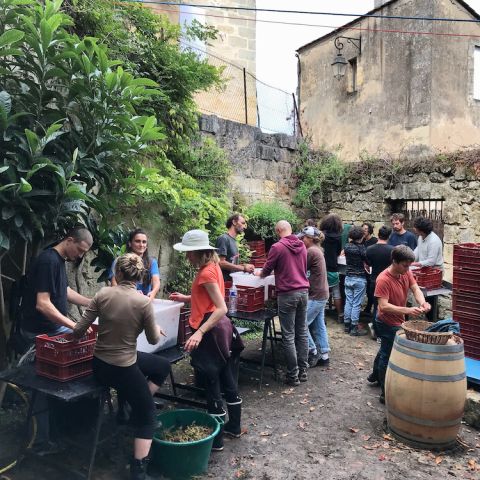
Because his harvest team, seen above hard at work destemming, have to be summoned from so many different locations at least three weeks in advance, it can be difficult to choose exactly when to pick. ‘But it’s part of the way we do things. And at least it keeps us away from the local St-Émilion sport of seeing who can be the last to pick and end up with a wine at 18% alcohol.’
From 2019 he has bought all his grapes from a biodynamic grower in Castillon, ‘the closest bit to St-Émilion’. The tragedy for Bordeaux is how easy it is for someone like Domercq to buy top-quality grapes. ‘Imagine all these grape-growers … They’re not winemakers and the co-op pays them nothing. The co-ops have three vintages in stock waiting for a buyer! A 900-litre [238 gal] tonneau of Bordeaux Supérieur sells for €700, maybe as little as €500. But I can pay the growers on 1 December or 1 January and they’re delighted. The Bordeaux crisis is very good for me. But it’s a terrible situation.’
Domercq’s advice for any ambitious young winemaker anywhere in the world is that they should come to Bordeaux and take advantage of the current parlous state of affairs for growers there. ‘Land’s only €15,000 a hectare here, and houses are cheap too. All the natural-wine people want to set up in Jura or Loire but they should come to Bordeaux.’
Ormiale wines, including a rather delicious waste-not-want-not £68 one called Lies made from all the lees and sediment from his 2021 vintage aged under flor in fibreglass, sell for up to £125 a bottle.
Great-value bordeaux clearly exists substantially because of the doldrums in the lower reaches of the bordeaux market. The Wine Society regularly offer such bargains and Haynes Hanson & Clark have recently been on a very successful fishing expedition. See their current offers of Ch Frontenac 2019 at £10.95 per single bottle, Ch Les Marcieux 2018 at £12.15 and, especially, Ch Coustolle 2016 at £13. Prices per case are even lower. It’s all a very sad state of affairs for the less-celebrated growers of a celebrated region.
See my tasting notes on the biodynamic wines from France and Spain recently shown by Dynamic Vines, including those of Ormiale.













