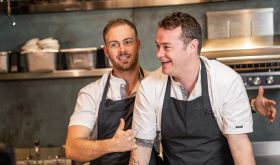
Alain Senderens, the renowned French chef who last year handed back his three Michelin stars, was waiting for me at the top of the stairs looking remarkably relaxed. And, perhaps more surprisingly given that this was shortly before lunchtime, he was not even wearing his chef’s whites. “Thank you,” he replied when I remarked on his surprising demeanour. “I must say that ever since I decided on this course of action I have felt twenty years younger”.
When I first heard of this decision, which also included changing the name of the famous Paris restaurant from Lucas Carton to Senderens, I was intrigued because Senderens has always displayed a distinctly cerebral approach to cooking, one that has looked back to the writings of Apicius, the Roman cookery writer of the 1st century AD, for inspiration and always sought empathy with the wines he has served. I wanted to discover what would, I was sure, have been the sound, logical reasons for this move and what, after several months, had been the financial consequences.
The most obvious consequence is that Senderens has not converted this elegant, Art Deco dining room into a brasserie or a bistro. Instead, there have been a series of conspicuous additions to the walls and ceiling; the tables and chairs are ultra-modern; lighting has been added behind panels on the walls and underneath the tables and there are no linen cloths on the almost formica-like tables. It is a redesign which had more detractors than supporters among our table of six and is not one which will leave anyone indifferent.
Nor does the menu play safe in any way. A slice of foie gras sits in a clear soup with Chinese spices; warm oysters are served with hazelnuts and a sherry butter; slightly over-salted cod comes with black truffles and a green salad. The duck Apicius, the combination of Fourme d’Ambert cheese and spicy, toasted brioche studded with cherries, and the mille-feuille with Tahitian vanilla are still on the menu – albeit in modified, considerably cheaper versions. The service from a young team is enthusiastic if a little too casual and heavy handed.
Prices and decor aside, there are two further obvious, hugely admirable changes. The first is that all of the 19 dishes on the menu now come with a particularly suitable liquid partner proposed by the glass. An eclectic choice ranges from Talisker 10 year old whisky with the restaurant’s own smoked salmon to Coche-Dury’s Bourgogne Blanc 2003 with the langoustines, and a glass of Commandaria from Cyprus with the duck. This arrangement has proved so popular that over 80 per cent of customers look no further.
But those that do face a fascinating wine list because Senderens’s two young sommeliers have chosen ten whites and reds to meet each of six different price points, at 32, 43, 54, 66, 79 and 96 euros. As price invariably dictates the customer’s wine choice this policy is extremely user-friendly. There are more expensive wines at the end but they are unlikely to offer such excellent value for money.
And value for money seems to have been at the back of Senderens’ mind for some time. “I have been thinking about this change for the past two and a half years. I had begun to appreciate that the luxury end of the restaurant market has always been driven by tourists and by Americans in particular but after 9/11 they stopped coming to Paris in the same numbers. Then I began to look at what I was spending on all those luxuries which were simply not contributing to the flavour of my cooking – the flowers, the linen, the large, unnecessarily expensive wine glasses and the serving plates – and I realised that I was spending 3,000 euros a month on all of these. And then I was asking my customers to pay for all these within what was then an average bill of 300 euros per person.
“So this was my overriding intention, to get rid of all the superfluous luxury items. That’s why I even changed the restaurant’s name because it too was associated with a luxurious past. But I still want to retain the sense of a restaurant, not a bistro or brasserie, because I want to provide the opportunity for so many young, talented chefs to cook this type of food, for there to be something between what is invariably available in a bistro and an ultra-luxurious setting invariably now found in an hotel.
“I am 65,” Senderens continued with a smile, “and suddenly I have discovered a new aspect to being a chef/proprietor after more than 40 years in the business. Today, I’m a cost killer. Initially, it was a question of substituting ingredients, for example using monkfish instead of turbot, or a Challans chicken instead of the more expensive Bresse chicken. But now I look at every recipe to see whether it really needs two chefs to make it or not.”
My request for financial information was greeted by the arrival of Daniel Angé, Senderens’ long time management accountant, who happily revealed that under the new identity turnover was averaging 540,000 euros a month excluding tax and service; that the average number of covers per evening had doubled from 60 to 120 but the average spend had fallen from 300 to 110 euros although now the restaurant was open seven days a week rather than just five. In the kitchens, where the changes had been warmly greeted and the same brigade is still cooking, they now operate a new, unusual rota of three days on followed by three days off. Operating costs are substantially lower and the restaurant is far more profitable.
“Some people thought I was taking a gamble but deep down I knew it wasn’t too much of a risk,” Senderens continued, “because I knew that most Parisians would want to come and eat here at least once which would give the business a good start. But I wasn’t prepared for the coverage outside France.
“And there have been two other unforeseen benefits. The first is that I now have a much closer rapport with my customers, of whom about 60 per cent are old clients. Now when they see me they call me over, ask me to sit down with them and have a glass of wine which never used to happen in the past, as though the three stars were an invisible barrier. And this new approach is changing the way I look at and appreciate wine. In the past we never seemed to look beyond les grands vins, the expensive wines of Bordeaux, Burgundy and Champagne, because most people came here on a special occasion. Now I’m continually tasting less expensive but really good wines and their range of flavours are making me look for and create new dishes. We’re tasting 30 to 40 wines this afternoon if you would like to stay.”
I declined reluctantly but instead ventured to suggest that Senderens should also abandon the practice of priced and unpriced menus, an obvious hangover from the old days. He thought about this for 30 seconds, then called over Margot, his PA, and asked her to ensure that all menus from that evening onwards would be priced.
In this, and many other respects, I hope many French chefs will follow where Alain Senderens has chosen to lead.
Senderens 9, place de la Madeleine, 75008 Paris, 01.42.65.22.90.
Open 7 days lunch and dinner.