Teutonic Pinots

This is a longer version of an article that also appeared in the Financial Times. See also my tasting notes on a range of top Austrian Pinot Noirs and St Laurents.
The price of top red burgundy has followed that of top red bordeaux through the roof. In view of this unpalatable development, lovers of good to great Pinot Noir may like to consider some of the alternative sources. Granted, although the quality of their Pinots has soared, none of Oregon, California, New Zealand and Australia can boast seven centuries of growing the red burgundy grape. But Germany and Austria can, just like Burgundy.
Medieval monks may have introduced the Pinot Noir vine, variously called Spätburgunder and Blauburgunder in German, to Germany and Austria by the end of the 14th century, and it's perfectly possible that the wines produced from it were delicious then. But they certainly weren't that great in the late 20th century. In my experience, the Pinot Noir made in Germany then was, typically, a sort of greyish pink, pretty tart, and also sweet so as to disguise the taste of rot. But then global warming helped solve this problem. German summers got hotter and drier. Far more Pinot Noir grapes ripened fully and healthily so the quality of the raw material improved immensely. But wine drinkers were not always able to savour their charms.
Riper grapes coincided with the world's wine producers' love affair with new oak barrels. Wine drinkers in Germany became keener and keener on red wines and Pinot Noir plantings soared so that by the early 21st century it was the country's third most planted grape variety and is set to overtake Müller Thurgau any minute. But for quite a time the seductive perfume of Pinot Noir was submerged by the straitjacket of toasty oak in too many German examples. It has been only relatively recently that the oak tide has receded and a good proportion of Germany's Spätburgunder producers, who often use the term Pinot Noir on their labels, make really well balanced, expressive answers to red burgundy.
Germany has recently lost no fewer than three of its most accomplished Pinot Noir practitioners, all of them relatively young: in the Pinot hotspot of the Ahr Valley, Gerhard 'Jean' Stodden and Wolfgang Hehle of Deutzerhof, and Bernhard Huber of Malterdingen in Baden. But their families will doubtless continue their glorious track records. And there are many others carrying the German Pinot torch such as Rudolf Fürst of Franken, the Gutzlers of Rheinhessen, the Näkels of the Ahr, and Hanspeter Ziereisen of Baden. Germany does now produce top-quality Pinot Noir, much of it at prices lower than comparable burgundy. (Our German specialist Michael Schmidt cites Huber, Fürst, Stodden, Knipser and Molitor as his most obvious favourite German Pinot producers.)
And what about Austria? Pinot Noir is not nearly as important there, but none is ridiculously expensive. Austria, until recently associated more readily with fine white wines, is also enjoying a red-wine renaissance but has its own rather winning red-wine grapes. In declining order of area planted they are Zweigelt, Blaufränkisch, Portugieser, Blauburger and St Laurent – all of which, as well as Merlot and Cabernet Sauvignon, are more common than the delicate Pinot Noir grape.
Zweigelt is a juicy-fruited, thoroughly Austrian cross of St Laurent and rising star Blaufränkisch that combines the very 21st-century attributes of refreshment with precise terroir variation. The waning Portugieser makes rather undistinguished wine and is a parent with Blaufränkisch of the deeply coloured Blauburger. St Laurent is an Austrian speciality also found in the Czech Republic, Slovakia and southern Germany. Its origins have long been disputed but grape geneticists at New Zealand's Otago University reckon they have just proved that St Laurent is the progeny of Pinot and the Jura white grape Savagnin.
I recently tasted 28 examples of Austria's best 2011 Pinot Noirs, immediately followed by 11 of the best St Laurents from the same vintage, and I must say that I was struck by how dissimilar the two varieties tasted. These Austrian Pinot Noirs were very recognisably varietal with the sweet fruit of Pinot and, in the best examples, haunting Pinot perfumes ranging from ferns, violets and herbs to sweet red fruits, mushrooms and mineral stoniness. They may not have been quite as complex as Germany's finest and definitely not as refined as Burgundy's best but, for what it's worth, I marked several of them 17 out of 20.
Most of the least successful Austrian Pinots exhibited the besetting sin of so many Austrian reds in the last decade or two: excessive oak with, in some cases, the tell-tale aroma of a Frappuccino, which suggests over-toasted oak. There were also some that suggested their makers think that heavy extraction and brutal concentration provide the shortest routes to Pinot greatness. These were the Pinots that were most like the St Laurents that followed, but in general the St Laurents were very much darker and bluer than the Pinots, much less subtle and in many cases had a relatively sour finish.
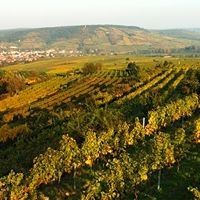
There was little correlation in this collection between Pinot Noir quality and its geographical origins, although none of my favourites came from the very hottest corners of the country. My four 17 pointers were grown in four completely different regions. One of my favourites was the fragrant, feather-light Black Edition example from Ebner-Ebenauer in the Weinviertel, not an area readily associated with Pinot Noir. I'm not sure I approve of the label design with its black lettering on a black label, but I certainly approve of the result of applying thoroughly burgundian hands-off techniques in the winery. Fred Loimer's biodynamic example from the Dechant vineyard (pictured) overlooking the wine centre of Langenlois comes from Kamptal just north of the Danube upstream of Vienna and was completely different in style, all energy, pzazz, super-ripe fruit but well-judged oak.
Gerhard Markowitsch of Carnuntum is already established as a respected Pinot Noir producer and his 2011 Reserve from the limestone-rich Scheibner vineyard showed impressive confidence and, surely, some stony influence of the local conditions. And finally, Wieninger, whose vineyards are on the edge of Vienna itself, is another Austrian vintner to have carved out a niche for his Pinot Noir already. His Grand Select 2011, also grown on limestone, the Bisamberg vineyard this time, was no shy, retiring flower but it carried its 14% alcohol well and actually had some of the delicacy that is a mark of great Pinot Noir. It was not excessively showy on the nose, but built appetisingly towards a thrillingly pure finish – another burgundian characteristic.
But it is of course wrong to judge all Pinot Noir by Burgundian standards. Doubtless both Germany and Austria will continue to educate us in their own particular styles.
TOP AUSTRIAN PINOTS
I scored all of these 2011 Austrian Pinot Noirs 17/20 in a recent tasting celebrating Austrian red wines' coming of age at VieVinum, Vienna's biennial wine fair. Prices are sterling equivalents of what they sell for in Austria.
Ebner-Ebenauer, Black Edition, Niederösterreich £25-30
Fred Loimer, Langelois Ried Dechant, Niederösterreich €25 from his website (about £20)
Gerhard Markowitsch, Reserve, Niederösterreich £20-30 currently available in Austria, Germany and Quebec)
Wieninger, Grand Select, Vienna £28-30
The photo above shows Loimer's Dechant vineyard (courtesy of the producer's website).


- Access 297,330 wine reviews & 16,161 articles
- Access The Oxford Companion to Wine & The World Atlas of Wine
- Access askJancis, our AI wine assistant


Everything in “Member”, plus:
- Early access to the latest wine reviews, 48 hours in advance
- Early access to the latest articles, 48 hours in advance
- Access 297,330 wine reviews & 16,161 articles
- Access The Oxford Companion to Wine & The World Atlas of Wine
- Access askJancis, our AI wine assistant
- Early access to the latest wine reviews & articles, 48 hours in advance
- Commercial use of up to 25 wine reviews & scores for marketing
Everything in “Professional”, plus:
- Commercial use of up to 250 wine reviews & scores for marketing
- Access to submit wines for review
- Offer memberships to your employees and manage them from a single place
- API access available for an additional fee
More Free for all




More from JancisRobinson.com