
I've fallen in love with a grape variety that's entirely new to me. I can neither pronounce nor spell it with ease in its native language but am told that its name translates as Bullseye, which strikes me as a pretty good name for a red wine that is round and fruity, with so much charm that it makes you smile when you taste it. Certainly better on export markets, I would have thought, than its more common name, Öküzgözü.
But this was only one of many new grape variety friends I made on a recent short trip to Turkey which is, believe it or not, rapidly developing a wine culture. The number of Turks who have signed up for wine courses is now comfortably into four figures. Şeyla Ergenekon's Guide to Turkish Wines, the first such book in English, profiles 35 wineries but there is now a positive rash of new ones funded by Turks who have made a fortune in other business (textiles to wine is particularly a common route). Istanbul's host of smart, modern restaurants provide the chief showcase for Turkey's new wines – indeed the biggest producers fall over each other in their efforts to secure listings in them.
One young couple is attempting to instil a spirit of co-operation into the cut-throat Turkish wine business by establishing a generic body, Wines of Turkey. They managed to persuade 10 Turkish wine producers to exhibit together at the London Wine Trade Fair last year but this year there was but one, Likya, a promising newcomer at 1,100 m above the holiday destination of Antalya. It must be hard to try to establish an official wine organisation in a Muslim country. The government is more of a hindrance than a help to the industry, levying a 63% ad valorem tax on all wines before VAT. So, for the moment, Turkish wines seem expensive in Turkey, and even the most optimistic modern Turkish wine producer admits that Turkey cannot compete on price.
But there are other reasons why the world's wine lovers might start to take an interest in the rapidly improving wines of modern Turkey. Although the country is one of the world's most important grape growers, only a tiny proportion of these grapes is fermented into wine and the old Ottoman winemaking traditions left with the Armenians and Greeks in the 1920s. On the basis of those few Turkish wines that had come my way over the years, I approached my three-day immersion in Turkish wine with low expectations, but a tasting of 50 of the best current releases was heartening. There were a couple of rather rustic, astringent whites, some evidence of the over-oaking that is a rite of passage for any new wine producer and a few rather dull, unambitious wines that hinted at over-production in the vineyard. However, the majority of the wines were very competently made, and what I saw in vineyards and cellars on two subsequent days out of Istanbul suggested that it will not be long before Turkey produces something truly exceptional.
While there has been a recent tendency among Turks to revere the well known international grape varieties at the expense of local specialities, I suspect that educated, non-Turkish palates may well be more tickled by the local likes of Emir and Narince for whites and Kalecik Karası, Karalahna and especially Öküzgözü for reds. Many of Turkey's grape varieties seem to have originated in the area where Anatolia, Armenia and Georgia meet that has been identified as the cradle of the world's viticulture. DNA analysis of scores of vine varieties from this region was made in 2005 and found them much more closely related to each other than previously thought. These varieties may well turn out to be much more than oddities; they may well help us untangle the complex web of Europe's Vitis vinifera, the vine species responsible for wine.
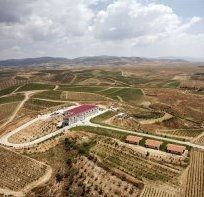
What really surprises me about the super juicy Öküzgözü from eastern Anatolia is that apparently the grapes themselves are rather big (usually a bad sign for wine quality since flavour derives from grape skins not flesh) and also do duty as table grapes, another contra-indication for wine quality. But apparently I am not alone in my enthusiasm for it. The admired Bordeaux wine consultant Stéphane Derenoncourt was brought in to advise one of the biggest Turkish wine companies Kavaklidere on an ambitious new 175-hectare estate, Pendore, on rolling hills inland from Izmir on the Aegean coast (pictured). When Kavaklidere wines were shown in Bordeaux during primeurs week in April, it was Öküzgözü that was particularly appreciated, I'm told.
Derenoncourt is also a fan of Öküzgözü's traditional blending partner Boğazkere, another variety originally from eastern Anatolia. I was struck by Boğazkere's famously vicious tannins and can see the logic of trying to disguise them with the much plumper, fresher Öküzgözü in young wines. This was traditionally done by Tekel, until 2004 the state monopoly that set the price of grapes for private producers and mopped up the leftovers, in its memorably named brand Buzbağ. The Buzbağ Reserve 2005 from Tekel's successor Mey-Kayra is certainly a big step up from the Buzbağ I remember from the early 1970s, but I still need some tutoring in the merits of aged Boğazkere.
Kalecik Karası is another local grape with a strong personality, a sweet, relatively simple speciality from Kalecik north of the capital Ankara that was revived by the local university and Kavaklidere in the late 1980s and is now fashionable with Turkish wine drinkers, along with the likes of Kayra Imperial Shiraz whose claim to fame is that it is on the wine list at The Fat Duck in England (whose sommelier happens to be Turkish). As Mehmet Başman, current head of Kavaklidere, says of trend-conscious modern Turkish wine drinkers, 'Turks taste via their ears'.
Oddly enough, Turks themselves are quite keen on whites produced from their humble and widely planted Sultana grape (known as Thompson Seedless in California) that is really better at being dried than fermented. Much more interesting for white wine are Emir, a native of the extraordinary landscape of Christian Cappadocia, that can make firm, mineral-scented dry whites, and the rather more fragile Narince from the far north east of Turkey.
Battling against the might of the dominant producers Kavaklidere and Doluca with their many labels are new wave 'boutique' producers such as Reşit Soley of Corvus. He gave up his career as one of Turkey's most famous architects to establish a new vineyard on the ancient, wine-producing island of Bozcaada within sight of Gallipoli. Like most producers, he also buys in grapes although fortunately for him most of the ancient vineyards from which he buys have naturally low yields so he does not have to battle against the general tendency of grape growers to over-produce. Along with his own young plantings, he is deliberately blending and showcasing some of the island's own grape varieties such as Vasilaki, Kundra and Karalahna (Greece's Xynomavro), as well as making a creditable white from the table grape Çavus.
Turkish wines can delight nowadays.
The following wines are those I gave at last 16 points out of 20 to in my tasting of 50 of Turkey's better wines in Istanbul. See also my complete set of 80 tasting notes.
Kocabağ 2007 Emir 16 Drink 2009-??
Sevilen 2007 Premium Chardonnay 16 Drink 2009-11
Diren 2007 Selection Beyaz 16 Drink 2009-10
Turasan 2007 Seneler Narince 16 Drink 2009-11
Sevilen 2008 R Syrah-Cabernet Sauvignon Rosé 16 Drink 2009
Kocabağ 2007 Kalecik Karası 16 Drink 2008-10
Gülor 2005 Sangiovese-Montepulciano 16 Drink 2008-10
Melen 2006 Öküzgözü Rezerve 16 Drink 2008-11
Büyülübağ 2005 Cabernet Sauvignon 16- Drink 2009-12
Büyülübağ 2005 Cabernet Sauvignon Reserve 16.5 Drink 2008-14
Talay 2006 Cab Sauvignon Merlot 16 Drınk 2008-11
Corvus 2004 Corpus 16.5 Drink 2009-13
Melen 2007 Ganohora Merlot 16 Drink 2009-11
Likya 2007 Kızılbel Cabernet Sauvignon/Boğazkere 16 Drink 2011-14
Diren 2007 Selection Kırmızı 16 Drink 2009-11
Corvus 2004 Blend #1 16.5 Drink 2009-13
Corvus 2005 Blend #2 16 Drink 2009-11
Prodom 2006 Syrah-Petit Verdot-Cabernet Franc 16 Drink 2009-12
Urlice 2005 Merlot-Shiraz 16 Drink 2008-12
Likya 2007 Kızılbel Merlot-Syrah-Öküzgözü 16 Drink 2009-11
Mey Kayra 2005 Imperial Shiraz 16.5 Drink 2008-12
Pamukkale 2005 Anfora Shiraz 16 Drink 2008-11
Mey Kayra 2007 Vintage Shiraz/Petit Verdot 16 Drink 2010-13
Corvus 2004 Öküzgözü-Boğazkere 16 Drink 2006-09
Mey Kayra 2005 Buzbağ Rezerv 16 Drink 2007-09













