The importance of scores to those buying and selling wine is understandable but regrettable.
In the years around the turn of the century when demand for young bordeaux offered en primeur (long before it was even bottled) was red hot, these numbers helped impatient buyers make decisions. And they were especially helpful to those whose native language wasn’t English, the language of most tasting notes.
Today, that demand is not red hot but almost frigid (though we’ll see what happens to the Bordeaux 2025 en primeur campaign later this month) and scores seem rather old-fashioned and questionable – especially when they are applied to cask samples that may not even represent the final blend.
At JancisRobinson.com we’re no great fans of scores but I have to admit they do focus the mind and palate when we taste, so we continue doggedly to score every individual bottle we taste, and out of 20 rather than the usual, US-inspired, 100. This may well frustrate some followers of the wine market but what seems to annoy some wine drinkers even more is that they encounter different scores for the same wine in our tasting notes database.
I do sympathise with the desire to have a single objective measurement of a wine’s quality but it’s just not possible. Without even checking, in very recent experience I can think of two completely different bottles of Château Lafite 1982, and point out that in our annual professional tastings of about 250 four-year-old bordeaux, we usually have to open second bottles of between five and 10 of them, so atypical do the first examples taste.
Apart from the cheapest, pasteurised examples, wine is a living thing. Just like cheese. One of the nine Masters of Wine on our team, Andrew Howard, observed recently, ‘To an extent every single bottle varies. Before I managed to get into the world of wine, I spent many years buying cheese for M&S [Marks & Spencer]. We did a lot of work which had extremely tight controls in production terms, at a very large creamery. We developed the recipe for what is sold today as Vintage Cheddar. Despite the precision of production and all the controls we utilised, every single 20-kg block of cheddar was subtly different and individual. Each was a living, evolving thing. So, wine bottle variation is always going to be there.’
Another Master of Wine Barry Dick was a food scientist before spending many years as a winemaker and specialist in wine quality control. He devoted his MW thesis to the results of monitoring wine temperatures in shipping containers. When I asked him to outline reasons for bottle variation he came up with four major influences, quite apart from the wine itself.
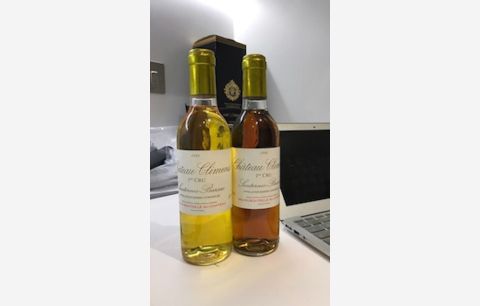
How the bottle is stoppered is a major one, and used to be the most common explanation for rejecting first bottles in our annual bordeaux tasting. Corks are every bit as variable as wine. Natural corks are, after all, just cylinders of cork bark with physical compositions which vary according to how much potentially browning oxygen they let in to the wine. One memorable example was a case of half-bottles of the Sauternes Château Climens 1988 I bought ages ago. The colour of wine in bottles from the same case varied from pale lemon yellow to dark tawny. I had a similar experience with different bottles of Château d’Yquem 1989.
Today’s cork suppliers are much more vigilant about quality than they used to be, however, and so-called technical corks such as Diams claim that their production process both equalises oxygen transmission rates and eliminates the risk of cork taint, a claim echoed by the manufacturers of screwcaps. But I still come across relatively young wines with that telltale smell of mouldy cardboard that signals cork taint. This is clearly a flaw and such a bottle would not be scored but mild cork taint that simply subdues aroma and flavour is by no means always so obvious and is much more insidious. And Kathleen Van den Berghe MW points out in her article earlier this week that, while it may be the most common, cork taint is just one of the haloanisoles that can affect the taste of a wine to a greater or lesser extent.
Dick pointed out how much bottle variation can depend on exactly how and when the wine was bottled. Bottling lines are flushed out with water at the beginning of a run so a very early bottling may dilute the wine to a certain extent, or there may be an adjustment to the level of sulphur dioxide or dissolved gas (some wines are bottled with tiny amounts of carbon dioxide) halfway through the bottling run that effectively creates different batches of the same wine.
‘Any stoppages also introduce risk’, he adds. ‘Dissolved oxygen pickup is significantly higher during starts, stops, and ends. I once saw a batch split by a bank-holiday weekend; they returned to finish it three days later, and needless to say the second half was completely knackered. Cross-contamination when changing between products (white/rosé to red, or even red to red) can introduce obvious variation. Filtration failures – where part of a run is effectively filtered and part is not – is also a common source of microbial differences within a single run, and in the worst cases can result in a portion of the wine having an entirely different microbial profile from the rest.’
Most fine wine is aged for a while in the producer’s cellar after bottling and before shipment. This is typically on pallets, and exactly where a bottle is stored can make a difference if it’s in a particular corner of the pallet that is exposed to strong light, strong smells or extreme temperatures. And wine in clear glass bottles (like so many rosés and quite a number of champagnes) is especially vulnerable to lightstrike, a condition that can imbue a wine with the smell of overcooked cabbage or even sewage. This is the reason for instance that bottles of Louis Roederer’s famous Cristal champagne are wrapped in orange cellophane (incongruously like Lucozade). Prolonged sunlight can damage wine in virtually any colour of bottle; retailers who put their bottles in shop windows, please note.
Both Dick and Tamlyn Currin pointed the finger at the many things that can go wrong when bottles are shipped. (Wine shipped in bulk is even more vulnerable because it is generally exposed to pumps and filters but my subject here is smart wine bottled in the country of origin.) Wine sold at a cellar door near to your home is free of exposure to these risks, but the longer the journey an imported bottle has to travel, the longer it may be exposed to shipping effects such as variations in temperature and exposure to light.
As Tam points out, the time of year that bottles are shipped can make a difference, with bottles on the outside of pallets running the risk of being more exposed to extreme temperatures than those in the middle of the pallet. According to Dick, ‘The most common problems occur at trans-shipment hubs, where containers left on a dockside in summer heat can experience extreme thermal stress, particularly in the top layers beneath a hot tin roof. The opposite is true in winter, when extreme cold can cause its own form of thermal stress.’
And it is not the case that two bottles of fine wine on a list or shelf will necessarily have been in exactly the same shipment. Regulatory changes, increases in tariffs, confusion at customs, drivers’ visas, and the increasingly complex accompanying paperwork can all make a difference between shipments. ‘As we have all seen with Brexit’, observes Tam, ‘this might mean that pallets of wine sit in trucks or on ships or in dockyards, freezing or cooking for weeks or months’, adding, ‘Few importers are going to admit this.’
But even if bottles were in the same shipment, they may have encountered quite different conditions. According to Dick, ‘Containers may be stored in different positions on a vessel – above or below the waterline, exposed to sun or not, near the engine or not. All of this means that different containers can be exposed to more or less temperature stress or exposure to airborne contaminants.’ This is why conscientious importers insist on temperature-controlled reefers, but they are not cheap.
Our Ferran, former elBulli sommelier, identifies a particular conundrum: ‘For me, the craziest thing was the Burgundy wines from the 2000s, especially the Chardonnays. At elBulli, we had many bottles from that period, and something fascinating would happen: a bottle could show an intense honeyed character – so strong that you couldn’t serve it – and yet, a year later, that same evolution had completely disappeared. It’s a phenomenon that has always obsessed me: the ability of that honeyed note to come and go within the same bottle.
‘One possible explanation could be certain Strecker aldehydes – compounds that give honey-like aromas but are highly unstable during the wine’s ageing process, appearing and disappearing over time. Such a fascinating topic.’
Despite all these reasons why bottles of supposedly the same wine may vary, I am certainly not excusing us tasters. Like it or not, tasting is a subjective process. We may well be (unknowingly) influenced, however hard we try, by our mood, our health, and various prejudices (which last factor makes me seize any chance to evaluate wines blind, without a look at the label).
And then of course there is wine and time, for wine so often changes in the bottle, as I pointed out last week in relation to Sassicaia 2023. Wines can evolve considerably, for better in the case of good ones or worse in the case of inconsequential or very fragile old ones, when exposed to oxygen. This is why it can pay off to decant a young, reticent wine. Aeration – pouring it vigorously into another clean, inert container (it doesn’t have to be a decanter) – can really bring it to life by accelerating its evolution. Just pulling the cork, on the other hand, won’t expose enough of the wine to air to make much difference. A tasting note and score written as soon as the bottle is opened may differ from an assessment of the wine 24 hours, or even longer, later.
In an ideal world I would taste every bottle several times, over a prolonged period, and taste several bottles of the same wine. But that would necessarily reduce considerably the number of wines I was physically able to review. For the moment I have to resort to suggesting readers look at the range of scores for a particular wine. If there are lots over 16.5, this is a very good sign, even if there was one disappointing bottle with a lower score.
I’m tempted to suggest abandoning scores altogether but there is an understandable thirst for opinions on wines long before any sensible person would start to drink them.
Perfect wines?
I have so far scored 164 of the 290,000+ wines reviewed on JancisRobinson.com 20/20. (Others on the team have added another 56 perfect scores.) Discounting the Bordeaux first growths and Burgundy grands crus that would be expected to feature, these are some of less obvious and younger (therefore perhaps easier to find) 20-point wines, presented in the order they were tasted, Château Lynch-Bages 1989 most recently.
Château Lynch-Bages 1989 Pauillac
Paul Jaboulet Aîné, La Chapelle 1990 Hermitage Rouge
Bollinger, Vieilles Vignes Françaises Blanc de Noirs 2016 Champagne
Domaine J-F Mugnier, Les Amoureuses Premier Cru 1999 Chambolle-Musigny
Louis Roederer, Cristal Rosé 2008 Champagne
Henschke, Hill of Grace 2008 Eden Valley
Gianfranco Soldera, Soldera Riserva 2004 Brunello di Montalcino
Château Rayas 1998 Châteauneuf-du-Pape Rouge
Château d’Yquem 2001 Sauternes
Château Coutet, Cuvée Madame 2001 Barsac
Domaine Armand Rousseau, Clos St-Jacques Premier Cru 1999 Gevrey-Chambertin
Sassicaia 1985 Bolgheri Sassicaia
Quinta do Noval, Nacional 1963 Port
Dom Leroy, Les Narbantons Premier Cru 1999 Savigny-lès-Beaune
Trimbach, Riesling Clos Ste Hune 1990 Alsace
Egon Müller, Scharzhofberger Riesling Trockenbeerenauslese 2003 Mosel
The image at the top of this article is courtesy of Amorim Cork SA.
For tasting notes and suggested drinking dates, see our tasting notes database. For international stockists, see Wine-Searcher.com.