I wonder whether you ever look at the small print on wine labels? If you do, you may well be a bit puzzled by a recent revolution in the labelling of wines from Europe, two-thirds of world production.
For example, some of the best-value French wines used to be called Vin de Pays, a nice, friendly term that could be translated as 'country wine'. But the EU has decided that a major shake-up in the structure of its wine market is needed to make it more competitive with New World wines (see Will Europe's labels change? ). One of the many results of Brussels' redrawing of its wine policy is that Vins de Pays have generally been replaced by wines with an Indication Géographique Protegée, or IGP. Not nearly as attractive or cosy a term.
In the old days European wine fell into one of three categories. In the most important top drawer were the likes of Appellation d'Origine Contrôlée (AOC) in France and DOC or DOCG in Italy. The smaller middle drawer contained categories such as Vin de Pays in France and Vino de la Tierra in Spain. And what remained was put into the bottom drawer called table wine, known variously as Vin de Table (France), Vino da Tavola (Italy), Vino de Mesa (Spain) and Tafelwein (Germany).
But the drawers have been relabelled. Everything in the top drawer is now described as a PDO, a protected designation of origin. Member countries are free to decide what to do about this new name and many of them seem to be deciding to keep their own old designations such as Appellation d'Origine Contrôlée (which may now be called Appellation d'Origine Protegée, or AOP, instead of AOC), DOC and DOCG. But, terrified by the new edict that any future protected appellations have to be approved by Brussels, the Italians in particular have gone mad and, in advance of the 2011 deadline, created myriad new DOCGs, their own special tip-top drawer. (The C stands for a controlled denomination, the G means that it's not just controlled but guaranteed.) The situation in Spain and Portugal is described by local experts as 'fluid'.
The middle drawer is now known as PGI, protected geographical indication, which translates in French into the IGP referred to above. The Italians have long called wines in this category IGT and will continue to do so, while the Spaniards again seem to favour a pick and mix approach, continuing to use Vino de la Tierra in some regions and IGP in others.
As for the bottom drawer, it may currently represent only a small proportion of total European wine production but it is my strong suspicion that it will become increasingly important. The new EU rules decree that wine at this lowest level should simply be labelled the equivalent of 'wine' in the local language. So, vin, vino, vinho and Wein are the new order of the day (and will perhaps strike the wine drinker as blessedly simple after all these initials) – although the French have decided Vin de France is much more seemly than just 'vin'. In the old days when they were labelled table wine or equivalent, these wines could not officially be labelled with a vintage year or a varietal name such as Cabernet or Pinot Grigio. But, in an attempt to make these wines more saleable, wine producers are now allowed to put both grape names and vintage years on wines in this lowly bottom drawer.
This makes this redesigned category much more interesting for the consumer, and the producer. I have so far tasted several hundred wines labelled Vin de France and, while some are industrial big bottler products too dreary to warrant a tasting note, others are truly exciting wines representing admirable ambition on the part of their producers. Take, for example, Le Retout Blanc 2012. This was made by the owners of Ch du Retout in the Haut-Médoc, a nervy, beeswax-flavoured blend of some of France's most assertive white wine grapes Manseng, Mondeuse Blanche and Savagnin, not one of them sanctioned as an approved variety in Bordeaux. So, the wine has to be (hand) sold as a mere Vin de France.
Or, the delicious red and white Naïck bottlings of Domaine L'Oustal Blanc in Minervois-La Livinière. The red is a blend dominated by the cherry-fruited Cinsault grape while the white is a fair approximation to a grand cru burgundy in terms of structure, but is made mainly from very low-yielding Grenache Gris grapes. None of these assemblages is sanctioned by the local AOC or even IGP rules, so they are sold as Vins de France.
Many of the producers of so-called natural wines , particularly in the Loire Valley, also choose to sell their products as Vin de France, sometimes because they know they are so outré that they would not be passed by the local tasting panel insisted upon by the AOC authorities. But there are good financial reasons a small producer might choose the Vin de France route too.
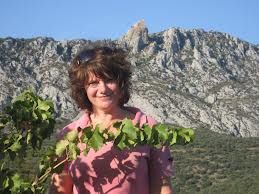
Katie Jones (pictured) of Domaine Jones on the border of Languedoc and Roussillon (the poor Leicester lass whose cave was vandalised last year) has done the maths. For her range of old-vine reds and whites she could label some AOC Fitou, some AOC Languedoc, some AOC Corbières, some IGP Pays d'Oc, and all of them would qualify as Vin de France. Every 'drawer' is managed by a different body, each of them requiring quite hefty cotisations (contributions), so it made sense to plump for one. Vin de France has the most liberal regulations and, in particular, would sanction her delicious 100% varietal bottlings of Grenache Gris, Carignan Gris and Carignan Noir (outlawed by the local AOC and IGP regulations). Furthermore, ' Cotisations are 100 euros for up to 500 hl compared with well over a 1,300 euros for the same quantity of an AOC wine such as Fitou. To be awarded appellation status you also have a one-off audit on your vineyards by a third party to check that you have the correct grape varieties and in the right proportions for another 250 euros. And, with Vin de France, you do not have to wait for wines to be tasted before bottling and selling them, as you do with, for example, IGP Côtes Catalanes, while AOC Fitou take a representative sample from each blend after bottling. The simpler the better!' Her wines are sold by The Wine Society, Naked Wines, Majestic and via www.domainejones.com.
The disadvantage of Vin de France is that some knowledge or research is needed on the part of the consumer to work out where exactly the wines are grown. Producers may put their address on the back label, but if that address includes the protected wine name (an appellation in old parlance), the letters have to be quite small.
I am already seeing an increase in Vin de France listings on smart restaurant wine lists, especially in France of course. But while cavistes can guide us by putting their Vins de France with other wines made in the same part of France, on lists they have to occupy their own rather anonymous section.
SOME FAVOURITE VINS DE FRANCE
WHITES
Maris, Brama Grenache Gris 2011
£40 Armit
Le Retout Blanc 2012
£181 a dozen in bond Fine & Rare
Les Perles de Jones Macabeu 2013
£99 for six www.domainejones.com
Jones, Grenache Gris 2013
£14.95 The Wine Society (2014 will be Vin de France)
L'Oustal Blanc, Naïck Grenache Gris 2011
£14.29 Noel Young Wines
REDS
Les Terrasses de Gabrielle, Wonderland Cabernet Franc 2013
About €7 Vins Etonnants in Limousin, France, and Vins Lacroix in Liège, Belgium
Abbotts & Delaunay, Alto Stratus Carignan 2010
£16.99 Averys of Bristol and Telegraph Wine Club (currently sold out)
Mas Coutelou, 5SO Cinsault 2013 (the name is a pun on 'cinq-so')
£12.95 Roberson