Brunello di Montalcino, Tuscany’s grandest wine zone, has been on a rollercoaster ride, changing immeasurably over the years. The changes seen in the last 10 years or so have been decidedly for the better.
In the 1990s too many of the wine producers seemed to be using Napa Valley Cabernet as their model. Their wines were densely purple, aggressively alcoholic, sweet and oaky – and tasted very unlike the grape from which Brunello is supposed to be made, Sangiovese, the Chianti grape whose attributes are verve and transparency.
Now that the 250-odd wine producers of the hilltop town of Montalcino have voted to insist that their famous Brunello is made from nothing other than Brunello, the local name for Sangiovese, and stylistically freshening winds have blown through the wine world, Brunello di Montalcino is much more likely to be a truly vivacious essence of Tuscany. This lightening and brightening of Brunello has been helped by the widespread return to ageing in large old oak casks rather than applying a layer of sweetness via the new oak of much smaller French barriques.
Chianti Classico, or a superlative Chianti Rufina such as Selvapiana, is the Tuscan red to head for if you are impatient, and/or looking for a bargain. The quality of Chianti Classico is better than it has ever been and the hills of Chiantishire are generally much cooler than the 75 square mile wine zone around Montalcino. This used to be a grave disadvantage. Many years the late-ripening Sangiovese grape struggled to ripen in Chianti Classico’s higher estates, particularly when they were planted with poor-quality clones of Sangiovese.
In today’s world the hot summers of Montalcino in inland southern Tuscany are not necessarily an asset, but when the vines are located in the right site and everything is in the right proportion in the wine, Brunello di Montalcino can be the single most majestic example of Sangiovese while retaining its freshness. This is a wine that can continue to develop in bottle for a decade or two – or many more in the case of Biondi Santi, the patron saint of the zone. The 1994 Brunello Riserva of Gianfranco Soldera, who has been making some of the purest, longest-living Brunellos at his Case Basse estate since this forthright perfectionist arrived in Montalcino from Milan in the 1970s, is just coming into its own now. Brunello is serious Italian wine for the cellar at prices generally a little friendlier than those of the other most obvious candidate Barolo – from about £35 a bottle (although Biondi Santi and, especially, Soldera wines cost far more than this).
I recently had the great pleasure of tasting 44 of the finer examples from the recently released 2012 vintage and was thoroughly impressed – not least because these wines that combined concentrated fruit, tannin and an unexpectedly high level of refreshing acidity are the product of a vintage so badly affected by drought that at the end of August the producers thought they had a dud on their hands. From June until late August Montalcino baked. The tourists who now flock to the medieval hilltop town were forced to take shelter in the enotecas that proliferate in its narrow streets.
The previous winter had been fairly mild, but many growers, such as the Sesti family, believe that the key to the vines’ survival during the drought-ridden summer was the substantial snowfall, a novelty in Montalcino, at the end of the winter, which melted gently into the soil, thereby much more usefully penetrating the soil than sudden rainfall on parched topsoil that can so easily run off. Even so, the dry summer of 2012 stressed the vines considerably and many growers were careful to leave enough leaves on the vine to shade bunches and prevent sunburn, an increasing problem in vineyards in warmer regions today.
In these drought conditions photosynthesis continued at a snail’s pace during the summer but then came refreshing rains at the end of August and a particularly fine September, with a little more, propitiously timed, rain that favoured a steady ripening of fruit and phenolics towards a relatively late harvest. Coolish September nights seem to have preserved lip-smacking levels of acidity and the 2012s I tasted look like promising candidates for ageing. The summer drought resulted in very small berries, however – hence all that concentration – and one of the smallest harvests overall that the region has known.
Alcohol levels (never particularly low in warm Montalcino) were generally 14 to 14.5% although 13.5% is noted on the label of Poggio di Sotto and the decidedly embryonic Biondi Santi 2012 and 15% on that of the concentrated but dynamic Mastrojanni 2012 in Castelnuovo dell’Abate in the far south east of the zone.
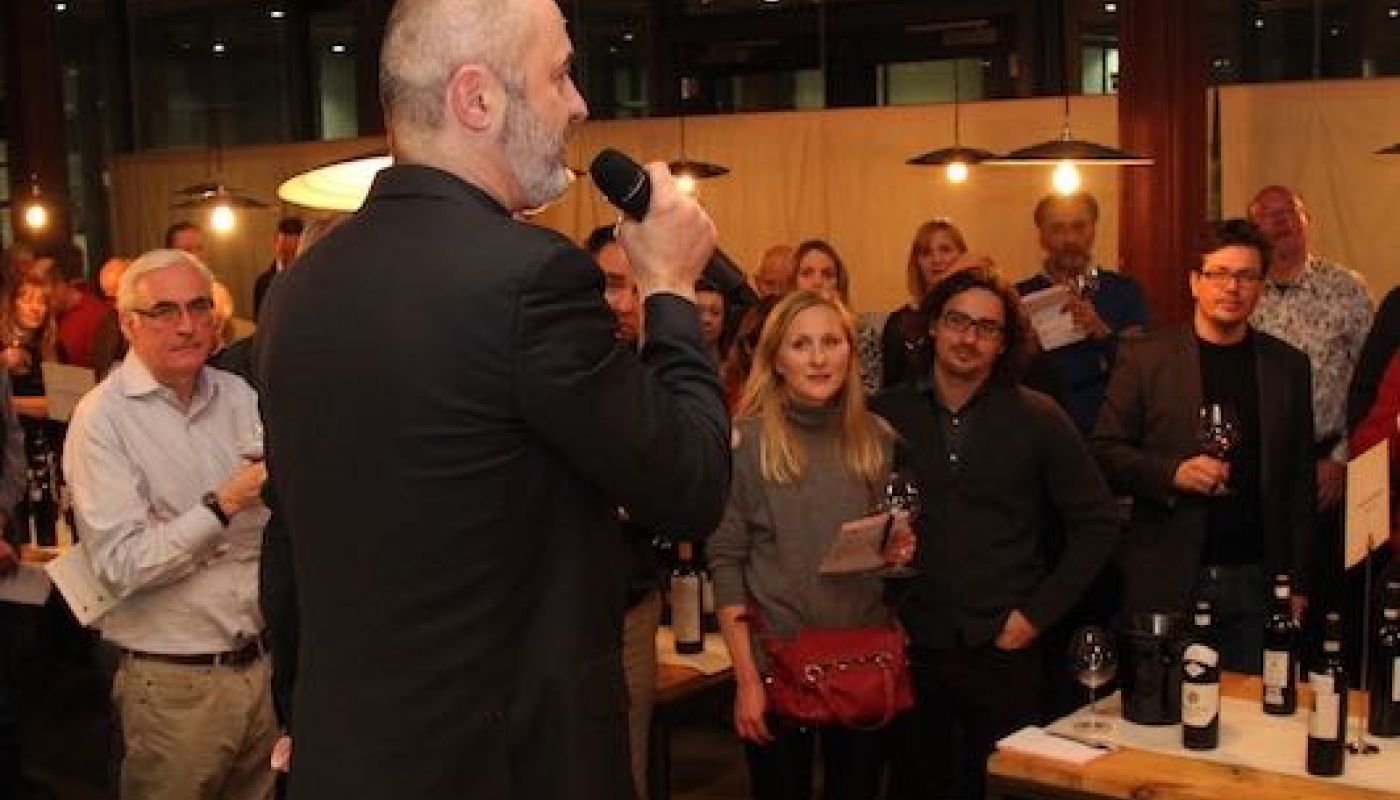
Specialist writers such as Kerin O’Keefe, author of the excellent monograph Brunello di Montalcino – Understanding and Appreciating One of Italy’s Greatest Wines which came out at about the same time as these 2012s were being harvested, and Walter Speller (pictured above addressing the tasters during Brunello Night 2), our Italian specialist, have been arguing for a while that it is high time that subzones were identified in the Brunello di Montalcino zone. In roughly ascending order of body, Walter’s suggestions, which he describes as ‘provocations towards further discussion’, are Comune di Montalcino, Montalcino Nord, Montosoli, Montalcino Sud, Podernovi, Tavernelle, Camigliano, Sant’Angelo and Castelnuovo dell’Abate.
The producers’ association, the Consorzio, is stuck in the middle, listening to calls for subzones (recently backed by Biondi Santi) while trying to pacify producers who fear that their location will count against their reputations. In an area this big, there is inevitable variation: in soil types, aspect, slope and, particularly, elevation. Soldera, for example, maintains that his site, a south-west-facing slope in south-central Tavernelle at about 320 m (1,050 ft), is ideal and that Sangiovese planted higher than this will not ripen fully. Fuligni, on the other hand, whose wines are admittedly more delicate, swear by their 400 m elevation in Montalcino Nord. One sign that geography is playing an increasingly important part in Montalcino is the emergence of more and more single-vineyard wines, those with a comma in their names in my list below.
One thing is certain: Montalcino has been buffeted by change. In the late 1970s there were barely 20 members of the Consorzio of wine producers, operating in an almost forgotten corner of Tuscany. Of the early 1980s when Soldera was making his way, his son Mauro, now a lawyer in Milan, says, ‘Montalcino was so poor. But since the late 1980s it has been so easy for wine producers to become rich there’.
FAVOURITE 2012 BRUNELLOS
These were my favourites from a recent tasting of 44.
L'Aietta
Baccinetti, Saporoia
Baricci, Colombaio Montosoli
Biondi Santi
Caparzo, La Casa
Canalicchio di Franco Pacenti
Canalicchio di Sopra
Castello Romitorio, Filo di Seta
Le Chiuse
Fuligni
La Magia
Mastrojanni
Padelletti
Poggio Antico, Altero
Poggio di Sotto
Il Poggione
Villa Poggio Salvi, Pomona