See tasting notes on more than 50 Ningxia wines.
You know a wine venture is a success if you have the world's most energetic purveyor of special glasses and artful decanters, Georg Riedel of Austria, volunteering to take part.
The weekend before last I flew to a remote province of China to participate in the inaugural Ningxia Wine Festival. But Riedel got there several days before me. To such an extent that when I managed to visit the wine producer who first alerted me to the potential of Ningxia, vivacious Emma Gao of Silver Heights, I found that her collection of Riedel glassware took up almost more room than her tiny barrel cellar.
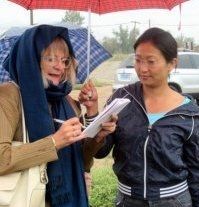
(Tasting organiser Jim Boyce of grapewallofchina.com pictured her above in her rather soggy vineyard, kindly shielding my notebook from the rain. On the right are just two of the Riedel decanters from which she served a group of us at her family winery on the outskirts of the provincial capital Yinchuan.)
Ningxia is a small, impoverished province 550 miles west of Beijing.
Until recently it was best known for its inhospitable mountains and desert, for lamb and for goji berries. But local government officials have become convinced that Ningxia's future lies in wine. It started in earnest in the late 1990s when the Ningxia Agricultural Reclamation Management Bureau swung into action, transforming the desert between the Yellow River and the eastern slopes of the Helan Mountains into potential vineyard, by determined applications of irrigation water, cover crops and bulldozers. It was clear that cereals and corn wouldn't thrive there but that the plants that supplied a drink that the Chinese were rapidly becoming interested in would thrive.
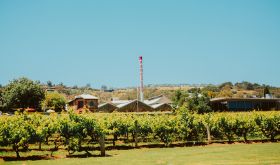
Before then there had effectively been just one winery in the area, Xi Xia King, but in a sign of the times, this winery is now engaged in a vineyard joint venture with LVMH to produce their first Chinese sparkling wine – supplying the raw material for the vast 5,300 sq m winery currently being constructed nearby for Chandon, the international brand name for sister fizzes to the Moët of Champagne. The tenebrous picture below shows Frenchman Gérard Colin, something of a legend in Chinese wine for his work with Grace Vineyards and current co-operation with the Lafite Rothschilds in Shandong in the east, contemplating LVMH's nascent vineyard in Ningxia, with vast new winery going up in the background.
LVMH is the second French drinks giant to have committed itself to Ningxia. Four years ago Pernod Ricard took out a lease on a substantial proportion of one of the first big vineyards to be reclaimed and sell competent varietals under the Helan Mountain label – mainly in China but depending heavily on expertise flown in from their Jacob's Creek base in Australia. Others who have constructed or are constructing vast 'chateaux' designed as tourist magnets include not just an array of private investors but two of the big three Chinese wine producers, the giant Changyu, who, inter alia, are in partnership with Ch Lafite in China's first wine region Shandong in the north east, and COFCO, who make Great Wall wines. Dynasty has been making Imperial Horse wine in Ningxia for many years.
A big advantage Ningxia has over many other Chinese wine regions is that the government owns the land, so can lease large tracts of it, which can be farmed exactly as the producer wishes, in a single transaction. In Shandong, for instance, the land is owned by thousands of smallholders. In Shanxi, where Grace Vineyards, for long one of China's most admired wineries, is based, most of the grapes have to be bought in and there is a constant battle to persuade peasant smallholders with no wine culture that, for example, small grapes packed full of flavour are more useful to a winemaker than large juicy ones.
But is the nascent wine region of Ningxia propelled by expediency and local government determination or by the fact that it does actually produce superior wine? It was to try to establish this that I flew there for three nights last week, to see the terrain and to act as one of a handful of international judges in the first Ningxia Wine Awards. We tasted eight white wines and 32 reds blind and were asked to mark them variously as deficient, commercially acceptable, good and excellent. In my four previous tastings of the best Chinese wines on offer, undertaken roughly every two years since 2002, it was a struggle to find wines that qualified as commercially acceptable. But a week last Friday I found five wines that qualified as excellent. There were only six that were less than commercially acceptable, but that was because of the very easily remedied fault of oxidation – because the wines had been either badly made or badly stored. Both in the Awards and at several wineries it was clear that Ningxia's raw material (assuming that is what we were tasting) is impressively consistent.
Moët may be betting on sparkling white (rosé doesn't sell in China), but the great majority of what is currently produced in Ningxia is red – mostly Cabernet and Merlot, as is the Chinese way. The wines have an attractive frankness of fruit, rarely more than 13% alcohol nicely balanced by natural acidity and, oxidation apart, were generally both clean and expressive. Although summer days are warm and (generally) dry, temperatures reliably fall at night at this altitude (over 1,000 m) so that the growing season is not too short. But winters are almost as severe, and early, as they are in China's westernmost wine province Xinjiang, so that here too vines have to be buried every autumn to save them from freezing to death. For the moment, the Ningxia government can provide relatively cheap labour, having moved so much of the population from the inhospitable mountains in the south, lock stock and barrel as only China can, to specially built settlements around the capital Yinchuan. But the continued urbanisation of China will surely start to make wine production in Ningxia much more expensive. And what, everyone wonders, will happen when those leases run out?
I did keep finding one very strong, unfamiliar flavour in our blind tasting though: a green streak accompanied by something peppery, almost like red peppers. This is the local grape speciality known as Cabernet Gernischt, which my Wine Grapes co-author's DNA profiling has shown to be identical to the Carmenère best known in Chile. Chile's climate is generally much warmer than Ningxia's but even there Carmenère can be difficult to divest of its greenness, and in Ningxia this is a much more serious problem.
There are some who argue that Cabernet Gernischt should be promoted as Ningxia's distinguishing mark, but I'm not convinced, especially since a significant proportion of the plants of this variety, presumed imported from Bordeaux along with Cabernets Sauvignon and Franc at the end of the 19th century, are affected by leafroll virus, which exacerbates the problem by slowing ripening (although see yesterday's wine of the week).
Perhaps it's time Chinese wine producers ventured outside the confines of Bordeaux's red wine grapes and perhaps Ningxia, suddenly China's most wine-minded province by far, could lead the way? I'd love to see the Riedel Ningxia Syrah glass, or even one for Riesling.
NINGXIA – MOST PROMISING WINES
He Lan Qing Xue, Jaibeilan Grand Reserve 2009 Ningxia
This wine, made by Jing Zhang, pictured above, at the government-run model winery, famously won a trophy in last year's Decanter World Wine Awards. The special 'red footprints' bottling is even better and won the Ningxia Wine Awards I judged recently.
Silver Heights, Emma's Reserve 2009 Ningxia
Emma Gao worked for Spanish-owned distributor Torres in China then trained in Bordeaux, and married Ch Calon Ségur's maitre de chai.
See tasting notes on more than 50 Ningxia wines.