See detailed tasting notes in 2003 first growths at 10.
Long-standing readers may remember the noble tradition instituted by my predecessor as FT wine correspondent Edmund Penning-Rowsell: an annual tasting of all eight Bordeaux first growths and equivalents at 10 years old, the age at which they have traditionally been regarded as broachable.
After Edmund died in 2002 the tradition fell into abeyance for several years. One of Citibank's more generous bons viveurs resurrected it in 2007 when we tasted the 1997s and I reported on the event here. The fact that during that evening he introduced us to the term sub-prime provides a clue as to why the exercise was not repeated.
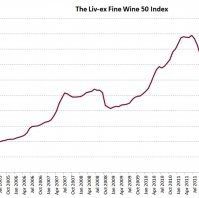
Since then prices for first growths (see an explanation of what is charted below by Liv-ex at the end of this article) in particular have risen stratospherically and it is a sign of the times that we have had to rely on a star in the east to resurrect the tradition. Earlier this month saw our third first-growth dinner courtesy of Hong Kong wine merchant and restaurateur Paulo Pong of Altaya Wines. He has kindly supplied the great majority of the wines, with any gaps in his UK wine collection generally plugged by Stephen Browett, owner of London's biggest fine-wine trader Farr Vintners. Two years ago we tasted the 2001 first growths, one year ago the 2002s and this year it was the turn of the controversial heatwave vintage 2003 (see my detailed tasting notes in 2003 first growths at 10).

In the old Penning-Rowsell days, many a bordeaux enthusiast would treat themselves to the occasional first growth. But now that they have so definitively drawn away from the rest of the pack in terms of pricing, I have assumed that the number of wine collectors with an active interest in first growths has reduced considerably so have been slightly wary of devoting an entire FT article to each tasting session. But three such comparative tastings gives some perspective on the general success of these three vintages, and on how each of the eight first growths performed in the early years of this century. The first growths themselves do everything in their power to prevent comparisons between each others' wines; independence and considerable investment are needed.
Firstly the mechanics. The key ingredients are a bottle each of Chx Haut-Brion, Margaux, Latour, Mouton, Lafite, Cheval Blanc, Ausone and Petrus. Normally one might run to a back-up bottle of each in case of a faulty cork but with Petrus 2003 at £2,000 a bottle and even the cheapest of the wines reviewed in these three tastings, Ch Haut-Brion 2002, around £300 a bottle, that would be wildly extravagant. And anyway, no one puts more effort into cork quality control than the first growths.
The next important ingredient is a top-quality wine glass for each wine and for each taster so that we can keep refilling and comparing how the wines develop in the glass, a good guide to how they are likely to develop in the bottle.
And then of course there are the tasters. Of the original team of six of us who tasted together more than 20 times, Edmund and Meg Penning-Rowsell are no longer with us but Daphne and Michael Broadbent (he set up and ran Christie's wine department for decades) managed to attend both the 2001 and 2002 tasting, even though he dislikes blind tasting. The Broadbents were all set to come to the recent 2003 tasting when he suffered a pacemaker-related electric shock (he had recovered well when I spoke to him recently), so their places were filled at short notice by two wine professionals, one of whom (less than a week after his wedding) agreed to be the vital person who would decide which wine went into which numbered decanter.
When it was first presented, in spring 2004, many sang the 2003 vintage's praises because it broke so many records: the hottest summer and earliest vintage for centuries together with record levels of sugar and tannin. But one thing most 2003s lacked was balance. The sugar levels were often the result of dessication rather than genuine ripening through building up flavour compounds and they were so high that yeasts often struggled to complete their fermentations. Acid levels were so low that throughout Europe growers were allowed to add acid. Many grapes suffered sunburn, particularly the thinner-skinned, earlier-maturing Merlot grapes. Christian Moueix, then in charge of Pomerol's most famous all-Merlot wine Petrus, warned that if vines had been grown in the less manicured, more 'natural' ways of 30 years ago, they would have been more protected by leaves from the fierce sunshine and would probably have fared better. No 2003 was produced at Petrus's new Pomerol rival Le Pin.
It was generally agreed that the most successful wines were those made from old Cabernet Sauvignon vines grown on water-retaining soils such as those at the northern end of the Haut-Médoc. And tastings of many of the lesser 2003s have suggested that these red bordeaux should be drunk earlier than most other vintages. But our tasting includes all three of supposedly the finest Pauillacs in the most propitious soils: Latour, Lafite and Mouton. And indeed these were the wines that stood out for all six of the tasters who scored the 2003s, particularly a richly dramatic Mouton and a monumental but already broachable Latour. Lafite was my third favourite wine. It was far from a blockbuster but its freshness and elegance made it supremely atypical for the vintage. Haut-Brion, where the harvest started as early as August in 2003, produced another wine with admirable freshness on the finish. Margaux may have suffered by being served first. Gently, lightly sweet, it took a long time to open up in the glass and had a rather drying note on the end. It may well be worth keeping this longer, even though most of these wines, unusually for wines at this exalted level, were easy to appreciate already.
In some ways the Ausone, one of our three right-bank wines, was the most youthful of these 2003s; so tight and dry was it on the finish. We happen to have some of the opulent, loose-limbed Ausone 1983 made by the previous regime in our cellar. The contrast could hardly be greater. As for the other top St-Émilion Cheval Blanc, this particular bottle was the real disappointment of the tasting – simple, lightweight and dull. I usually love Petrus but I found a clove-like note and heaviness that made this 2003 vintage less than appetising to my palate. The left bank definitely triumphed over the right.
However, as Edmund was always at pains to point out, our tasting was based on a single bottle of each wine – and bottles can vary.
In the graph above, Liv-ex chart the evolution of their mid price of a case of 12 bottles of 50 wines – the last 10 'physical' vintages of the five Bordeaux left bank first growths. Wines are added to the index in July of the year they become physical (the 2010s, for example, were added in July 2013), and removed after 10 years (the 2000s were removed in July 2013).