
Wine tourism is flourishing as never before and bottles bought sur place have a special resonance for their purchasers – even if the more outré ones have a nasty habit of tasting quite different back home under leaden skies. (This may be yet another example of the influence of subjectivism on wine appreciation.)
I thought therefore that at this time of year a few tips on visiting and tasting etiquette might be useful. One important warning applies to wine tasting in any circumstances – certainly at any event billed specifically as a wine tasting and ideally even at a dinner table where particularly fine wines are to be served.
Smell is all-important in wine tasting. The olfactory bulb that is the gateway to all our brain’s hugely sensitive tasting equipment is at the top of our noses and the array of complex aroma messages that make up a wine’s flavour are transmitted there by our sense of smell. Most of what we sense in our mouths, as opposed to our noses, is not the character of a wine but its dimensions: how sweet, sour, tannic (chewy), bitter or alcoholic it is.
So when tasting wine, always smell it thoughtfully beforehand – preferably liberating the aroma compounds, the odiferous messages, by swirling the wine in the glass. Countless experiments have shown that if the sense of smell is disabled, by a nose clip or heavy cold, for example, a taster is unable to distinguish between, say, grated apple and grated onion.
This is why it is polite and considerate to minimise any distracting aromas. This means – obviously – smelling clean and fresh yourself, and neither smoking nor reeking of old cigarette smoke. But it also means being thoughtful in the bathroom and boudoir beforehand. Strong perfume really can ruin a wine-tasting experience, as witness this email message I received last month after a tutored tasting in London: ‘It was a pleasure to see you again tonight at the Christie’s tasting as I sat two seats down from you. At one point in the evening a woman came to sit between us and I would think that, like me, you were disconcerted by the intensity of her ... fragrance! Ruined part of the evening for me.’
When it became commonplace for women to attend wine events, both amateur and professional, many a complaint was made by men about women’s perfume, but I can assure you that strong aftershave is just as intrusive and culpable. The thing to remember is that those who splash on fragrances of whichever sort tend not to notice them because they are used to them, but for the rest of us they really are a serious distraction.
This is why you rarely see flowers in places where wine is tasted – certainly not headily perfumed ones such as lilies – and why rooms where wine tastings are held are often actively aired beforehand. Brrrr.
More contentious is the question of food smells. The aroma police disapprove of food being served in the same room as wine is being tasted professionally. There were mutterings about the smoky whiff of barbecued meat from the corner of a big South American wine tasting at Leadenhall Market in London recently. But of course wine is made to be drunk with food so I for one feel a little more forgiving of intrusive food-related aromas.
Obviously it is sensible to be careful to visit wineries and cellars in an aromatically unadorned state, but there are other protocols. The first is the timing of any visit. In much of Europe and especially in France it is wise, and often necessary, to avoid lunchtime. Appointments to visit should ideally be made in advance. The vast majority of wine producers nowadays have websites with their contact details. (The free Learn section of this website has a directory of regional wine websites, many of which provide information on individual wine producers.) In well-known wine regions – particularly in Burgundy’s most famous villages where demand seriously outstrips supply – it is only at addresses that actively advertise dégustation and vente (tasting and sales) that it is fair game to turn up without an appointment. But you will be almost unbelievably lucky to find really good wine so freely available.
In less famous corners of the wine world, including in many parts of France, wine producers will be thrilled to find unexpected visitors on their doorstep. For the vast majority, selling the stuff is far, far more difficult than making it. You will be playing into their hands. And producers in many parts of the wine world depend crucially on sales at the farm gate or cellar door. England, New York’s Finger Lakes and Hunter Valley in New South Wales are obvious examples of wine regions within easy reach of well-populated cities, as is the Napa Valley, whose particular wine tourism mores I have written about specifically in Being a tourist in the Napa Valley. Wine tastings here have typically to be booked and paid for in this, the most evolved example of wine tourism.
In Europe winery and cellar visits are generally much less sophisticated and often guided by producers themselves. But whoever is doing the pouring, the sequence is likely to be from low to high in terms of quality, so it would be wise to save the superlatives initially. Greet the first wine with pleasure and admiration but perhaps not the peak of enthusiasm.
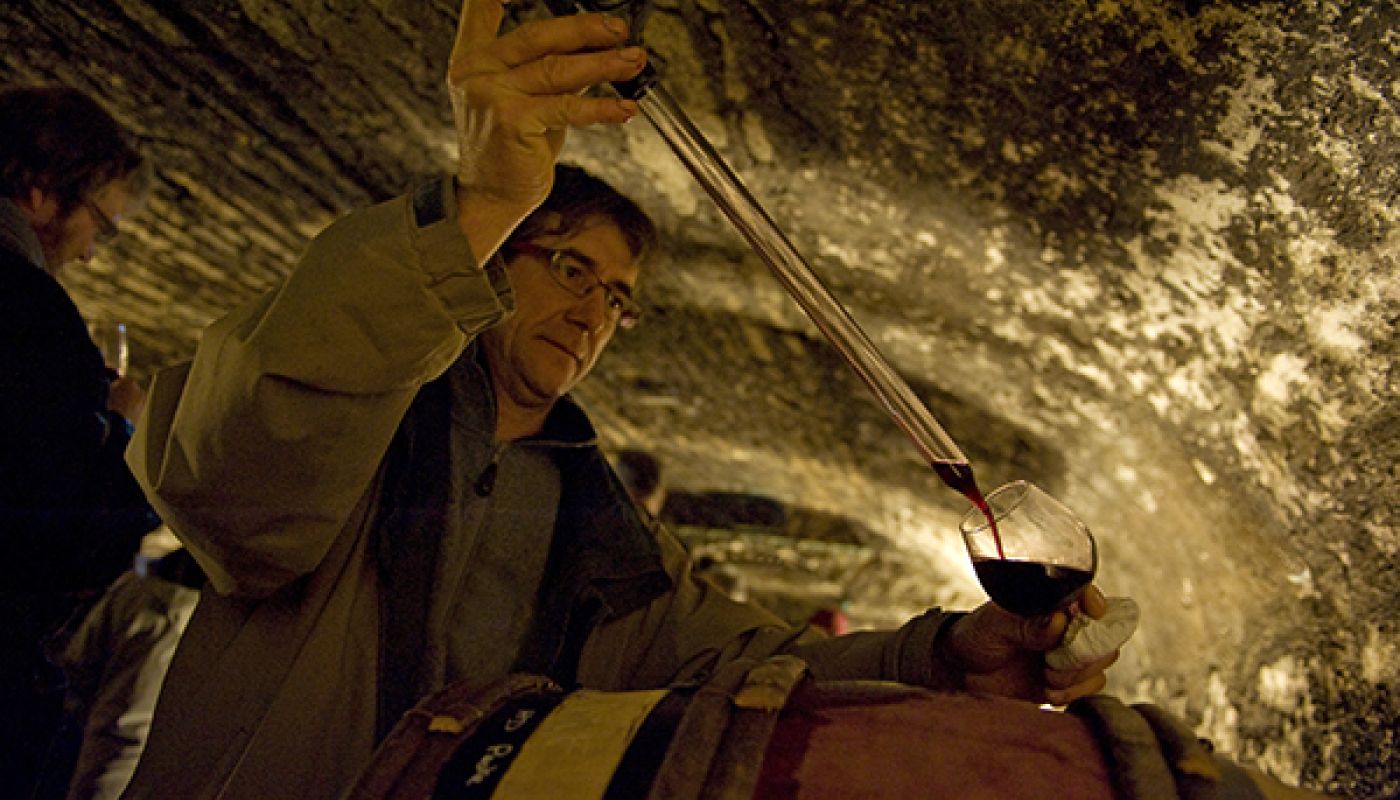
If your host draws wine from a barrel using a wine thief (illustrated in the image above of the old Hospices de Beaune cellars by photographer Jon Wyand), hold your glass helpfully ready to receive your ration and offer to pour the leftovers back into the barrel.
And, particularly if you are planning more than one visit per day, it really is worth losing any self-consciousness about spitting in public. Wine producers and their staff expect visitors to spit (practise in the bath beforehand) and usually provide spittoons, or indicate an acceptable place to spit. What can be a bit confusing is that some producers like to gather leftovers in another jug or container. As you may imagine, the cardinal sin is to spit into the leftovers.
It is usual to progress from whites to pinks to reds, if only because you will generally be issued with a single glass (wine professionals are cool about using the same glass for wines of different colours) and this makes a decent visual progression. But in some regions, the upper reaches of Bordeaux and Burgundy for example, it is customary to serve whites after reds. The best policy is not to express surprise at anything. Just take what you are poured gratefully and appreciatively.
And don’t use toothpaste immediately before tasting wine. It will make the wine taste horrid. As outlined in our extensive coverage of wine and teeth, you should avoid brushing them too soon after prolonged wine tasting as it will damage the enamel, weakened by the acidity.
TASTING & VISITING ETIQUETTE SUMMARISED
Make an appointment
Don’t use perfume or aftershave
Swirl, smell, slurp, spit
Be careful when brushing your teeth













