
See also Alder on the US bulk wine market.
In the last few years there has been a huge structural change in how wine is delivered to those who drink it. The UK, for example, is the most important market for one of the world's most enthusiastic wine exporters, Australia. In 2008 fewer than three in every 10 bottles of Australian wine on British shelves contained wine that had been shipped from Australia in bulk rather than in bottle. Four years later that figure was eight in every 10, and the total amount of wine shipped out of Australia in bulk overtook the volume exported in bottle.
And Australia is far from the only country to ship substantial quantities of wine around the world sloshing around in a tank inside a container rather than neatly sealed in bottles. Spain and Italy export far more wine in bulk than any non-European wine producer and 65% of all South African wine exports were bulk last year. Chile is a particularly enthusiastic exporter of bulk wine and earns the highest average price per litre for it. According to the OIV, the global wine statistics-gatherer, the total volume of wine shipped around the world in bulk rose 61% between 2005 and 2012 to represent more than 40% of all exported wine.
That date 2005 is significant. This was when Britain's major retailers and food producers signed the Courtauld Commitment to reduce packaging waste, which had the result of dramatically increasing the proportion of wine brought into the country unencumbered by heavy glass packaging. Those who study the back labels of supermarket wines started to notice more and more British addresses there, often heavily disguised or abbreviated, signifying one of what was then a handful of British wine bottlers. At that stage, corks were still used for basic wine, and those inserted into bottlenecks in Britain were easily identifiable by their numerical code and a 'W'.
But what started out as a commitment to sustainability – a reduction of 42% in carbon footprint is claimed by some – quickly became a drive by the UK supermarket giants to maintain margins, accentuated in 2008 when the Chancellor of the Exchequer introduced the sneaky 'alcohol duty escalator' whereby wine duties are automatically increased by 2% above inflation each year without this having to be spelt out in unpopular detail in the annual Budget speech. Shipping their increasing preponderance of own-label branded wines in bulk shaved valuable pennies off the retailers' costs and allowed them to stick to their blessed price points, while driving ever harder bargains with their suppliers as duty rose remorselessly. (The Wine & Spirit Association is currently mounting a campaign, 'Call Time on Duty', to have the duty escalator scrapped.)
The big beneficiary of this change in wine transport has been a hangar in Avonmouth in south-west England the size of 12 football pitches. It belongs to Accolade, the private-equity-owned company that swept up all the UK and Australian subsidiaries of Constellation when what was the world's biggest wine company decided to concentrate on its original American sphere of influence. Hardys, Banrock Station and Kumala are some of Accolade's better-known brands. The new company bet that the switch to bulk shipping to the UK would continue and broke ground for Accolade Park in 2007. The first bottles clanked off the bottling line in 2009 and they now fill 720,000 bottles a day. As well as bottling all but the poshest Accolade wines sold in the UK, and those sold in Scandinavia and in UK holiday destinations in Spain, they bottle all Morrison's own-label wines and are steadily poaching the Tesco business from rival bottlers Kingsland of Manchester, who have tactlessly started up their own wine-sourcing division. Another rival, IPL in Norfolk, is owned by Asda, whose IPL-dependent scheme to concentrate on 'three for £10' has just been abandoned. Sainsbury's had such a good deal with a bottler in Corby that it went broke and so they are now using the second biggest UK bottler Quinn Glass in Cheshire, which bottles a much wider range of drinks than Accolade.
Accolade pride themselves on being so wine-centric that every permanent employee has a wine qualification, and the one who managed to get through the Master of Wine exams, the wine trade's stiffest, is referred to by Accolade Park's site manager Richard Lloyd as 'our hero, Barry Dick MW'. Lloyd could not be prouder of his eerily clean site, a bit like a gym for giants. During my visit, when I had to take off all jewellery, and wear special shoes, ear plugs and a 'high-vis' waistcoat, my head spun with the quality-assurance statistics Lloyd was so proud of. Lloyd and his team have 'huge respect' for the other specialist wine bottler, Greencroft of Durham, but clearly revel in their own greater size. (You will note that, of these UK bottlers, only Accolade has an address remotely near a port – but apparently Avonmouth isn't deep enough, so most of their wine is landed 220 miles away in Felixstowe.)
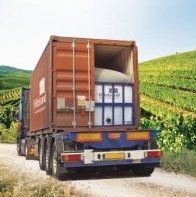
The wine typically arrives in a giant plastic bladder known as a flexitank within a fixed frame (pictured above by specialist wine shippers Hillebrand). Dick's MW dissertation was a treatise that suggested that flexitanks did not compromise the quality of wine shipped in them. He was able to draw on an MW student's dream mountain of statistics, thanks to the plethora of analyses to which all wines bottled at Accolade Park are subjected. Lloyd is tickled pink that his staff devised a unique pump-and-tilt system for getting the last 150 litres out of each container and quotes wastage tolerances with enthusiasm. The used, wine-soaked bags are eventually shredded and turned into traffic cones, apparently.
But what may have been good for Avonmouth and, overall, good for the planet, has been bad for Australia and bottlers in other major wine-exporting countries with their mothballed bottling plants. The big bottle producers are international companies that have merely switched their supply bases, but in countries such as South Africa, bulk shipping has had a serious effect on local employment. The trend to bulk shipping for all but the finest wine shows no signs of abating, however, and the likes of Richard Lloyd and Barry Dick would be delighted to explain in detail to you why it does commercial wine no harm at all. Forty per cent more buyers attended the fifth World Bulk Wine Exhibition in Amsterdam recently, and from my vantage point I see more and more brands, especially but not exclusively in the US, sourced from wherever can produce wine most cheaply.
China's newfound love of wine but not wine laws presents enormous opportunities for exporters of wine in bulk. Chile is expected to benefit particularly from a trade agreement which sees China reduce its import duty on Chilean wine from 43% by value to zero next year.
It is perhaps not surprising that the UK and Germany are two of the three most important importers of bulk wine. These are countries that obviously consume much more wine than they produce. The statistical surprise is that France is one of the world's top three importers of bulk wine. I leave you to figure that one out.*
ALTERNATIVE WINE PACKAGING
Nothing beats glass for subtle, complex wines designed to age for decades, but for wines that will be drunk within a few months (and according to some estimates 90% of all wine bought in the US is consumed within 24 hours), glass may be considered a heavy, fragile waste of resources. The following alternatives are worth considering.
Cans – much lighter and less fragile than glass. OK for the short term but if the anti-acid lining is less than perfect the wine can deteriorate rapidly.
Cartons – especially popular for basic wine in South America, these have the advantage of lightness, sturdiness and prolonged shelf life. Tetrapaks weigh only about 10% of the equivalent bottle size.
Plastic PET bottles – indestructible and light but can only be 'downcycled' (eg to textiles) rather than recycled and the worst can impart a plasticky taste. Wine keeps for up to two years in the best examples, which use only a tenth as much energy as glass bottles.
Pouches – light, convenient. Wine keeps fresh for up to four weeks after opening, but relatively high levels of preservatives are needed.
Bag in box – handy for big parties, or big drinkers, but, thanks largely to non-airtight taps, wine stays fresh for no more than four weeks once opened, despite higher levels of preservatives.
See also Why does wine have to be in a bottle?
*Several people have pointed out that France is home to a number of bottlers who import vast quantities of wine for bottling and re-export, including EU blends.













