Despite the obvious modernisation and Europeanisation of the past 30 years, the region between Oporto and Lisbon remains thoroughly distinctive.
Our hotel welcomed us with a decanter of tawny port; the fish markets are full of octopus and small squid, sadly no longer caught around the UK; and the fish stalls in the supermarkets, far superior to their British equivalents, are piled high with fresh fish, razor clams and the Portuguese firm favourite, salt cod, most of which now is now caught in Norwegian and British waters.
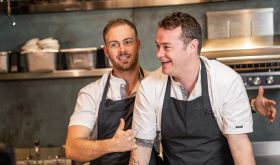
But my lasting impression from a short trip which included four meals that were high on quantity and value, and one in particular that was as good as any in a European city centre, was of the strength of the chefs' faces – and their biceps.
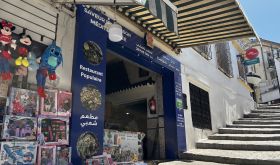
Both were obvious at our first stop, Casa Aleixo, in downtown Oporto. The restaurant is U-shaped, separated by stairs with a bar on one side and the dining room on the other at the end of which is a tiny, open-plan kitchen where three women in their mid-50s cook at a wood-fired oven, small gas range and sink.
There is nothing misleading about their food. Crispy salt cod cakes; octopus rice, rice that has been cooked with diced octopus meat so that it takes on a pink hue; and a salad of desalinated salt cod that had not been cooked but flaked off the bone then mixed with plenty of olive oil, salt and pepper were but a prelude. There followed fillets of hake and octopus (strategically held together by toothpicks to prove the point that even the most experienced professionals cheat!) fried in the lightest of batters.
What was misleading was the sign above the stoves which called this kitchen a laboratorio or laboratory when in fact it was more like a nest. From inside this nest these three female chefs, or mother hens, dispensed food to the hungry chicks in the restaurant, handed over the washed cutlery to be dried and, I could not help noticing, preened one another whenever a hair or a stain spoilt their appearance.
My next encounter with Portuguese chefs was of an altogether more violent nature. As we parked the car at the side of the restaurant Meta do Leitoes in Mealhada, crucially equidistant between Oporto and Lisbon, we saw the glowing embers of the ovens and three young male chefs fooling around at the end of a day during which they had roasted a mere 300 suckling pigs. When we looked into this furnace the chefs took us as eager disciples, beckoned us in to the kitchen and proceeded to explain how the wood-fired ovens are lit, the pigs basted and turned and then the juice drawn off so that when the suckling pig is served in the restaurant next door it is as crisp and lean as possible.
Mealhada is suckling pig heaven. In the space of three kilometres there are over 50 different suckling pig restaurants, many with garish illuminated pigs outside to woo in the undecided. The edible pigs are maximum 5kg in weight and fed on an acorn-only diet before they are basted in vinegar, red wine, onions, garlic, salt and pepper and roasted, suspended and rotated over a strong heat for an hour and a half.
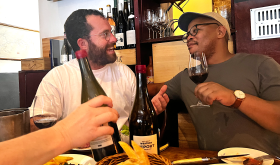
As well as the ritual of cooking these pigs there is another to their eating, which incoporates plates of the restaurant's own thin potato crisps, green salad and bottles of sparkling local red made from the ultra-tart Baga grape whose acidity neatly cuts the fat of the pig.
Apart from the obvious presence of many able-bodied young men who could baste, roast and carve these pigs all day, seven days a week – and at the weekend the biggest ovens will have accommodated 700 whole pigs – what I was keen to find out was how and why Mealhada, otherwise not an exceptional town, had found its way on to Portugal's gastronomic map. The answer, it appears, is simply location: as the halfway house between Oporto and Lisbon, Mealhada developed into the stopping point for hungry lorry drivers and business flourished. Today, with restaurants some of which are as big as the vast dim sum halls in the Far East although others are much smaller, Mealhada is a magnet for hungry Portuguese families, particularly at the weekends, and the origin of a great deal of the cooked suckling pig sold in supermarkets around the country.
The restaurant Tromba Rija in Leiria, an hour north-east of Lisbon and within striking distance of the pilgrimage site of Fatima, is equally renowned amongst restaurant-loving Portuguese but for two very different reasons which earn it the title of the world's most democratic restaurant.
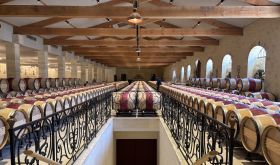
The first is the quantity, and in many instances, the quality on offer. There is no menu here, just a table of about 80 first courses from which you help yourself, then tables of 15-20 cheeses and the same number of desserts. In between, although our friends forgot to warn us, came four hefty main courses including two variations on salt cod, a partridge and cabbage stew and another minimalist classic, clams with sausage and beans.
The democratic principle – you help yourself to everything other than the plates of fruit, nuts, digestifs and coffees – is extended to a large supply of notepaper on each table for comments which are then affixed to the restaurant's wooden beams. Tromba Rija (pig's snout) is not the place for a romantic dinner but for any group travelling in the area it is a must. As long as they arrive hungry.
On my return to Oporto when I met Miguel Silva, the chef/proprietor of the Bull & Bear restaurant where I ate so well last year. 'I hope you have a good meal,' he said modestly, 'but I am just getting over three personal setbacks. I have just turned 40, published my first cookbook, Una Cozinha de Aromas, and been voted the best chef in Portugal. I do hope I can live up to all this.'
My second meal was as exciting and well executed as the first and Silva's restaurant, above the city's futures markets, should be a starting point or finale for anyone travelling the Douro this summer.
Casa Aleixo, Rua da Estacao 216, 4300 Oporto, tel +351 22 537 0462
Meta dos Leitoes, Sernadelo, 30500382 Mealhada, tel +351 23 120 2170
Tromba Rija, Rua Professores Portelas, Marrazes Leiria, 2400-406 Leiria, tel +351 24 485 5072
Bull & Bear, Aveniada da Boavista 3431, 4149-017 Oporto, tel +351 22 610 7669