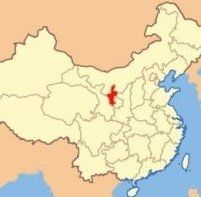
I've never been anywhere where the local government is so pro wine as the small province of Ningxia in north-central China (550 miles west of Beijing and just south of Inner Mongolia), where I spent three days recently.
Officials in general, encouraged by Cao Kailong (above, having breakfast), 'director of theBureau of Grape and Floriculture Industries', a local who spent several useful years in a relevant government department in Beijing before coming back to encourage what one might call the vinification of Ningxia, are convinced that wine presents the best economic opportunity for this province with few mineral resources and a wine-friendly climate.
It's roughly on the same latitude as Etna in Sicily but is at an altitude of over 1,000 m, which means that although the annual heat summation is about 3,300 ºC, with an average of 960 ºC July to September, nights are usefully cool and the grapes don't ripen until well into September and sometimes October. In theory, annual rainfall at under 200 mm is a little low but officials point to the unpolluted Yellow River that follows the base of the east-facing piedmont of the Helan Mountains and the (mostly flood) irrigation possibilities from it and meltwater from the mountains. Some of the irrigation canals are 800 years old and those who have experience of vine growing here say that irrigation-water availability can be erratic.
During my visit, there seemed no shortage of rain in fact, and my guide, the respected teacher and wine consultant Professor Demei Li (above), who, inter alia, advised on the Ningxia wine that won a Decanter trophy last year, admitted that, since 2009 when that wine was grown, Ningxia has been enduring a run of exceptionally rainy summers.
The north–south strip of land on which most vineyards are currently planted varies from quite stony at the immediate foot of the mountains down to reclaimed alluvial soils and sand much closer to the river. Soils, pH under 8.5, could generally be described as sandy gravels with a water permeability of 40–100 cm. Annual sunshine hours are around 2,800 to 3,100. All in all, the numbers are quite propitious. Summers are usually much drier than further east, including the historically important Shandong region, and soils here drain much more freely than in Gansu to the immediate west, where, for example, Michaelis Boutaris of Greece has literally put down roots.
But the big meteorological drawback is that, as further west in Xinjiang, vines have to buried every autumn to protect them from being killed in severely subzero temperatures every winter.
For the moment this is (just) feasible. The Ningxia authorities have instituted a programme of moving the (often Muslim) population from the inhospitable mountains in the south to settlements around the capital Yinchuan further north and hope that there will therefore be sufficient inexpensive labour to undertake this work. But one cannot help but wonder how long, in increasingly urbanised China, this can be counted on, and of course this is a labour force with zero wine culture. Ningxia vineyards are pretty haphazardly designed in the main. There is certainly little provision for mechanical vine-burying as vineyards are currently designed, and in any case the process of burying tends to weaken the vines to such an extent that a proportion are lost each year, resulting in very varied, but generally young, vine age within each vineyard.
Most vineyards (and those above are some of the better ones) look pretty disorganised, over-productive and unruly to the outside observer. There are few sustained attempts at canopy management and yields have traditionally been favoured over wine quality. There is much to learn in terms of viticulture and, especially, spraying. As one foreign winemaker who did several vintages here observed to me, 'the vines are way, way, way over-fertilised (wrong type, wrong time). International fertiliser companies have a case to answer for misleading developing countries! Effective spraying is difficult due to the generally large fruiting zone and poor equipment. Critical timing of applications is missed.'
So there is much to learn in the Ningxia wine industry but the authorities are nothing if not ambitious. The wildly ambitious official plan is to establish a 'grape corridor' of one million mu (about 70,000 ha, more than Bordeaux's entire vignoble) of vineyards by 2020 that will also be home to a wine centre, 'three grape culture cities, 10 different theme towns, and over 100 chateaus'. To the Chinese, a winery should look like a sort of Toytown copy of Pichon Longueville.
Faith is being pinned on attracting wine tourists to Ningxia. That same foreign winemaker told me that in the last five years Yinchuan has been transformed from a small town characterised by 'broken pavements, weeds and dust' to somewhere with restaurants and even a smart, modern Kempinski hotel. Georg Riedel stayed there on his recent visit, natch, while we judges of the first Ningxia Wine Awards were put up in the marbled vastnesses of the government-run hotel, which had a cavernous wood-panelled 'wine bar' without a single wine you would want to drink.
So, for the moment, much is intention rather than reality, as evinced by the spooky sight on my travels around wine country of this 'wine chateau', swathed in scaffolding and without a single paved road in sight. But that didn't stop Château St Louis Ding (sic) from featuring a lavish illustration of their 'chateau' in the local wine brochure with extravagant promises of the vistas afforded from it.
Winery equipment, on the other hand, tends to be good quality, and in the blind tasting of 39 local wines that was a focal point of my short visit, there was little evidence of, for example, over-oaking. The only fault was occasional oxidation, which should be resolved very easily.
See 10 winemakers chosen for Chinese adventure for details of another enterprising wine-focused official wine venture here. Just now, 10 winemakers from around the globe are arriving in Ningxia to make a red and a white, and presumably to spread much needed wine culture there. The Ningxia officials really are determined to make this work!
Tomorrow I'll publish my report on this tasting, the most encouraging tasting of Chinese wine I have ever participated in, and on what I tasted while visiting wineries after the tasting. On Saturday I'll be publishing a general overview of the region and its wines, and next week I'll be reporting on one or two of the more interesting aspects of wine in China in general and in this ambitious wannabe wine province in particular.