When might a wine producer not want to make the best possible wine?
Now. Now particularly.
All over the world winemakers are more obsessed than ever with terroir, with the way geography can shape how the produce of a particular plot of vines can taste. Terroir was once acknowledged only by the French but today it’s an international concern – particularly outside France where it has the additional appeal of novelty.
Geologists may argue that the rocks under a vineyard can have only minimal influence on how a wine tastes but the microbiologists are hard at work on providing an explanation of the links between what’s in the glass and what’s under the vine. And geologists’ caution certainly hasn’t stopped wine producers investigating, celebrating and being sure to broadcast the characteristics of each vineyard. Soil pits are dug, weather monitored, electromagnetic induction harnessed, and vineyards understood and mapped with far more precision than ever before.
The result of all this has been a dramatic increase in the number of geographically specific bottlings. Single-vineyard wines and even single-block wines are increasingly common. Block 3 and Block 5 Pinot Noir from Felton Road have long been two of New Zealand’s most treasured reds. Geological credentials are now de rigueur on labels and technical specifications, and some producers even name their various offerings with a specific soil type (several Muscadet producers and Mullineux in South Africa spring immediately to mind). It sometimes seems to me from where I sit as a wine writer that the world is full of wine producers desperate to cram the special qualities of each vineyard into the bottle, even at the expense of producing the best wine they possibly could.
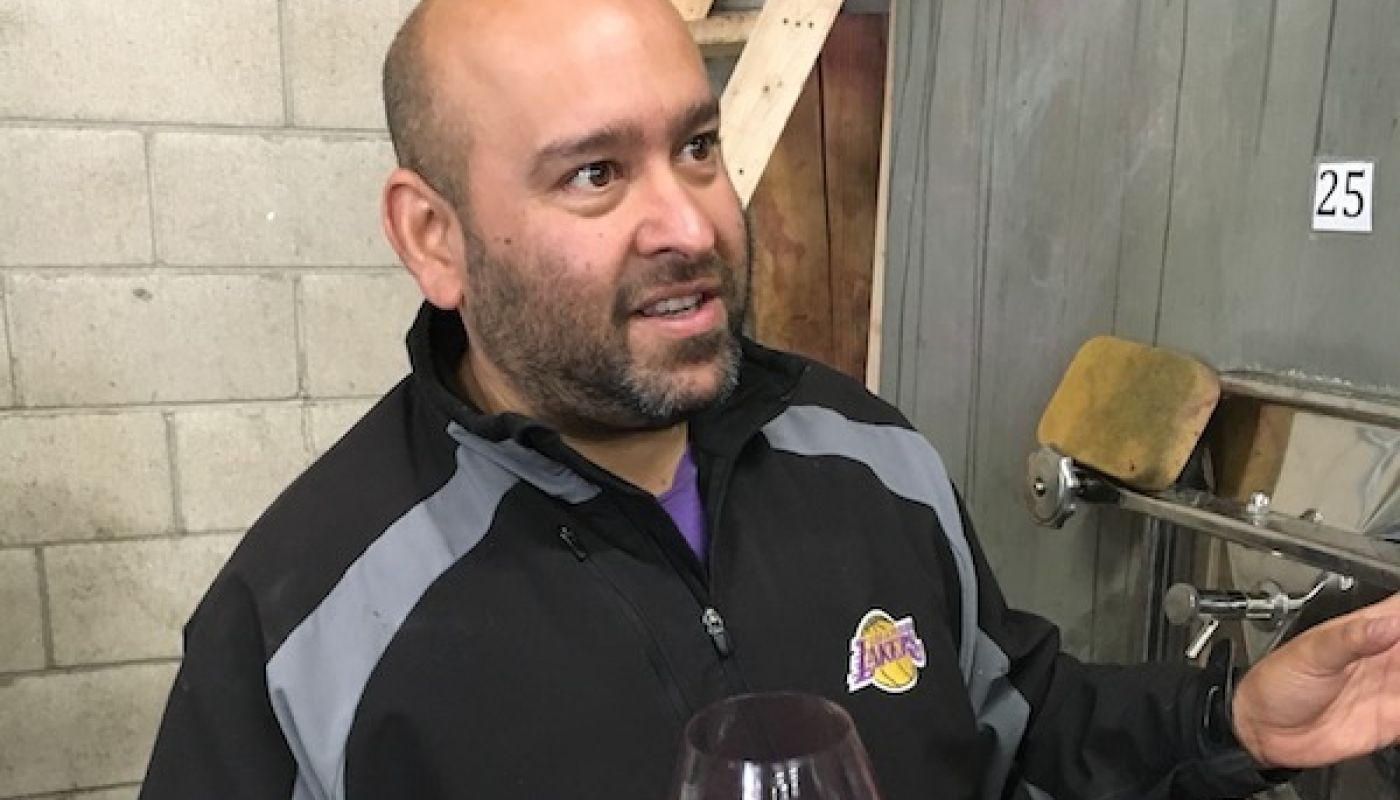
I remember reading an interview with Rajat Parr (seen above tasting wine from different tanks), the celebrated California sommelier-turned-vigneron-and-social-media-king, co-founder of the In Pursuit of Balance movement, which encouraged lower-alcohol, more expressive California wines. In the interview he was clearly absolutely thrilled with how differently his various Santa Barbara Pinots tasted, even though the interviewer hinted that he found one or two of them lacking.
Next time I had a chance to sit down with Parr, in my home city of London, I asked him about this tension between authenticity and quality. He smiled, as though this were a familiar topic, and explained, ‘coming from the New World, with no AOC system, we’re still discovering what happens where. Wines from different places should taste different and I want to find out what those differences are. This is a very personal quest.
‘At Domaine de la Côte [the Sta Rita Hills wines Parr has made since 2011] we have four main vineyards with exactly the same plant material, of the same age, and mostly the same rootstock. We make all four wines in exactly the same way: in the same concrete vessel with no cold soak, aged in the same cooperage for the same length of time. So there are no variables except for the terroir. And what’s exciting is that you can really see the differences between the four wines, from the beginning to the end.’
Tentatively, I asked whether he was ever tempted to make any modifications to winemaking in order to improve the final results but he was adamant. ‘I could imagine adjusting the winemaking to suit each vineyard eventually, but for the moment I don’t want to take away from my learning curve.
‘Of course, if I were in Burgundy and had vines in Bonnes Mares and Clos de Bèze, then I’d make wine in a different way for each vineyard. But it’s far too early for that in Santa Barbara. For the moment we are still learning. We do the same at Sandhi [another of his operations]. The Bentrock vineyard wine is always reductive; the Sanford & Benedict always a bit salty.’ I noted that he, a burgundy fan above all, just takes for granted that he will never blend between vineyards.
It is easy to understand why Raj Parr wants so desperately to understand the Sta Rita Hills terroir. The first vineyard, Sanford & Benedict, dates only from 1971, and was a lone vineyard in the region for years and years. It was recognised as an official wine region only in 2001.
Contrast this with Burgundy, Parr’s seat of learning, where vines have been grown for at least two millennia. Although another French wine region, Alsace, claims geological superiority. There’s a new group of producers in Alsace, ACT or Alsace Crus & Terroirs, formed of 16 of the most highly regarded domaines, plus négociants Trimbach, Martin Schaetzel and Josmeyer. Their mission is specifically to communicate the varied terroirs of their region in their wines and they boast of having wildly more different terroirs than Burgundy. Thanks to the particularity of tectonic movement at this juncture of the Black Forest and the Vosges, Alsace lays claim to a total of 800 different terroirs, as opposed to Burgundy’s pathetic 60.
Just like the Burgundians, Alsace vignerons do their utmost to keep grapes from each of their 51 grand cru vineyards (each of which now has its very own appellation) separate. And since some of these vineyards can be bigger than 70 ha (170 acres), producers are keenly aware, and usually proud, of exactly which part of the grand cru their vines are.
Presumably Raj and his like in newer wine regions around the world should take heart from the fact that Alsace delimited and officially recognised its grand cru vineyards as recently as 1983. ACT, with its careful association of each wine’s characteristics with a particular soil type, shows how far you can progress in 35 years – although I suspect that is too slow for many of the most impatient and ambitious young guns in places such as Australia, South Africa, Argentina and Chile.
Chile is a particularly interesting case because it is home to one of the world’s most peripatetic consultants on soil types. Pedro Parra (seen below in Itata) offers advice not just far and wide in South America, but also in some of Europe’s most hallowed wine regions – including Barolo, Italy’s hotbed of terroir, and even chez Roulot and Comte Liger-Belair in Burgundy.

Funnily enough, the one region where expressing terroir seems a minority sport is Bordeaux. Most of the châteaux have mapped their vineyards very precisely, but more in order to process their produce most efficiently prior to blending the whole lot together.
My overarching project at the moment is updating The World Atlas of Wine for its next, eighth, edition. I suppose this article is in effect an advertisement for a wine atlas. But I promise you – honestly – that I have only just realised that.