Frog’s Leap has always been a bit of an exception among Napa Valley wineries. The Williams family who founded it were preaching the organic gospel long before most of their neighbours. They were early adopters of the cover crops that provide such beautiful photo opps each spring nowadays. They have treasured old vine varieties that are less fashionable and more obscure than the most profitable, Cabernet Sauvignon. They also seem to have managed an amicable and successful transition from one generation to another. And now John and his son Rory Williams are Napa’s first to adopt a winemaking practice that has been spreading like wildfire in cellars all over the world.
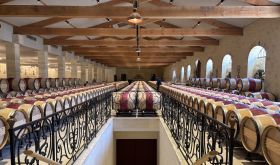
Wood, and specifically oak, has long been the material of choice for ageing and, often, fermenting wine in. It clearly has an affinity with the flavours of wine and, most importantly, encourages just the right amount of oxygen needed to stabilise and clarify it. Ancient civilisations may have used clay pots and the like but wooden barrels succeeded amphorae as containers for both storage and transport as long ago as the third century AD.
Towards the end of the 20th century it became a badge of honour among the world’s wine producers to boast about how many new French oak barrels they bought each year. Indeed for many wine producers the world over, the greatest annual cost is their investment in new barrels holding the equivalent of about 300 bottles. They can cost $1,000 each and may be used for no more than three years.
For wine producers in poorer parts of Europe, an oak barrel, indeed ageing wine at all, was long regarded as a luxury. Towards the end of the last century they typically hoped to replace their old concrete vats, often as big as and shaped like a room, with shiny new stainless-steel tanks that are so much easier to clean. The abandoned wine co-ops that now dot the Languedoc for instance are full of these ghostly vessels, often still encrusted with the purple tartrate crystals deposited by red winemaking. Some of the more energetic wine farmers would use dynamite to rid themselves of these concrete dinosaurs.
But concrete has become increasingly à la mode in wine production. This century many wineries have experimented with giant concrete egg-shaped containers which are supposed to encourage movement and useful contact with the lees. And glamorous new wineries such as those expensively designed for the glitzy likes of Château Cheval Blanc in St-Émilion and Masseto in Bolgheri boast concrete fermentation vessels in all manner of shapes and sizes. Perhaps the fact that, whatever the prevailing fashion elsewhere, Bordeaux’s most expensive wine Petrus has always been fermented in concrete played a small part in encouraging this phenomenon.
But it applies only to fermentation. Most fine wine nowadays is aged in wood, even if the world’s wine producers and consumers have taken against the pronounced ‘oaky’ flavours associated with new, small barrels, so the size and average age of the oak barrel or vat has been increasing (see Oak decline).
What the Williamses of Frog’s Leap are doing however is flying in the face of current practice in northern California, where demand for new French oak barrels has long been so great that the major French coopers established outposts there many years ago.
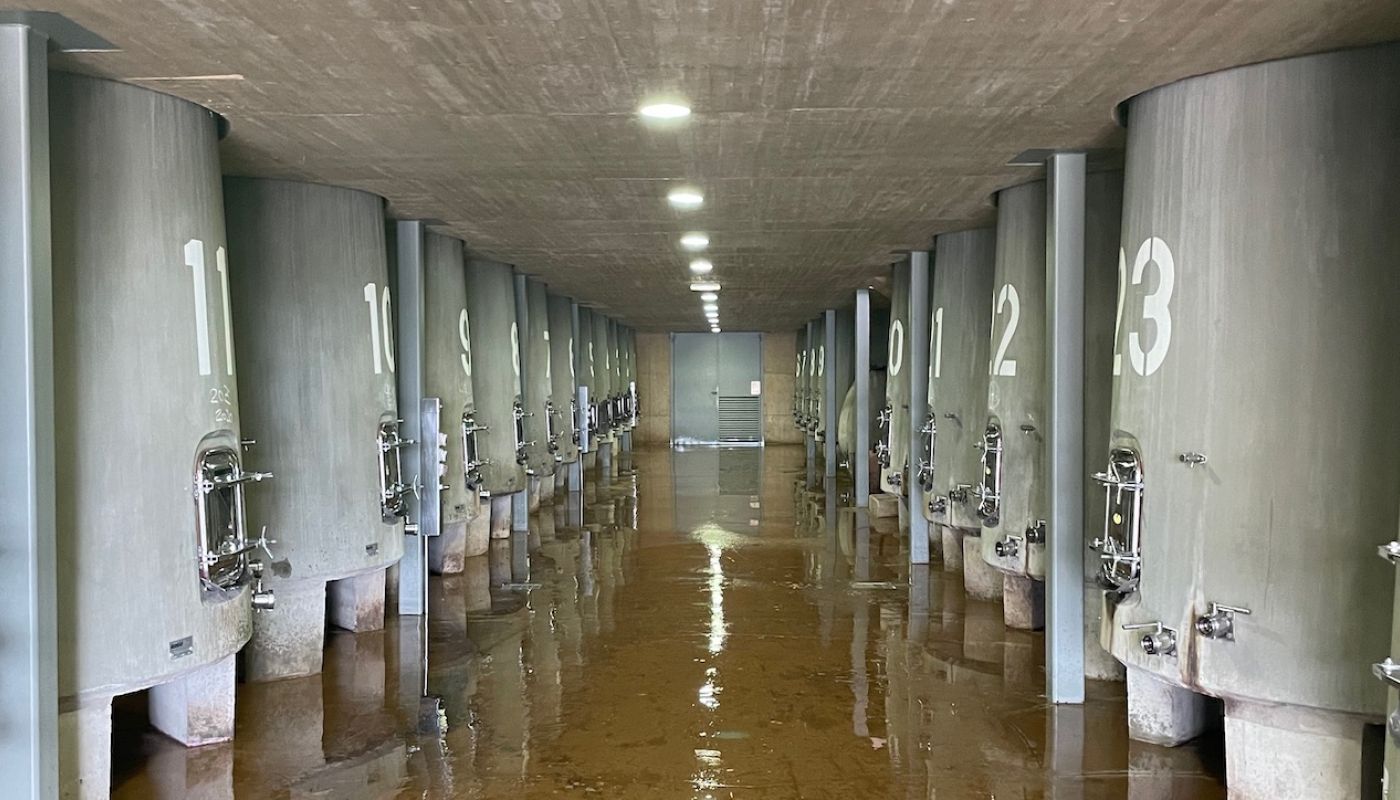
As well as an array of concrete eggs, which John Williams describes as ‘space-eaters’, they have installed two 13,000-US gallon (nearly 500-hectolitre) concrete ‘rooms’ in which they age their Chardonnay and trademark Sauvignon Blanc and are thrilled by the additional texture that results. So pleased are they by this retro material that they have also invested in 100 small, square 240-US gallon (910-litre) concrete cubes for their unusually zesty Zinfandel, with results John Williams describes as ‘tremendously exciting’. (The results for Cabernet Sauvignon are less conclusive; it seems the Bordeaux red wine grape really appreciates its stay in oak, perhaps because it allows more oxygen ingress.)
Concrete’s appeal for the Williams is both financial and ecological. According to John Williams, ‘it takes one 75-year-old oak tree to produce two barrels for wine use and those barrels have a usable life of three to five years. If we can make better wine while using concrete with its low carbon footprint in production and an unlimited lifespan of use, the result is a potential huge value in reducing our carbon footprint.’
In fact producing the cement for concrete is relatively heavy on sand and on greenhouse gas emissions, but at least the Williams are sourcing their new concrete vessels close to home, from Sonoma Cast Stone in Petaluma just over the hill, whose main business is producing sinks. The Frog’s Leap concrete containers have to be rinsed each year with a heavy solution of tartaric acid (the most common acid in wine) but are still easier to maintain than oak. And one of concrete’s great advantages over oak is its steady temperature.
Such enthusiasm for ageing wine in concrete may be unusual in Napa Valley but it has become increasingly common in Spain where some see concrete (and, in some regions, clay tinajas) as a wholesome revival of local tradition. Highly respected vintner Telmo Rodríguez decided that his new Lanzaga winery in Lanciego in Rioja would be all-concrete, reproducing how wine was made there in the 1930s. He was encouraged by his partner Pablo Eguzkiza who had experience of making wine in concrete when working at Petrus in Bordeaux. ‘I really like wooden tanks’, Eguzkiza admits, ‘but they are very difficult to conserve in good condition (they always have to be full).’ Lanzaga’s concrete cylinders hold up to 100 hectolitres (2,640 US gallons).
Other prominent fans of concrete include Michel Chapoutier of France and Australia, who has long favoured it for grape varieties prone to oxidation such as Grenache, and Sebastián Zuccardi of Argentina. When Zuccardi built a new winery in Valle de Uco, high in Argentine wine country, he deliberately focused on concrete vessels because he wanted to express local characters un-occluded by the flavour of oak. He too points out that he is merely reviving a material that was common locally in the 1930s.
But not everyone is convinced. Over the Andes in Chile, Burgundy-trained winemaker François Massoc is highly sceptical of what he describes as ‘concrete tanks in all kind of shapes growing like mushrooms all over the world’. He argues that although their proponents argue that wine can ‘breathe’ in concrete, ‘they forget that the inner pores [of the concrete tank] are not connected with the exterior pores so this is impossible’.
Williams and Chapoutier argue that, so long as the concrete is unlined, it is not oxygen outside wine containers that works its magic but minute amounts of oxygen trapped in the thin layers of the interior of the container. Concrete-aged wines certainly don’t seem to be starved of oxygen, and often seem to me to have freshness and additional texture, though perhaps I am imagining a certain graininess.
Massoc is also concerned that there may be contamination from chemicals used in making them, adding, ‘for example Cheval Blanc made a large study before choosing their concrete, and we need to remember that Kees [this famous château’s chief advisor] is a geologist, so he knew what he was doing. That’s the reason why they have a beautiful and technically extraordinary winery. Others? I don’t know…’.
Ageing in concrete seems very much in line with the current vogue for pure fruit flavours, and seems to be well suited to many a lively white wine and reds for relatively early consumption. But for complex reds designed for long ageing, the coopers probably need lose no sleep.
Concrete recommendations
Whites
M Chapoutier, Bila-Haut Occultum Lapidem 2017 Côtes du Roussillon 13%
£15 Frazier's Wine Merchants, £16.99 Noble Grape
Frog’s Leap, Shale and Stone Chardonnay 2019 Napa Valley 13.3%
£25 VINVM, £27.17 Justerini & Brooks, £27.90 Hedonism and from $23.95 from many US retailers
Gerard & Pierre Morin, Ovide 2018 Sancerre 13%
£27 The Sourcing Table
Reds
Bertrand-Bergé, Origines 2019 Fitou 14.5%
£9.50 The Wine Society
Alto Las Hormigas, Clásico Malbec 2018/19 Mendoza 13.5%
£12 approx Hay Wines, Vinified Wine, Eton Vintners and others
Dom des Espiers 2020 Côtes du Rhône 14.5%
£12.82 Stone, Vine & Sun
M Chapoutier, Bila-Haut Occultum Lapidem 2017 Côtes du Roussillon Villages, Latour-de-France 14.5%
£15.50 London End Wine
Frontonio, Microcosmico Garnacha 2018 IGP Valdejálon 13.5%
£17.95 Winedirect, £17.99 N Y Wines
Lanzaga, Corriente 2017 Rioja 14%
£18 Honest Grapes, £18.50 The Sourcing Table (2018)
Zuccardi, Concreto Malbec 2018 Mendoza 14%
£28.75 Frazier’s Wine Merchants, £29.95 Winedirect
Tasting notes on Purple Pages. International stockists on Wine-Searcher.com.