6 March 2021 See a further addition on terminology, particularly use of the word amphora.
2 March 2021 See an addition to the end of this article, on Flextanks.
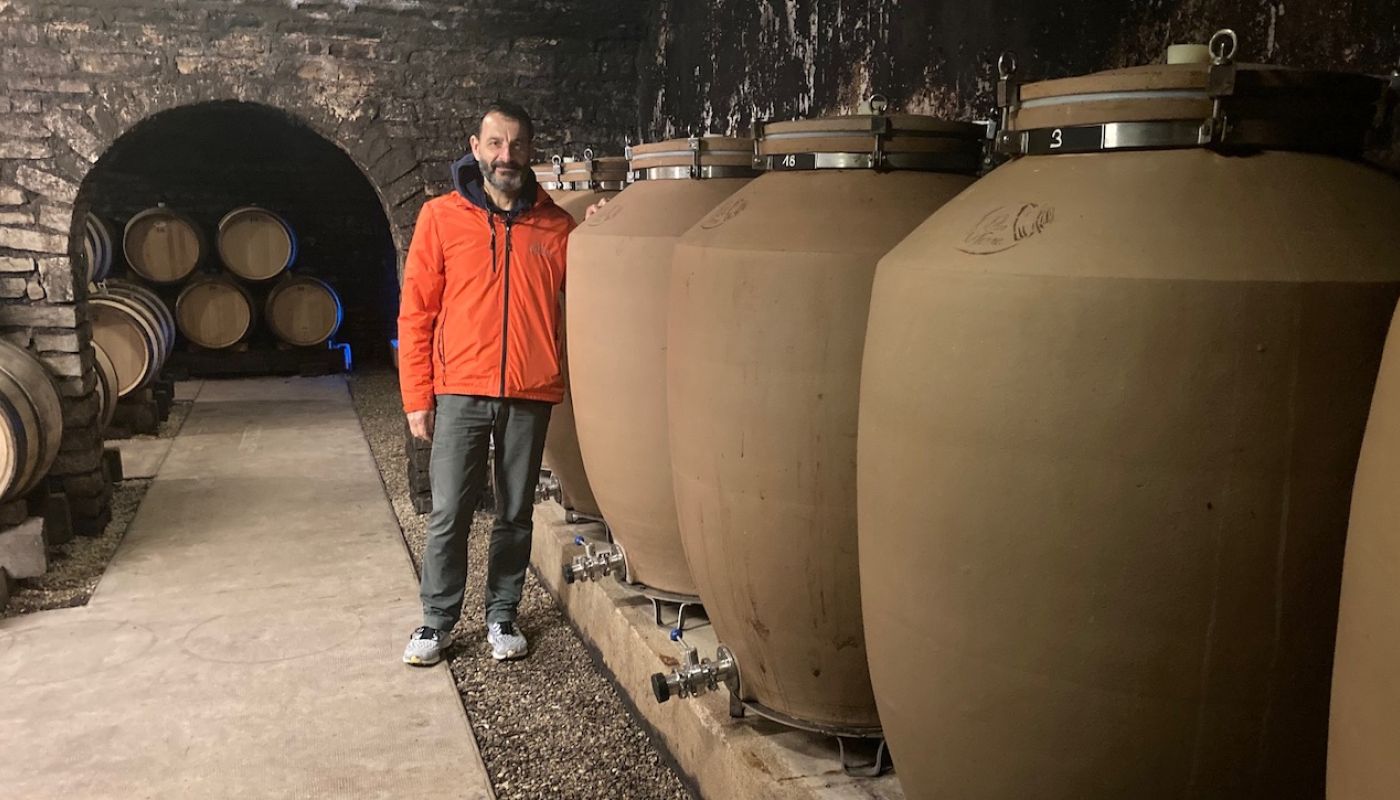
27 February 2021 How our attitudes to oak have changed. A slightly shorter version of this article is published by the Financial Times. Jean-Marc Roulot of Meursault is seen above with just one of his many alternatives to oak barrels.
For the next two months or so the wine business’s two great ancillary suppliers, cork producers and coopers, will be anxiously watching weather reports in the northern hemisphere. Damaging frosts such as those that shrank the 2017 wine harvest in Europe have a serious subsequent effect on their bottom lines.
But just as the cork industry has over the last quarter-century or so been having to deal with the threat of alternative bottle closures, especially screwcaps, the world’s barrel makers have a more recent threat: indifference.
Oak has been by far the material of choice for wine barrels. Being watertight, supple but hard, oak has a natural affinity for wine. As the wine ages it allows in just enough oxygen to encourage stability and clarity and its flavours seem to marry particularly well with many wines. American oak is used for ageing many spirits and sherry but for wine producers French oak has been the ne plus ultra – not least because for centuries the French government has been managing extensive forests carefully dedicated to the needs of winemakers.
Around the turn of the last century, however, consumers fell out of love with overtly oaky wines. Whereas in the 1980s and 1990s, wine producers would boast to the likes of me about how many new French barrels they bought every year – and at several hundred dollars each, this would be their single biggest annual capital cost – ‘oaky’ swung from being a compliment to a criticism.
New, small barrels impart the most oaky flavour; old, large ones the least. Many wine producers in countries new to sophisticated wine production, and new to selecting the best barrels made from the most sensitively seasoned wood, ended up making wines that tasted crudely of oak. These often rather obvious oak flavours could swamp the fruit and it was perhaps not surprising that there has been an anti-oak backlash among consumers.
Among well-educated wine producers it is the physical properties of oak, the way it smooths the wine and leaves it more complex, that have been treasured rather than the flavour it imparts. But there has been a notable shift away from new, small barrels to re-using barrels several times in the same cellar or winery instead of selling second-use barrels to a less prosperous wine producer.
Similarly, there has been a move away from the most traditional barrel size of around 225 litres to bigger containers for wine ageing of between 300 and 600 litres, whose oak imprint on the wine is less marked.
Wooden fermentation vessels have been popular for smart red wine – as well as stainless-steel tanks – but concrete is experiencing a revival in popularity, in all sorts of shapes and sizes, especially large concrete eggs, which encourage contact between the lees of fermentation and the wine. And in some regions there has been a return to giant clay jars and even amphorae* as tradition continues to trump technology. A couple of top Meursault producers are ageing some of their wine in glass. Jean-Marc Roulot, pictured above, has a mix of glass globes, six cooked earth vessels, a steel barrel and Stockinger casks as well as the oak pièces traditional in Burgundy. He keeps track of what is where and its performance on a spreadsheet.
I have observed over the last few years a real evolution in what wine producers boast about. It used to be how new and small their barrels are; often now it is how old and large.
With all this in mind, I have been wondering about the effect on the French coopers’ balance sheets of their established customers cutting down their orders. I collected comments from three of the biggest.
Jérémie Le Duc is commercial director of Seguin Moreau who have cooperages in Cognac, Burgundy and – a sign of the times – Napa, California. He is based in Cognac whose brandy must by law be aged in French oak barrels.
‘You’re right’, he wrote in an email, ‘there is a trend for less oak and larger barrel sizes. But if we look in detail, the trend is soft and didn’t start yesterday. Some winemakers tried to completely stop the use of oak (fashion, influencers’ role, price …) but most of them came back and found another balance.’
Le Duc reports a current fashion for really large oak vessels, with a capacity of 1,000 litres or more, and some signs of interest in woods other than oak such as chestnut and acacia that have in the past been used for wine production. ‘So I would say, yes, less oak, but also different oak. Some winemakers and consultants want, like and need oak (for structure, oxygen, tannins, roundness) but without oak aromas.’
While he admitted that demand from the traditional wine regions may have weakened, he claimed that new, cool wine regions in countries such as Poland and Sweden were helping to fill the gap.
Seguin Moreau’s holding company Oeneo diversified into stoppers some time ago and owns Diam, the leading manufacturer of technical corks, the ones made up of tiny cork fragments, which are guaranteed to be free of the dreaded cork taint – and to be awfully difficult to reinsert into a bottle neck unless you do it as soon as the cork is pulled. They have also been busy developing particularly fancy barrels and even spherical concrete tanks. The ‘alternatives’ listed on their website include oak chips, oak staves and oak sticks to be dangled in tanks to impart that unfashionable oak flavour.
François Frères is the best-known Burgundian cooper. Its managing director Max Gigandet was not the only cooper to acknowledge the effect that the wildfires in Australia and California are having on their business. Smoke-tainted grapes have led some producers to abandon the usual careful barrel maturation for the 2020 vintage and one must assume that Seguin Moreau Napa will break no sales records this year.
A good 80% of François Frères barrels are exported from their base in Burgundy and Gigandet reports increasing orders from Canada, China, Brazil and Eastern Europe. He saw demand for larger barrels grow quite considerably over the last 10 years but thinks the trend is levelling off. And the chais of Bordeaux, for instance, with their barrel-ageing cellars carefully and expensively designed to accommodate the traditional 225-litre cask, may find it difficult for purely logistical reasons to change.
Chêne & Cie is one of the world’s most important coopers, with cooperages in France, Hungary and one in Kentucky specialising in American oak barrels for whiskey distillers. CEO Henri de Pracomtal admitted by email that ‘indeed in many regions the proportion of new oak has been adapted and excess new oak on thinner wines has stopped. Larger formats, between 300 and 600 litres which have been traditional in the Rhône and Italy, are gaining popularity. But no famous Cabernet or Pinot Noir [producer] has stopped aging in new oak barrels, even if a number of them are experimenting with amphoras.’
He takes comfort in a recent trend towards moving back to ageing wine in oak in Champagne, not just chez Krug and Bollinger but by a host of ‘small brands and vignerons as a means of differentiation and reaffirming a positioning as grand vin’.
de Pracomtal is proud of the fact that his French cooperage business Taransaud posted consistent growth between 2014 and 2020, helped presumably by demand from distillers, though he is braced for the effects of the California fires.
Like Seguin Moreau, Chêne & Cie offer a host of oak-based alternatives to barrels but de Pracomtal rules out serious diversification. ‘Our little group is called Chêne & Cie [Oak & Co] so from an image and credibility standpoint, and due to the experience of our sales team, we would have difficulty selling steel or clay!’
Oak and wine may be a marriage made in heaven but the divorce rate is slowly increasing.
Addendum on Flextanks* from Graham Shore, owner of Vintur in Ventoux:
We now use neutral storage vessels for maturing wine, made from hard plastic which admits air slowly (similar rate to concrete or wooden barrels). They are called Flextanks and I am told that one in four or five wineries in America uses them. I think they were invented in America. We have a French supplier from Bordeaux who imports them but also makes their own versions (eg eggs) under licence.
They are significantly cheaper per hl and more flexible than concrete. They weigh less when empty, are easier to move around with a forklift (especially the stacker) and relatively easy to clean. I won’t bother to compare them to amphorae as they don’t have any romance. At Plumpton they were doing an experiment with amphorae buried in the ground outside, which I saw when I went back a few years ago. I don’t know the results.
The results from them are very good. We started buying them a few years ago and have become converts. We still use oak barrels as well but bigger ones and specifically where we want oak flavours. And never new oak for our reds.
Concrete’s great but the new-generation tanks are very expensive.
* Addendum on the use of the term amphora
Purple Pager Steve Slatcher has written a thoughtful essay on the various terms for the clay vessels that are increasingly used in wine production in his winenous blog.
The experimenters
These are some of the producers most obviously experimenting with alternatives to oak barrels for wine maturation.
France
Ch Durfort-Vivens, Margaux, Bordeaux
Ch Pontet-Canet, Pauillac, Bordeaux
Domaine Guy Roulot, Meursault, Burgundy
Domaine Gayda, Languedoc
Italy
Abbia Nòva, Lazio
Castello Monterinaldi, Chianti Classico
Robin Baum
Iberian Peninsula
Pepe Mendoza, Alicante, Spain
Herdade do Rocim, Alentejo, Portugal
Rest of Europe/Eurasia
Heimann & Fiai, Szekszárd, Hungary
Ludwig Knoll, Franken, Germany
Meinklang, Burgenland, Austria
Zorah, Armenia
North America
Pax Mahle, California
Zaca Mesa, California
Beckham, Oregon
Syncline, Washington State
Okanagan Crush Pad, BC, Canada
South America
Altos Las Hormigas, Argentina
Finca La Celia, Argentina
Zuccardi, Argentina
Viña Leyda, Chile
Pedro Parra, Chile
Garzón, Uruguay
Plus a wide range of producers in Georgia, southern Chile and Montilla-Moriles in Andalucia (following tradition) and in Australia (forging a new path).
For tasting notes see Purple Pages of JancisRobinson.com. See also all our articles about oak.
* The executive team of Flextank write: As avid readers of your content, we are thrilled that your readers have been introduced to the Flextank brand! We enjoyed reading Mr Shore’s wonderful experience, and wanted to confirm that we do indeed passionately engineer polyethylene tanks designed to provide the similar (and in many cases, improved) functions to that of oak barrels, and at a significant cost, space, time and oak savings to the winemaker.
Our products are so beloved, however, that we have been made aware of unauthorised dealers, unlawfully selling imitation Flextank branded tanks. We want all wine and beverage makers to be able to have the very best experience using authentic Flextank products, and to see the best results for their investment. Due to current lawsuits, we will refrain from naming unlawful dealers, but we would like the opportunity to direct your readers to a complete list of authorised dealers of authentic Flextank tanks and products throughout the world on our website https://flextank.com/contact-us/ . We do have an authorised dealer for France, which is Kerttrade Kft (http://www.kerttrade.hu). Further inquiries about purchasing authentic Flextanks can be made to Tamas Joo at [email protected].
We love hearing testimonials from customers and look forward to seeing even more successful results. We would like to wish you and your readers warm wishes for a wonderful 2022!