As a follow up to his Bordeaux 2015 harvest continues the rule of five, Gavin Quinney has created this admirably detailed review of the weather in Bordeaux leading up to the 2015 harvest. See also Bill Blatch's two-part review of the vines and the wines. For even more riches, you can download a pdf of Denis Dubourdieu's report, including specific comparisons with earlier vintages, here.
As a backdrop to the official en primeur tastings in Bordeaux next week, here’s my report on how the weather had an impact on the 2015 vintage. The graphs and images should provide a Bordeaux enthusiast with a fairly thorough grasp of how this fine vintage came about, and also why there are regional differences. It’s a seriously long post, so you may prefer to download it as a pdf – ideal for reading later on an iPad or large-screen mobile.
10 weather highlights for 2015

- 2015 was a dry year, with every month from March to October being drier than average – except for a wetter August.
- A cold January and February led to later budding at the start of April but the early growth in the vineyard accelerated through April with warm weather.
- The flowering in late May and early June, in close to ideal conditions, was the best for years, followed by useful rain in mid June.
- The summer wasn’t consistent – extremely dry in late June and July, then rain in August. At times, it was hot – 39 out of 92 days of summer saw 30 °C or more.
- Late August to 10 September was dry – handy for the dry white harvest and ripening of the reds.
- The fallout from Storm Henry brought rain 11-17 September, just before the Merlot harvest. The amount varied significantly – eg 87 mm in the northern Médoc v 16 mm in St-Émilion (see below).
- Crucially, it was pretty dry from 18 September to 2 October for the bulk of the red harvest. Châteaux that harvested later had to contend with rain 2-5 October.
- 2015 is an excellent vintage but unlike other top vintages in 2000, 2005, 2009 and 2010, the harvest brought plenty of anxiety for many growers over when to pick.
- The vines and bunches looked extremely healthy at harvest time, with no rot on the reds to eliminate.
- A very good vintage is supported by generally good yields on the reds, but lower yields on the whites.

It’s useful to note the lack of rain each month – and the reverse in August – and how sunny it was in June and July as the grapes formed.

Between April and October, 2015 was drier (375 mm) than the 30-year average (497 mm) and the four previous years. Compare this with the top vintages of 2005, 2009 and 2010.


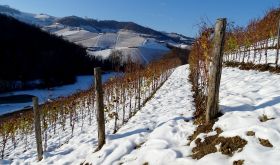
It’s probably useful to show what was happening in the vineyard between April and October. This was the same block of Merlot, with Pavie our Jack Russell for scale. You can see how dry it was, especially in late May and at the end of July, then how green it was in August and, importantly, dry again in September for the ripening.

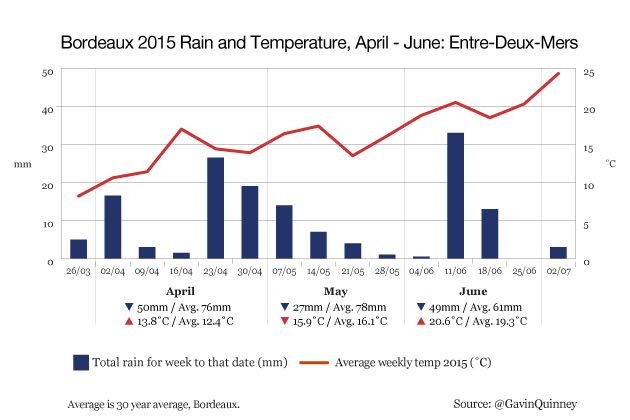
Below is a week-by-week summary, combining figures from eight subregions divided into two graphs – April to June, and July to October. You can find each subregion’s graphs in the appendix at the end of the article.


The production in 2015 of 529 million litres (equivalent to 700 million bottles) was just above 2014 and exactly matched the average of the last 10 years. Red accounts for more than 85% of the total.

For the appellations most involved in selling en primeur, 2015 saw the highest yields for some years. Notably Margaux and St-Julien (highest since 2007), St-Estèphe (2006), Pauillac (2010) and the large appellation of St-Émilion Grand Cru.

The entire surface area and production of these high-profile appellations accounts for just 10% of Bordeaux. The en primeur campaign is largely concentrated around these areas but there’ll be quality and value elsewhere as well – as and when the wines become available.
Appendix
Here are the week-by-week stats for eight subregions, divided into two graphs – April to June, and July to October. There is considerable variation in the rainfall between regions, notably in August and September.