'Are we going to Australia today?' the boys used to ask. They knew all about the project; what they didn’t realise was that Australia lay a little further away than the three-mile Saturday shopping trip down the road to Tonbridge (in Kent).
Gradually, though, their 18-month-old and three-year-old worlds began to change. Their parents became even more tense and stressed than usual. Dad had coughing fits; Mum got migraines. Strange people began strolling around the house as if it was their own. Toys disappeared into boxes; boxes into lorries.There was a lot of queuing at the post office.The car disappeared, to be replaced by a hired alternative (which someone drove into, then … disappeared). A week of staying with friends and family terminated at the airport, with two teetering trolleys’ worth of luggage, a chaotically bad meal at Garfunkels, and lots of running up and down on the travelator by the departure gate.This was part of a cunning parental plan to ensure in-flight exhaustion; it more or less worked. And then, after a brief but happy Singaporean intermission, and woozy with time zones, exhaustion and inactivity, two pale little English boys emerged blinking into the bright sunlight of an early Adelaide summer morning. Their Britain had morphed into Australia.
They love it: a garden to play in, a bigger house to run around in, sunshine and bright moonlight and trees full of parrots. England is long forgotten; they’re Australians now. They take the beach for granted; rain has become a misremembered curiosity; they’ve stroked koalas and fed kangaroos and eat Vegemite. And their parents?
Advice to anyone contemplating migration, even temporary: the bureaucracy will be oppressive, and you’ll need a big cash float. I’ve now got my one-year temporary work visa, at very little risk to the Australian state, but acquiring it was a perfect example of the one of the worst uses of the online revolution: the protection of civil servants from any sort of direct contact with the public. Websites can indeed be loathed, and deliver trauma to powerless supplicants as effectively as they deliver pleasure to enthusiasts. If you can afford to hand over the migration process to a professional helper, I would.
For about two months to each side of the flight, too, money haemorrhaged alarmingly from our bank account: call it £15,000 to get here, rent a house including the ‘bond’, fix up your own house so that it becomes rentable, get your furniture stored, bring a few books over, pay for the chest x-rays and online forms, buy a beaten-up old car with 200,000 km on the clock and get set up with food and saucepans and washing-up liquid. We’d heard rumours that it was cheaper to live in Australia than in the UK. If so, that was when the pound was a much stronger currency than the trembling weakling it has become in early 2009. At almost 50p to the Aussie dollar, nothing much is cheaper here except sunshine.
But is it better? Most Australian bread is as dismal as most British bread; we can’t even seem to find good stone-milled hard flours to bake our own. Fine cheese can be had, by contrast, but for a fearsome price; the affordable domestic stuff is awful. Most of the fruit juice proved to be contaminated with sugar, and food labelling regulations almost amusingly lax, permitting all manner of fakery and chicanery. I bought a jar of mayonnaise which contained more sugar than egg. We quickly learned not to buy any prepared products in the supermarkets.
Raw ingredients are a different matter, though. Vegetables are often outstanding: cabbage and celery, for example, have a strength of texture and power and clarity of flavour which vastly eclipses their in-bred, weak-tissued British equivalents. Despite size: there’s a head of celery in the fridge downstairs which weighs over 1.5 kg. It’s like a small tree, and is almost as sturdy (see photo, with boy for scale). No more abominable Dutch greenhouse tomatoes and peppers, either: both have grown flavoury in the sun here. The plums just after we arrived were superb, and this is the first place I’ve ever eaten tiny fresh raisins on the bunch: the children loved them. Perfect for 18-month-old Joe and his tiny fingers. Meat is good, too, especially if you’re up for ‘roo and croc; but it’s the fish which is most seductive. We are slowly working our way through the panoply of strange names (strange and often treacherous: it takes a while for Brits to realise that something called King George whiting sits as effortlessly at the top of the qualitative pile as Dover sole does at home); the full process will take a blissful piscatorial year. With the Great Southern Ocean to trawl, perhaps fish can even be eaten here without deep-freezing the conscience, which is hardly true in Europe any more. (If I’m wrong, please delay telling me for a month or two.)
I’m here for wine, of course, and will be tracking my discoveries via blog entries on www.andrewjefford.com as well as a now-monthly column in Decanter; the full picture will be written up in a book. A culture shock, a challenge, but also an education: two months of living Wine Australia have been all of these. The two things I miss most so far are red wines with a pH much over 3.5 combined with low acidity, and red wines with ripe, chewy, textural and flavoursome tannins; Australia as a nation seems to have abjured both. I don’t think I’ll ever get used to richly fruited reds from obviously warm, sunny regions (perfect for ripening black grape skins) which fetch up with titanium-hard pH, a swingeing TA (total acidity) of 7 g/l and the barest dusting of fine-talc tannins which may or may not have come from grape skins. They just taste too made, too sour-and-sweet, almost wholly unvinous: wine-drink, but not exactly wine. They’re what Australian consumers are used to and enjoy, though. No other wine-producing country seems to have such a high percentage of wine made within relatively confined stylistic parameters. The downside of the show system?
Perhaps I should cite a little evidence. UK supermarket Waitrose provides, in its bi-annual press-tasting booklet, technical details for most of the wines shown. At last autumn’s tasting, the pHs of all the Aussie reds shown varied from exactly 3.4 (2004 O'Leary Walker Reserve Shiraz) to exactly 3.6 (2006 Henschke Henry's Seven), with TAs of between 5.6 (2006 Yalumba Organic Shiraz) and 7.1 (2005 St Hallett Old Block Shiraz).
Contrast that with some of the other reds shown, where you find pHs of 3.73 (2006 Waitrose Chianti Classico from Ricasoli), 3.82 (2006 Hess Syrah from California), 3.83 (2007 Mont Gras Carmenère Reserva from Chile), 3.85 (2006 TMV Syrah from Swartland in South Africa), even 3.93 (2007 Cuvée Balthazar Syrah Vin de Pays d'Oc, priced at £9.99).
TAs are a more problematic in that the Waitrose booklet doesn’t say whether they are expressed as sulphuric or tartaric, and in any case I understand that Australia titrates to a different end point to Europe (pH 8.2 compared with pH 7) which also makes Aussie TAs look higher by about 0.5g/l. It’s a shame there isn’t an international standard for these analysis figures. Nonetheless, for what it's worth, the Chianti figure is given as TA 5.39, the South African TMV TA 5.6, the Californian Hess Syrah TA 5.5, the Chilean Mont Gras TA 4.27 and the French Vin de Pays d'Oc TA 3.45.There was a Bordeaux (2004 Bellisle Mondotte from St-Émilion) with pH of 3.74 and TA given as 2.95, but I assume that has to be as sulphuric and not as tartaric.
There aren’t any analysis figures for tannins in the Waitrose booklet and I haven’t come across any here in Australia either, though the Bordelais love to cite their IPTs (indices des polyphénols totaux (a polyphenolic index: 65 or 70 is high but regularly achieved or exceeded in some recent vintages). The nub of the problem may be that many red wines finish fermentation in barrel here, and that precludes the kind of extensive post-fermentation maceration which builds structure and texture. (Not the only way, of course: vintage port achieves all its prodigious extraction before fermentation is more than half-finished, so you could still have palpably tannic wines which had finished fermentation in barrel.) When I’ve discussed this issue with producers and retailers, several people have told me that Australian consumers have a special descriptor for any even moderately tannic wine: 'bitey'. This is pejorative, and producers seem shy of palpable, chewy tannin as a consequence. I haven’t tasted a single tannic or deeply extractive red since arriving ... though a 15% Adelaide Hills Tannat from Bowe Lees tasted last night was heading in the right direction.
Of course my sampling is almost certainly inadequate. I thought I’d swing into the sample circuit here, and that this would give me a big cross-section of wines to try. To date, though, this hasn’t happened (though a big thanks to those who have sent samples), perhaps because I’m not regularly writing for any Australian newspapers. Another shock has been the price of wine here: interesting wines seem to start at AU$20 to $30 a bottle (roughly £10 to £15 – higher than the entry point for interesting wine in the UK), which inhibits extensive self-funded discoveries. Needless to say, I’m keen to taste and try as many wines as possible, particularly those from less accessible regions, and those produced using techniques designed to maximise the sense of place in the wines, or anything stylistically adventurous.(The address is 12 Rawson Penfold Drive, Rosslyn Park, SA 5072.)
The travels are underway, of course, and I have already tasted many good and great wines which either do escape the national stylistic paradigm, or which (by dint of vineyard efforts and winery restraint) achieve outstanding results within it. A recent trip round the Adelaide Hills, for example, introduced me to excellent wines from Stephen George at Ashton Hills (Riesling with unusual vinosity and structure; Chardonnay with brilliant vintage differentiation; a fine ‘Gentil’ blend of Riesling, Pinot Gris and Gewurztraminer; and Pinot Noir with perfume, poise and architecture); some fascinating Pinot Gris and avant-garde sparkling wine from Simon Greenleaf’s Cloudbreak label; carefully crafted Chardonnay and Shiraz from ex-Oddbins émigré James Tilbrook; and the exuberantly savoury Shiraz of Paul and Kathy Drogemuller at Paracombe, which proved that good Adelaide Hills Shiraz isn’t just a preserve of Mount Barker. Mind you, over at Mount Barker I spent a memorable few hours with Erinn and Janet Klein at Ngeringa, a property which makes the Mount Barker case every bit as convincingly as does Petaluma’s Shiraz. With a biodynamic difference? (The photo below shows them with their own Highland cattle cow horns.) Too soon to say, perhaps, but the fine Ngeringa 2005 did seem to have unusual savoury warmth and succulence, and a singingly natural balance. (A pH of 3.8, since you ask.) I was very sceptical that Pinot Noir could perform well there, but Erinn’s chewy, rooty, earthy 2006 won me over. Lindsay Barratt’s classy Chardonnay also deserves a mention.

I cite less well-known names, but Adelaide Hills’ more celebrated wineries have high standards and a general willingness to accept the vineyard balance as a given – otherwise why stray up into their cool heights in the first place? Shaw and Smith’s 2007 Pinot Noir a few nights ago, for example, was as seamlessly drinkable as any Pinot I’ve enjoyed over the last year: lip-smackingly good, and far better than ordinary grouchy red burgundy from yet another half-ripe year.
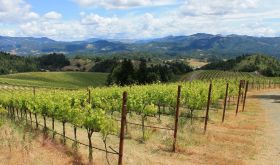
Lots more kilometres ahead, of course – though few of them will be as beautiful as those travelled in the Adelaide Hills. Australia’s wine landscapes are often uneventful (Rutherglen never set anyone’s heart racing), but the Adelaide Hills are secret, mysterious, ever-changing, always surprising, an entire province of gulleys and ridges where the stringybarks stalk. Geographically speaking, we amateur emigrants have struck lucky. We can be up there in half an hour.