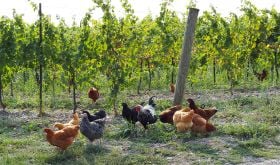
4 December 2019 As the COP25 UN Climate Change Conference takes place in Madrid, and following on from Tam’s Fifty shades of green, Dr Richard Smart examines the issue of carbon specifically, highlighting ways in which producers, and particularly consumers, can help to reduce wine’s carbon footprint. The logo shown here is his own.
Since graduating from Sydney University I have spent over 50 years in wine grape vineyards. During my career I have worked as a research scientist, a lecturer in viticulture and more recently as an international consultant viticulturist with clients in over 30 countries around the world.
My prime professional interest has been in climate effects on the grapevine and subsequently on wine quality. This led me to PhD studies at Cornell University in upstate New York in the early 1970s. It was here that I heard one of my Professors Ed Lemon warn a gathering of soil scientists about the implications of increasing atmospheric carbon dioxide (CO2) levels for the global climate. ‘There is evidence', he said, ‘that man’s activity of burning fossil fuels is increasing atmospheric CO2, and this will eventually lead to global warming. This is because of the so-called “greenhouse effect” whereby CO2 absorbs and traps in the atmosphere radiation which normally is lost to space. The planet will get hotter, and eventually the climate in general will change. Who knows what that will mean?’
In fact, this was not a new idea. The Swedish scientist Arrhenius predicted as long ago as 1896 that burning fossil fuels such as coal would cause global warming via atmospheric CO2 increases; of course this trend began with the industrial revolution and has increased substantially since the 1950s.
Global records taken over the last 35 years have clearly demonstrated this point. Global warming has given way to climate change as a major concern for society. Most countries have had recent experiences of record temperatures and heatwaves, and for some, hurricanes, droughts, floods and now wildfires of unprecedented occurrence and ferocity. Predicted to come are declines of food production and loss of farmland, a rise in sea levels, the likely disruption of global trade, famines and possibly wars, and with as-yet-unseen record numbers of refugees.
For more on the implications of our continuing use of fossil fuels and their effect on atmospheric CO2 levels I can recommend The Uninhabitable Earth by David Wallace-Wells (Penguin, 2009).
Should wine consumers care?
My aim here is to advise readers about the implications of wine production for climate change, in the hope that I might help consumers to put the enjoyable activity of wine drinking in perspective with their other lifestyle choices, including their domestic energy consumption, meat eating, the size of car they drive, and air travel. I mention these since their effects on CO2 emissions are well known.
You may well wonder at the inclusion of wine production here. Don’t vineyards absorb CO2?
If you are well read on environmental matters you will probably know about Life Cycle Analyses (LCAs), which are used to estimate the contribution of various human activities to atmospheric CO2 levels. Let me state at the outset that grape and wine production are not major contributors to the problem compared with, say, transport or electricity generation from coal. However, nor is the impact small, and it could be easily reduced if wine producers were made more aware.
The wine sector has a problem
For example, the Australian Wine Research Institute (AWRI) estimated that equivalent CO2 emissions for 2017 for the Australian wine sector were 1.6 million tonnes. This can be compared with, for example, the figure for civil aviation in Australia, including domestic and international flights, of 22 million tonnes. So wine production is not in the big league of polluters like air travel, but neither is the extent of pollution insignificant, nor so small that it can be ignored, as happens at present.
There is now a general and growing sentiment that we all need to do what we can to limit CO2 pollution of the atmosphere, which applies to individuals, families, communities, states and nations. It certainly applies to industries such as wine. The early research to support this campaign has started but as yet too few wine companies are involved.
Which parts of the wine production and consumption life cycle particularly contribute to CO2 emissions to the atmosphere? Studies in Australia and elsewhere have shown that particular problem areas for CO2 emission are in transport and glass packaging, accounting for a whopping 68% of the wine industry’s carbon footprint (although admittedly Australians probably export over longer distances than some other wine producers). Contributions from grape growing and winemaking are relatively minor, respectively 15% and 17%.
What the wine sector could do
Let us consider the smaller vineyard and winery footprints first. In the AWRI study, electricity (from fossil fuels) and diesel were big components for grape growing, and electricity the biggest by far in the winery. These costs can be offset by using biofuel from the vineyard and winemaking process, which include as by-products winter prunings and pomace (skins and seeds from the winery presses). Disposal of both is currently a cost for wine producers but there are carbon-saving alternative uses for them. After drying, each can be combusted in ovens attached to the winery to provide an alternative energy source to grid electricity from fossil fuels. Otherwise, they can be converted to biochar, a means of carbon sequestration, and used as a soil conditioner. Such initiatives would be classified as renewable energy, being offset by the CO2 absorbed from the atmosphere by vineyard photosynthesis.
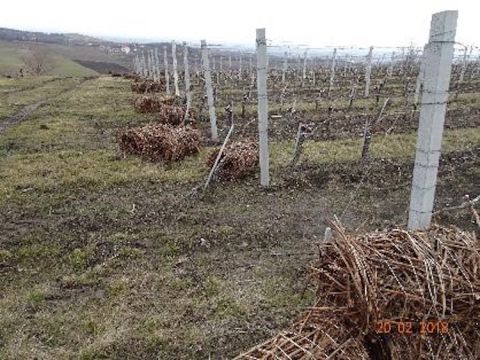
Above are bales of prunings in a Romanian vineyard. Each weighs around 20 kg (44 lb) and can be easily stored for air-drying under cover, then chipped and burnt using biomass boilers attached to the winery to create heating, cooling or electricity.
But the really big reductions in carbon footprint are to be made in reducing the carbon costs of glass bottles and transport. Wine bottles require much fossil fuel-based energy to manufacture, and then to transport, and maybe recycle. Wine bottles are round and tapered, shapes that are inefficient of space, and are often as heavy as their contents. Little wonder that bottles are now considered inefficient. It is surely remarkable that the wine industry is still using packaging that dates from the seventeenth century. Certainly it is about time that the global wine sector reconsidered packaging, at least for the great majority of less expensive wine that is made for immediate consumption rather than ageing in bottle.
There are several alternative packages, all more environmentally friendly than a tapered, round 750 ml glass bottle. These include lined cardboard cartons, bioplastic bag in box, aluminium cans (see Alder on The phenomenal rise of canned wine), pouches, and surely many forms of packaging as yet unconsidered. One likely possibility is re-use. In some parts of the world, washed containers are filled by retailers. Alternatives are making their presence felt as progressive wine companies test the market, all the time aware that millennial consumers tend to be more environmentally concerned than their parents. My prediction is that glass bottles will soon be seen as yet another dinosaur in wine packaging and transport. They will surely join barrels and corks to be less frequently used and before too long to be considered old fashioned?
How large might the transition away from glass be, in volume terms? Might alternative packaging bring wine prices down? What might be the reaction from consumers? Might older consumers differ from younger ones? Importantly, will we see the rise of environmentally aware wine consumers who may shun glass bottles in future? These are questions to be answered in the next decade or so, as the wine sector tries to get its act together in a carbon-conscious world.
It is worth bearing in mind that, according to Euromonitor International data for July 2019, roughly 87% of all table wine retailed in the UK sold for £5.50 a bottle or less. This suggests that replacing glass bottles with an environmentally sound alternative for less expensive wine would have a major impact on the carbon footprint of wine in the UK market.
The picture is very similar in Australia and the US, although the data shows that in the Chinese market, more than 80% of sales are of wines above 90RMB (the equivalent of £10, $13 and AU$19). They are drinking well for beginners!
Should wineries treat the earth’s atmosphere as a sewer? I do not think so, and you probably don’t either. Yet almost every winery around the globe does just this. Fermentation gas is one of the most concentrated forms of CO2 known, yet invariably it is released to the atmosphere. Wineries have to be well ventilated as workers have been known to die from CO2 asphyxiation. Only a few European wineries, including ecologically aware Ch Smith Haut Lafitte of Bordeaux, are trying to capture the CO2 given off by their fermentations.
The technology exists to capture the fermentation CO2, clean it of impurities, compress and reuse or sell it. Those who visit wineries often see a tank of compressed CO2 (dry ice) outside the winery. It is used to protect wine from oxidation, but it is also lost to the atmosphere. Is this not a little incongruous?
A couple of European companies are producing systems to capture CO2 and it is surely desirable that more do so internationally. There should also be more research on alternative uses of CO2. Sequestration as limestone is one option, another is to use CO2 to enhance photosynthesis of algae, which in turn can produce renewable sources of biodiesel. More will surely be developed in the future.
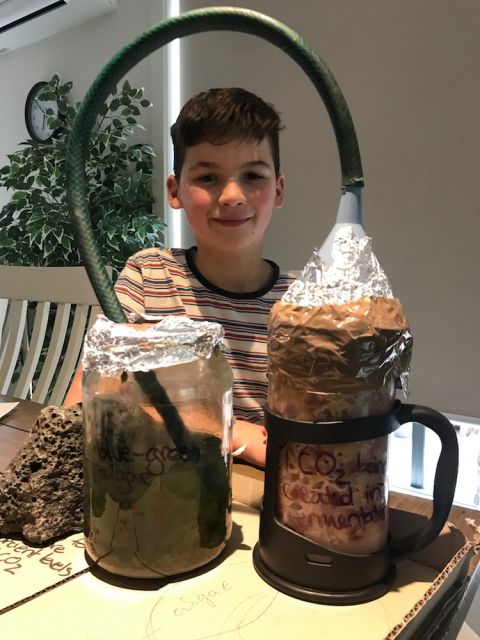
My grandson Spencer Cooper was given a school project of developing a working model of an alternative energy system. He and his interfering grandfather developed the above. See the bubbles in the coffee plunger on the right. They are CO2 produced by fermentation of grapes.The container on the left has algae from a local pond. It too has small bubbles not visible in the photo. They are oxygen produced by photosynthesis of the algae, a reaction made stronger by CO2 fertilisation. The resulting algae soup could be made into biofuel and biodiesel to power cars and aeroplanes.
The approach is quite relevant to solving the wineries' emission problem, and is being evaluated by Familia Torres of Catalunya, who are fertilising algal cultures. Moreover this picture reminds us that, while climate change may not be our problem, it is the legacy we are leaving our children and theirs. And they are disenfranchised!
Conclusion
While the wine industry is not a major contributor to increasing CO2 emissions and climate change, it is still a significant source. The major task is to replace glass bottles, and help reduce transport costs. Most wine is not consumed locally. Some of it is shipped halfway around the world, and bulk shipping to market and local bottling helps reduce the carbon footprint.
As for CO2 released from wineries, I believe this is environmental vandalism. Wineries now realise that they cannot discharge waste water into the environment as it is widely regulated by local and state authorities. Why not the same for CO2 discharges? Why do the authorities not invoke a Clean Air Act?
For my part, I look forward to selecting wine (in an environmentally friendly package) on the basis that it carries a logo like the one I have designed above indicating that no CO2 was released during fermentation.
I hope this article shows that there is more to environmental awareness than recycling bottles at the weekend. There are still too few environmentally aware producers. As Alistair Cooper MW pointed out in his recent article Discussing climate change in Montreal, Torres have made great strides in this regard. Together with US-based but internationally spread Jackson Family Wines, they have formed International Wineries for Climate Action (IWCA), a working group with the overarching goal of leveraging science-based targets for carbon-emission reductions aimed at decarbonising the wine industry. Membership requirements include a commitment to an 80% absolute reduction in emissions by 2045, as well as a commitment to on-site renewable energy.
Encourage them with your spend.
Jancis adds A wide-ranging carbon emissions audit conducted by Jackson Family Wines, one of the wine companies most active in this area, found that glass bottles made the greatest single contribution to their carbon footprint, accounting for 18% of the total, with other elements of packaging such as cartons and corks bringing the total to 24%. The next most important element was transport of bottles, accounting for 16% of the total. (Jackson Family Wines’ emissions inventory is currently being verified by Lloyd’s Register; exactly how carbon emissions are measured has become a contentious issue and some figures may be disputed, but it is clear that glass bottles are the major culprit.)
See also what the Symington Family Estates have been up to in Symingtons join B-Corps. The US-based FIVS yesterday issued a list of awards to wine producers they identified as taking sustainability most seriously.