What unexpected treasures! I'm looking at a grainy shot from the 1950s: the parents of veteran winemaker Pierre Morey, picnicking in the Meursault climat known as Tessons, which at that time was admired more for its panoramic view than for its terroir. (In acknowledgement of its former status as pleasure spot,
 Roulot name their Tessons bottling Clos de Mon Plaisir, although now that the land is fully planted, the plaisir is all ours.)
 And here is a brooding Marlon Brando type, stripped to the waist astride a tractor, cigarette glued to bottom lip, cultivating his patch of the southern Rhône some time in the 1960s. Some digging reveals he is Antoine Aliaga, a Spaniard who worked at Domaine de Beaurenard in Châteauneuf-du-Pape for 30 years and has now retired to his homeland.
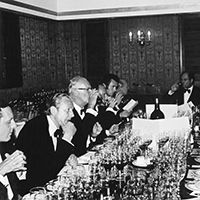
And who are these stern-looking dinner-jacketed gentlemen, ranged round a table covered in Paris goblets, about to taste what appears to be a flight of serious bordeaux? Well, that's Joseph Berkmann* at the head, of course – the picture belongs to him, my employer. But on the left a veritable ID parade of industry giants: (left to right) David Peppercorn, Michael Broadbent and Harry Waugh. So this must indeed have been some pretty serious bordeaux. What a shame about the glasses. 
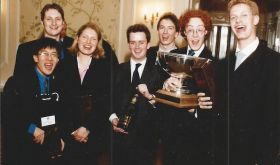
It seems to me that, in a way, those were more innocent times. The service of top-drawer claret in bargain-basement glassware is symptomatic. That is not to say that the participants were in any way ignorant or blasé. After all, in those days, one was required even in the Varsity tasting match to identify the château as well as the year, and people – students – did!
No; the innocence surely stems from the fact that great wines were admired rather than venerated. With comparatively little exported outside Europe, demand was lower, and therefore so were prices. These were still treated as drinks, albeit very superior ones; they had not yet joined the class of collectible assets. Last week I bumped into an Alsace producer who spent time as a student in London in the late 1960s, and ate at Berkmann's restaurants (the latter being a restaurateur as well as a wine merchant back then). He smiled as he recalled being able, as a treat, to drink Mouton-Rothschild 1945 for less than £10, the equivalent of about £150 today. It's a fair chunk for a student to splash out, I'll grant you, but now that sum would barely get you into young third-growth territory in a London restaurant, and the equivalent Mouton (1986 perhaps) would run well into four figures.
As such, the opening of such a bottle has gone from accompanying a special occasion to more often being the occasion itself, with all the attendant pomp. As a staunch believer in the value of decent glasses, I can see the positive side of this shift – which of course benefits more than just the top echelon of fine wine. But the prices now commanded by the superstars raise their status to Icarian heights; too often, perhaps, we are subservient to the wine, when it should be the other way round.
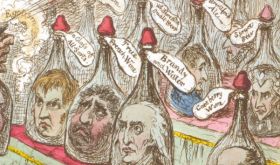
If I find myself getting overly nostalgic for this more gung-ho, less prissy approach to wine appreciation which seemed to prevail before I was born, contemplation of one subject above all makes me grateful to live and work in the 21st century: adulteration. Wine fraud today is a hot topic thanks to the high-profile case of Rudy Kurniawan, convicted last year for producing and selling counterfeiting rarities. But Kurniawan and his ilk are lone wolves, abhorred by the trade at large. Until Common Market legislation sought to protect labelling integrity in the 1970s, however, passing off one wine as another was endemic in the industry.
Blending wine from North Africa, Spain, the south of France or wherever and labelling it as Beaujolais or Nuits-Saint-Georges happened in France (Joseph Berkmann himself ran an exposé in The Sunday Times in 1974) and it happened in England too. A supplier of mine worked as an intern for a London bottler in the early 70s, and described how the same tank would be used to fill Volnay, Nuits, Pommard and Échezeaux: only the label was changed before the machine was switched back on. Whether the tank even contained wine from any one of those four appellations remains open to speculation.
Last November I got to try a wine cut – it seemed – from the same dubious cloth. It was in a restaurant in Burgundy; the wine was a 1947 Richebourg from a well-known producer. It was delicious, still in good health, with rich fruit, and a nice lick of tannin – but it was not Pinot Noir, at least in the majority. Rather, the dense, raisiny, fruit-cakey palate was built very much like Châteauneuf, with maybe a bit more brightness and acidity. We suspected a blend. A colleague who had been smoking outside when the bottle was first poured re-entered, took one sniff, and said 'that's Grenache, isn't it?'
The argument often made regarding this type of adulteration is that the wines benefited. Who knows – maybe the 'Richebourg' would have been a tired, skinny thing without a majority slug of something else in there, and we would have enjoyed it less as a drink? But again, we find the same generational shift in attitude: a wine like this exists not just to slake the thirst, to provide an agreeable hint of intoxication, even to offer some immediate aesthetic pleasure. Its (now considerable) value lies also in how it fits into a wider context: how it relates to other burgundies, other Richebourgs, other 1947s, other wines made by the same producer. As wines' value has increased, so we have rightly come to expect more of them. If the label gives no clue as to the true origins of the wine, then the inquisitive drinker has been cheated out of a central source of enjoyment. Widespread labelling fraud stunted the development of wine's intellectual potential, and for that reason alone, the modern drinker can be grateful that era is behind us.
The advent of technology and understanding of winemaking process has rendered much of the motivation for surreptitious blending obsolete in any case. Improvements in technique permit good wines to be made in most places in most years, and without the need to lie on the label. Average quality has risen hugely, as has diversity of origin and style.
In front of me is a copy of the Good Wine Guide 1977, subtitled 'A critical appraisal of over 1,000 table wines under £2'. The selection is, as you would expect, overwhelmingly French. Four pages out of 46 are given over to Italy, and the nine pages dedicated to Riesling cover Germany and Austria as well as Eastern Europe. Spain manages to field a few contenders in the 'Ordinary Whites', 'Ordinary Reds' and 'Pink Wines' chapters, but after that, you're confined to l'hexagone.
How much more exciting today's vinous landscape is to the drinker! With the importance of certain key winemaking principles (particularly temperature control and hygiene) now widely promulgated, the world's vast diversity of terroir and vine varieties is now our oyster. It could be argued that the rare moments of genius that produced the incomparable greats of yesteryear are unlikely to occur again, stifled by the risk aversion that tends to reign when such large sums of money are at stake. Will we see another Mouton 1945, Cheval Blanc 1947, or Latour 1961? Time will tell. Will I resent being unable to afford it? Have a guess. What is certain, though, is that our relationship with wine, as producers, traders and drinkers, has changed in a few fundamental ways over the last half-century, and on balance, in my view, for the better.
* Joseph Berkmann adds: Left to right are David Peppercorn, Michael Broadbent, Harry Waugh, the Marquis de Goulaine, Georges Duboeuf, Monsieur Woltner (guest of honour – we were drinking 14 vintages of his Château La Mission Haut Brion) then myself, next one don't know, Paul Bocuse, Allan Hall [Berkmann's co-author of The Good Wine Guide], don't know, Hugh Johnson, John Brackenbury.
Dinner was at Lockets in Marsham Court, then one of my restaurants. I gave a whole series of these dinners (Latour, Margaux, DRC) – but then I had an enormous stock of old bottles from Glamis Castle, starting with Ch Montrose 1869 and so on, bought for 7/- (seven shillings!) the bottle. There was no market for old wines except at Taylor Restell at Beaver Hall at very modest prices, but then Christie's wine auctions changed all that [in 1966]. A pity I left all the signed menus, by then framed in the private dining room, when I sold the group to Kennedy Brooks. Maybe Roy Ackerman still has some of them.