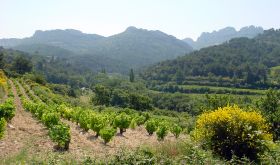
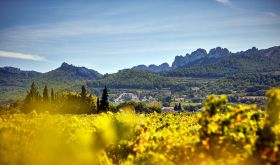
7 April 2025 Contrary to rumours in the Jurasphere, Vin Jaune, one of the wine world’s true originals, is not going to disappear anytime soon, says Jura expert Wink Lorch. Above, Château-Chalon.
The more the world discovers the tiny eastern France wine region of the Jura, the more misinformation seems to emerge. Vin Jaune, compulsorily bottled in the unique clavelin bottle (620 ml), is shrouded in mystery, and all too rarely seen on the shelves. In the US that may well change: while small numbers of Vin Jaune-filled clavelins have been noticed on shelves for years, a law that prohibited sales of alcoholic beverages in 620-ml bottles has been recently changed to allow them to be sold legally.

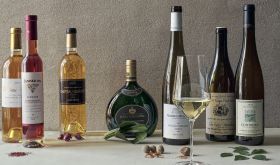
Around half a million clavelins are sold each year, about 5% of the total volume of Jura wine. This famed oxidatively made white wine (rarely visually yellow, despite the name) is made exclusively in the Jura from the Savagnin grape and spends six years or more ageing in cask under a veil of a flor-like yeast. It has long been considered the region’s flagship wine but there are some confusing disconnects.
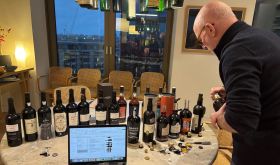
Up to a couple of thousand visitors attend Jura’s now well-established organic wine fair Le Nez dans le Vert (Le Nez, for short), held in late March in the region for consumers and trade, and in early November solely for trade in Paris. Newcomers to Le Nez are often surprised to find only a handful of Vin Jaune samples among the 40-odd producer stands. Paradoxically, the 35,000 visitors attending the region’s almost-annual La Percée du Vin Jaune winter festival (on hiatus in 2025) are attracted to it by the chance to celebrate and taste this searingly dry, precious wine. Despite being more of a street festival than a wine show, many Percée revellers are true wine lovers, and all the 50-odd producer stands offer a Vin Jaune to sample.
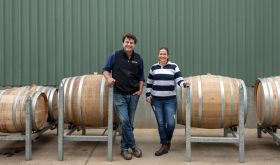
Why the difference? Le Nez includes many tiny, recently established producers who have not yet released a Vin Jaune or don’t ever intend to, either because they have a resolutely ‘modern’ approach to the Jura or a lack of Savagnin, space and/or cash flow; others produce so little that they don’t bring it to the fair. Noble exceptions are usually Stéphane Tissot, with a couple of his single-vineyard examples, and Domaine Berthet-Bondet, offering their renowned Château-Chalon.
Another disconnect: the picturesque hilltop village of Château-Chalon, with its vineyards fanning out below, is almost certainly where Vin Jaune was first made, and yet the term is rarely seen on labels. In the typical, obfuscated ways of French appellation rules, AOC Château-Chalon must by definition be a Vin Jaune, subject to its production rules. Historically, the term used for such wines was always vin de garde (wine to keep or age), and this is still seen on some labels, notably from Château-Chalon grandee Domaine Macle. Château-Chalon was always held in high esteem among French gastronomes. In the 1930s, just as the appellation laws were being drafted, the prolific writer known as Curnonksy (Maurice Edmond Sailland, 1872–1956), considered at that time the ‘Prince of Gastronomes’, included Château-Chalon in his list of the five greatest white wines of the world. (For the record, the others were French, too: Château d’Yquem, Le Montrachet, Château Grillet and Coulée de Serrant.)
How Vin Jaune is made
The term Vin Jaune emerged in the early 19th century and is enshrined as one of the wine styles permitted for Jura AOCs Arbois, Arbois-Pupillin, Côtes du Jura and L’Étoile, as well as being the mandatory style for AOC Château-Chalon, which represents about one-quarter of Vin Jaune production.
Savagnin destined for Vin Jaune starts life as any white wine. In the early summer after harvest the wine is transferred into old burgundian barrels (rarely under 10 years old), not fully topped-up, located in the so-called cave à Vin Jaune, which is rarely a ‘cave’ or cellar at all. In Château-Chalon, for example, it’s usually semi-underground, down a few steps; in Arbois it is often an attic; large producers have warehouse-like structures; and some vignerons use several different caves to create complexity from the different conditions.
Aeration, usually by simply leaving windows open, is essential allowing for temperature fluctuations through the year – the most extreme are in Arbois attics, which may go down to -5 °C (23 °F) and up to +35 °C (95 °F), resulting in significant evaporation and an increase of up to 2% in alcohol.

The air space in the barrels helps encourage formation of the voile (or veil) of yeast that lies on the surface of the wine, preventing extremes of oxidation. Whereas humid cellars were prevalent in the past, research in the 1970s showed that a dry cellar was more propitious for the veil to develop well. Note that the term ‘biological ageing’, used in Sherry country, is rarely heard in the Jura, probably because there is a distinct oxidative effect as well. Even if the first sniff of a Vin Jaune might remind you of fino, in style the closest equivalent is an aged amontillado.
The wine must spend a minimum of 60 months in barrel under the veil of yeast without any topping up or racking. Tests every six months on every barrel by the local laboratory ensure that volatile acidity does not reach a dangerous level, and that ethanal (acetaldehyde), the main marker for the so-called goût du Jaune or Vin Jaune taste, is rising.
Often a number of barrels – those less likely to make excellent Vin Jaune – are withdrawn from ageing after 1–4 years. There is a commercial interest here, as these are then sold much less expensively, either as a 100% Savagnin (sometimes referred to as a ‘baby Jaune’) or blended with Chardonnay (sometimes itself aged under veil).
Those wines that do make the cut for Vin Jaune must be bottled at earliest six years and three months after harvest in the 620-ml clavelin bottle.
Climate change and Vin Jaune’s future
Savagnin is a late ripener with high acidity, and half a century ago it wasn’t unusual for it to be picked in early November. With the dramatically warmer growing seasons of late, Savagnin now usually ripens by mid September. This means that it has much lower levels of natural acidity than in the past and can even end up with 2% unfermentable sugars – a potentially hazardous combination that increases the likelihood of volatile acidity rising rapidly, especially if no sulphites have been added at the start of vinification.
As a response, Savagnin for Vin Jaune is increasingly harvested earlier than Chardonnay, and the question of adding sulphites is a debate among the non-interventionist crowd.
The biggest risk to the future of Vin Jaune, however, may be the growing interest in ouillé (topped-up) Savagnin, which has been widely made only for 10–15 years. Despite increased plantings (Savagnin now accounts for 25% of the region’s total), choices must be made. However, most traditional producers with new generations taking over still continue the practice of making Vin Jaunes even if they add Savagnin ouillé to their range.
On the positive side are increased experimentation with Vin Jaune terroir selections, ageing trials and a growing market. Its survival seems assured, thank goodness.
The Vin Jaune experience
Bone dry, Vin Jaune attacks with a sometimes shocking acid kick, from actual acidity enhanced by the acetaldehyde effect. Alcohol varies from 13.5% to 15% depending much on the type of cave à Vin Jaune. No different from other fine wines, it is the texture, depth, aromatic complexity and length that singles out the best Vins Jaunes.
Flavours may include the walnut characters of most oxidatively made wines (more prevalent in Arbois Vins Jaunes); others might be spices such as fenugreek in particular (see the Oxford Companion to Wine entry on sotolon), ginger, cumin and so forth, grouped together in French as ‘curry’ (but without the chillis). Peaty flavours show especially in those from Château-Chalon or Arlay; and sometimes crystallised fruits are noticeable, or something reminiscent of mature Comté cheese (not so desirable, in my opinion).
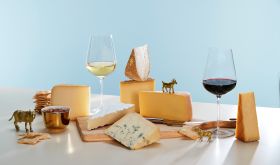
Comté, the Jura’s principal cheese, served alongside Vin Jaune makes one of those quintessential food-and-wine partnerships. To avoid overwhelming a top Vin Jaune, I choose a Comté that’s 12–18 months old rather than older. The other regional match par excellence is poulet de Bresse au Vin Jaune et morilles (Bresse chicken in Vin Jaune and morel mushrooms) in which typically a glass is added towards the end of cooking. There are many variations of the recipe, and the same sauce can be used with trout or with a morel-mushroom pastry dish. But local chefs have become far more adventurous in the past decade, discovering that Vins Jaunes match myriad Asian food flavours supremely well. In fact, there is a significant interest in Vins Jaunes in Japan.
Most importantly, a Vin Jaune should not be served chilled; it should be cellar temperature or even warmer. Ideally, open the clavelin several hours ahead or even the day before serving; if you order one less than 10 years old in a restaurant, ask for it to be decanted. And if by chance you don’t finish the clavelin, just keep it somewhere cool and it will be fine for weeks or months – it’s an ideal restaurant ‘wine by the glass’ option. As for buying to age, well, just do it – you will never be disappointed. Vins Jaunes are almost eternal.
All photos were taken by the author.
Wink Lorch is the author of Wines of the French Alps, Jura Wine and her newest, Jura Wine Ten Years On, recently reviewed by Tam Currin.