‘Farid, what's this stick across my seat for?’
‘Oh that… it's for the snakes. Unfortunately here in Morocco, they're all poisonous, but since we're already at 42 ºC (108 ºF) this morning, I don't think there'll be any in the vineyards today. Everyone has a hat, right?’
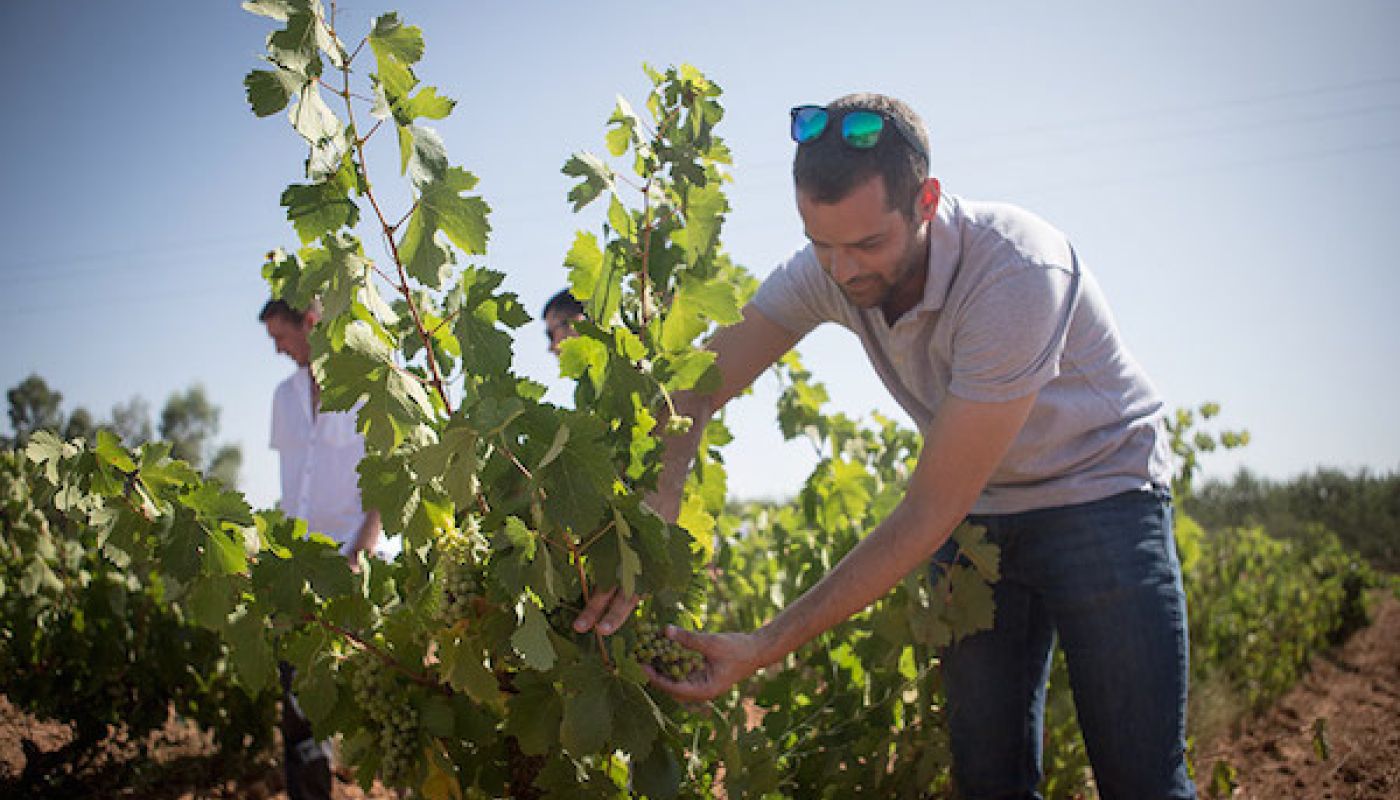
I did indeed have my hat and these were the comforting words of winery manager Farid Ouissa that started a 48-hour shotgun visit to vineyards around Meknès, Morocco, during Ramadan. Albert Costa of the Vall Llach winery in Priorat (seen here with old Carignan bushvines in Morocco) had been telling me about his random trips to the land of the Atlas Mountains for some time. During a recent dinner in Catalunya where I live, he mentioned he would be going again in a week. Despite living in Spain, I'd never been to Morocco and, more to the point, I'd never tried Moroccan wines, so I immediately booked a flight to tag along and see what was afoot.
The name Vall Llach should be familiar to any lover of wines from DOQ Priorat. Their classic style is crafted from vineyards in the village of Porrera and the wines have turned critics' heads for some time. Like most in the region, they have changed somewhat in style in recent years, drifting from the potent, full-bodied reds of Priorat's past to the more expressive, balanced style that allows the local character to come through.
If the last vintage you tasted was from a decade ago, you might want to try the wines again as behind this change is Albert, who, at just 30 years old, is both the head of oenology and co-owner with the famous Catalan signer Lluís Llach. Albert started working at the winery in 2009 and prior to that he had made his own wine T41 while studying. This is quite separate from the main Vall Llach winery and is made under the auspices of a different company, Clos l'Asentiu.
As the years have gone on, Albert has continued to make his T41 wine, but his curiosity and adventurous spirit have led him to broaden his Clos l’Asentiu portfolio to include La Matilde, a Provence-style rosé made from Grenache in amphorae that was released earlier this year. This is now being joined by an amphora-aged Grenache called La Catalina. Both of these are named after, and made as a tribute to, two of the older vineyard owners in the village. Catalina has especially deserved a vinous tribute for some time, being an amazingly youthful 101 year old who spends her days picking roses around the village and then spraying boisterous weekenders at the restaurant below her apartment with a hose. Soon, however, these Priorat matrons will be joined by distantly related siblings down in Meknès.
While Morocco produces 40 million litres of wine, the country exports only about 5% of this, and most of it ends up in France. The other 95% is supposedly ‘drunk by tourists’ in Morocco as any local will tell you with a bit of a smirk. The best-known of the Moroccan wines at the moment is the wonderfully pure expression of Syrah called Tandem (or Syrocco depending on your market) by Alain Graillot of Crozes-Hermitage. He makes this at Ouled Thaleb, which is one of Morocco’s eight very large wineries that produce much of Morocco’s wine. The biggest, Les Celliers de Meknès (which makes the Château Roslane wines), asked Albert a few months ago to work with them on a new wine.
Most of the winery's production sells for around €3 a bottle with the most ambitious wines priced at €20. The wines are overall quite decent although they are more like copies of well-known French wines than anything else. La Perle du Sud 2010 is an easy-going take on champagne. S de Siroua 2011 is an attempt at Côte Rôtie. Chateau Roslane 2011 is a tribute to left-bank Bordeaux. All of the wines are quite serviceable and, given the prices, quite reasonable. Their main issue is that there isn't anything about them that lets the drinker know that they're from Morocco.
Les Celliers de Meknès produce a hefty 30 million bottles a year from roughly 2,500 ha (6,180 acres) of vineyards that they own, of which a very modest portion is shown below, and a further 1,400 ha from which they buy grapes. (Thus the area they draw on is the equivalent of all of DOQ Priorat plus all of neighbouring DO Montsant put together.) They have several parcels of both old-vine Carignan planted in 1942 and Grenache that was planted in 1936 when Morocco was a French protectorate. They sought out Albert due to his wealth of experience with exactly these varieties and old bush vines on the slopes of Priorat.

Of course these Moroccan vineyards sit in terrain completely unrelated to the slate of DOQ Priorat. The Grenache sits in soils similar to DO Montsant, which are often a mix of red clay and limestone. The Carignan is altogether different, sitting in a sandy soil with a clay base to it. The weather is similar but more extreme. But there is one key difference: all the Moroccan vines are planted on their own roots since phylloxera never thrived in Morocco.
Travelling to Morocco nearly every month, Albert has been overseeing the grapes as they ripen and will advise on the production of their first experimental wines this year – 10,000 litres in total. Les Celliers de Meknès may look on this as an ‘experiment’, but some wineries in Priorat barely reach even half of this for their entire production. They intend to release the wines under AOC Les Coteaux de l'Atlas – one of only two AOCs in the country (the other being Crémant de l'Atlas.) Albert has insisted on creating single-varietal wines for both the Grenache and Carignan, stating, ‘varietal wines are what the market currently wants and they're the wines I want to make as they show the vineyards simply and elegantly'. He plans to vinify the Carignan in open-topped 300-litre French oak barrels and the Grenache in small stainless-steel tanks. He adds, ‘I would have preferred concrete for the Grenache but their smallest capacity at the winery is 10 times the size we need.’
The hot, dry, high-altitude climate of Meknès, which sits at 700 m (2,300 ft) above sea level next to the Mid-Atlas Mountains is nothing if not unpredictable. After months of extreme heat, including the chergui, which pushed temperatures up to 60 ºC (140 ºF) with its 100 km/hour winds, the harvest for this first wine is just about to start. Farid said, 'After the chergui we saw a significant drop in temperatures with highs around 30-35 ºC (86-95 ºF) and the lows around 20 ºC (68 ºF). This has delayed maturation but we should start with the Carignan the first week of September and the Grenache about two weeks later. We've been sampling daily now and these old vines seem to have handled the heat stress well and the leaves have protected the grapes to minimise scorching while allowing for a more ideal phenolic maturation.'
For his part Albert has great confidence in Farid and his team at the winery. ‘If we can get through the growing season and make good use of the selection table, there's no reason why we won't be able to produce a high-end wine from these vineyards here in Morocco that will express the unique locale of the region.’