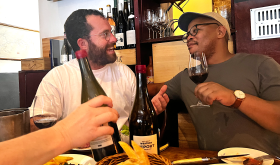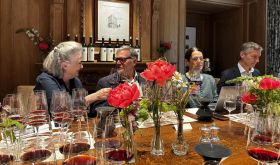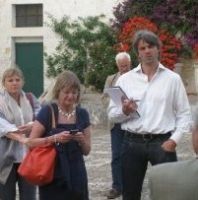
See my reviews of 232 current Puglian wines in which I describe my recent visit to Puglia. I am seen here in typical Blackberry mode (taking notes, not sending emails) with fellow judge David Berry Green of Berry Bros at Vallone winery in Castello di Serranova, famous for their late-harvest Negroamaro Graticciaia, a candidate for most misspelt wine in the universe. During that visit I also tasted 114 wines from the rest of southern Italy, and I will be writing about my thoughts on Aglianico in particular on Saturday.
When Lisa Gilbee graduated as a winemaker from Roseworthy in South Australia she went to practise at Castello di Ama in Tuscany 'because all the other Aussies were going to France then'. By 2001 she was in Puglia on the heel of Italy and decided to make a wine, still drinking well, as a birthday present for the man who is now her husband and father of two long-suffering children who have spent much of their lives to date in their parents' seven hectares of vineyard or the garage where they make Morella wines from them. Being an outsider helped her to identify what's best about the flat Salento peninsula cooled by the Adriatic on one side and the Ionian sea on the other: its ancient bush vines of Primitivo, the same variety as California's Zinfandel.
Puglia has been in the process of converting itself from shipper northwards of anonymous strong, dark red in bulk to beef up weaker but more famous ferments into a producer of wines of real quality on its own account.
Even today co-ops such as the recently renamed Vignuolo just north of Bari, with its 500 hectares of vineyards and 250 members, are still shipping vast quantities of wine to vermouth producers and to France, whence they are shipped to Germany with heaven knows what appellation. Such trade, for long one of the shadowier aspects of the European wine business, is certainly doing nothing for the reputation of Puglia, or even Italy. 'It's our fault – we should have managed to sell our own products. We've always been much better at making than marketing. We have to take responsibility for this sad state of affairs.' The co-op's director Sebastiano Iannuzzi smiled almost complacently as he explained all this to me in Puglia earlier this month.
Things have been changing, however, even if many of those with old, untrained vines have been tempted to accept EU subsidies, actually designed to drain the wine lake by reducing the area of substandard vines, to pull them out. The number of bottlers of wine, as opposed to growers of grapes, in this arid region has increased enormously in the last few years, and the cardinal sins of over-oaking and over-ripeness are much less in evidence than they once were. But because fine-wine production is a relatively new art in Puglia, it is taking time to work out how to make the best of each of Puglia's indigenous grape varieties and indeed, in some cases, what the character of each combination of variety and area is and should be.
The most obviously alluring local grape is Primitivo, grown on rich red and sometimes sandy soils over white limestone that are otherwise home to gnarled old olive trees. The wines are perforce quite strong, sometimes15%, partly because of the fierce sunshine and partly because this variety is a notoriously uneven ripener, but although these wines are obviously the result of prolonged sunshine, and can taste of the ripest of red cherries, leather and warm liquorice, they tend to be well balanced by fresh natural acidity and to have attractively round tannins that can keep them going as they develop in bottle.
But the Puglians seem determined to kill the goose that lays this particular golden egg. One of hundreds of changes to local wine regulations being rushed through by the Italians before an EU deadline has just seen the rules for the most commercially successful DOC down here, Primitivo di Manduria, change to allow up to 15% of any other varieties planted on a given estate, including such foreigners as Cabernet Sauvignon and Merlot. This seems crazy to me, but echoes developments we have seen throughout the country whereby locals seem to lack faith in their indigenous grapes. A similar slackening of the rules for the only wine of note made in the region to Puglia's immediate west, Calabria's Cirò, means that the delicate character of the local Gaglioppo grapes may be deadened by the addition of other so-called 'improving varieties'.
Most of Puglia's recent vine plantings have been of international varieties so that supermarkets and the like can sell well-priced Salento Chardonnay and Cabernet but the most interesting and distinctive wines tend to be Primitivos from Manduria or, often finer, Gioia del Colle on higher, hillier ground to the north, just south of Bari. If Primitivo is the signature grape variety of the Salento peninsula on the south-western Ionian coast, Negroamaro is characteristic on the north-eastern Adriatic coast, but the reds made from it tend to taste very sweet, occasionally porty, without quite enough acidity or real core of fruit in the middle.
Negroamaro is often blended with the velvety Malvasia Nera, and it can clearly make attractive dry rosés with real substance to them, and some fairly soft, chillable reds. There are also a few examples of sweetish reds made from late-picked Negroamaro grapes, but for the moment the average red made from 100% Negroamaro grapes seems a little wan and formless when compared with a Primitivo – and certainly does not have its life expectancy.
The characteristic grape of the Castel del Monte zone in the far north of Puglia has until now been known, rather distinctively in my view, as Uva di Troia (grape of Troy). But, fired by the success of Sicily's Nero d'Avola, the locals have decided that their own name for it, Nero di Troia, is likely to sell much better and so the name has been changed from henceforth. This variety is naturally high in tannin and is perhaps another candidate for blending. In fact one local producer told me matter of factly that the grape was famous as a blending grape in the expensive Amarones produced hundreds of miles north in the Veneto region. But among the dozens of varietal Troias I tasted earlier this month, there were some rather interesting, savoury reds with their own character.
Another new name we will have to get used to is that of Puglia's most headily scented white wine grape. Until now this was known as Fiano di Salento, Fiano Aromatico or Fiano Minutolo. But the DNA analysis that is revolutionising our perception of the relationships between different vine varieties has shown that there is no relationship between this Puglian variety and the more famous Fiano of Campania that has also been planted widely in Sicily, for example. Accordingly, it is to be purged of the F word and henceforth will be known as Minutolo. Puglia – land of change.
Recommended Puglians
Cannito, Drumon Riserva (Primitivo) 2007 Gioia del Colle
Morella, La Signora (Primitivo) 2007 Salento
Santa Lucia, Vigna del Melograno (Nero di Troia) 2008 Castel del Monte
Tarantini, Petrigama (Nero di Troia) 2008 Puglia
See my reviews of 232 current Puglian wines.