When it comes to pairing beverages with Chinese food, it is best to obey the centuries-old rule: 'When in Rome, do as the Romans do'. So, let's just look at the two most common beverages in China – tea and Chinese wine.
There is a Chinese saying that before a man locks his front door for the day, he must be sure of having seven essential items in the house: wood, rice, oil, salt, sauce, vinegar and tea ('关门七件事,柴、米、油、盐、酱、醋、茶'). There's no doubt that tea has a special place in every Chinese family.
Tea appreciation began at least 7,000 years ago, popularised during the Tang Dynasty (唐朝) and flourished in the Song Dynasty (宋朝). Chinese tea culture combines the various schools of teachings such as Confucianism, Buddhism and Taoism into the art of tea appreciation, making it into an everyday beverage regardless of time and occasion.
Tea production in China demonstrates the same principle as western wine production, where terroir plays an important role in its flavours and tastes. To maximise the appreciation of tea, it is always matched with the appropriate style of food. For example, in Jiang Su and Zhe Jiang provinces (on the east coast of China), green tea that has less tannin is a preferred match with the delicate desserts in this region. In Guang Dong province (on the southern coast of China), black tea with higher tannin is a common beverage to accompany the sweet and salty preserved foods served along with the main dishes. The main dishes also tend to be quite oily.
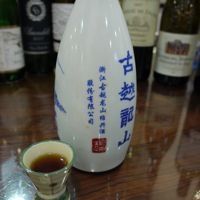
In addtion to tea, it is common to accompany food with Chinese wine, whose base ingredients are traditionally grains such as rice, millet and wheat. An example is the famous Huang Jiu yellow wine (黄酒) which is not distilled and has less than 20% alcohol. (My photograph shows a flask of a 10-year-old Shao Xing Jiu (yellow wine) from Zhe Jiang from China's east coast that we paired the other night with some of the Chinese dishes.) This 'wine' has a strong flavour and taste, almost savoury on its own, ideal for the equally heavy cuisines from Jiang Su and Zhe Jiang provinces. One delicious pairing is a warm yellow wine with the famous Shanghai hairy crabs, an incontrovertible match. When it comes to Guang Dong cuisine, which is lighter and less salty in style, yellow wine is replaced by the lower-alcohol rice wine(米酒) in order to harmonise with the cuisine.
So, what lessons do we learn here?
There is always a place for tea in Chinese dining. Whichever wines we choose, we must understand the contributions of tea as the consistent food beverage.
The strength of the alcohol and the savouriness in a wine are usually used to balance the food.
Often in the Chinese restaurants in international hotels in major Chinese cities, guests are handed a western wine list. It might be more interesting instead to introduce guests and especially foreigners to the traditional Chinese teas and wines for an age-old culinary experience. Properly matched, of course.
How to match China's own drinks
Guest contributor
Tuesday 9 November 2010
• 2 min read
Cher Lim writes:
Become a member to continue reading
Celebrating 25 years of building the world’s most trusted wine community
In honour of our anniversary, enjoy 25% off all annual and gift memberships for a limited time.
Use code HOLIDAY25 to join our community of wine experts and enthusiasts. Valid through 1 January.
Member
$135
/year
Ideal for wine enthusiasts
- Access 286,112 wine reviews & 15,814 articles
- Access The Oxford Companion to Wine & The World Atlas of Wine
Inner Circle
$249
/year
Ideal for collectors
- Access 286,112 wine reviews & 15,814 articles
- Access The Oxford Companion to Wine & The World Atlas of Wine
- Early access to the latest wine reviews & articles, 48 hours in advance
Professional
$299
/year
For individual wine professionals
- Access 286,112 wine reviews & 15,814 articles
- Access The Oxford Companion to Wine & The World Atlas of Wine
- Early access to the latest wine reviews & articles, 48 hours in advance
- Commercial use of up to 25 wine reviews & scores for marketing
Business
$399
/year
For companies in the wine trade
- Access 286,112 wine reviews & 15,814 articles
- Access The Oxford Companion to Wine & The World Atlas of Wine
- Early access to the latest wine reviews & articles, 48 hours in advance
- Commercial use of up to 250 wine reviews & scores for marketing
More Inside information
Inside information
On South Africa’s remote West Coast an unlikely fortified-wine revival is taking place. Malu Lambert reports.
Saldanha’s castle is an...
Inside information
Part three of an eight-part series on how to pair wine with Asian flavours, adapted from Richard’s book. Click here...
Inside information
Yields are down but pleasure is up in 2024, with ‘drinkability’ the key word. Above, a wintry view Château de...
Inside information
The fifth of a new seven-part podcast series giving the definitive story of Jancis’s life and career so far. For...
More from JancisRobinson.com
Tasting articles
Sherry, port and Madeira in profusion. This is surely the time of year when you can allow yourself to take...
Wines of the week
A brilliantly buzzy white wine with the power to transform deliciously over many years. And prices start at just €19.90...
Tasting articles
Gigondas Blanc lives up to its new appellation in 2024. Above, Clairette at Château de St-Cosme, one of the vintage’s...
Tasting articles
Cairanne and Rasteau headline the 2024 vintage among the southern crus, but there’s plenty to like in other appellations, too...
Tasting articles
Gigondas has the upper hand in 2024, but both regions offer a lot of drinking pleasure. Above, the Dentelles de...
Book reviews
A compelling call to really look at your wine before you drink it, and appreciate the power of colour.
The...
Tasting articles
Plenty of drinking pleasure on offer in 2024 – and likely without a long wait. The team at Clos du...
Nick on restaurants
A daughter revives memories of her parents’ much-loved Chinese restaurants.
The surname Poon has long associations with the world of...