A month ago I judged on a stage in a new hall in Riga, Latvia, on which millions of eyes, ears, cameras and microphones would soon be focused for the Eurovision Song Contest.
The music was almost as loud – it seems to be a prerequisite wherever food is served in Riga – and there were television cameras, but the audience was much, much smaller as I and three professional chefs (two Russian and one English) judged the first professional culinary competition between the now independent states of Latvia, Estonia and Lithuania which the host country won by a convincing margin.
But whilst the 18 young chefs, wearing ultra-fashionable kitchen uniforms whilst they created modern dishes using Australian fillets of lamb, Italian olive oil and balsamic vinegar and Venezuelan mangoes, worked their way round expensive ovens and induction-heated hobs, I was equally impressed by two members of the audience.
They were a couple of babushkas, gentle-faced Latvian women in their seventies wearing heavy overcoats and woollen hats who never took their eyes off the big television screen above the three interconnecting kitchens. In the past decade these women and their counterparts have seen an extraordinary change in not only the food that is widely available but also how it is cooked, even if on their state pensions they can probably only afford to watch it being prepared.
The sense of rapid change was less obvious when I stepped down the following morning from the number three bus to wander round Riga's vast Central Market. This comprises four huge hangars, built originally to house aircraft, which now sell meat, fish, vegetables and dairy although, in true post-Soviet fashion, to find the gems you have to pass tawdry shops selling jeans, shoes, belts and cigarettes (smoking is still permitted everywhere – even pipes in restaurants!).
There was personal pleasure in the mounds of sauerkraut, whose juice is a particular, if unusual, preference of mine, cucumbers and bottles of home-made horseradish, once the daily staples of my grandparents' diet, but there was no doubting the real quality of the Rubeni smoked chicken, the lampreys and the mounds of dark rye bread. From June the surrounding countryside produces stunning strawberries, raspberries, roses and wild mushrooms.
Stars of the market are, however, the rows of white-capped matrons selling jars of ultra-intense honey and their counterparts in the dairy hall selling balls of freshly churned butter, cheese studded with caraway seeds, various curd cheeses and dispensing sour cream so thick that it supported the spoon upright in the centre of its white porcelain jug. As Latvia progresses further into the EU I do hope the country's government can protect these national treasures from Brussels.
The proximity and quality of many of these farmers has not been quite the boost it should have been to Riga's nascent restaurateurs, however. They have been unable to make full use of this market due to a combination of bureaucracy and unwillingness on the part of the farmers to switch from spending their day selling retail to offering wholesale deals to professional kitchens.
That this process is gradually but successfully happening and that Riga can now boast a weekly organic food market in Livu Square on Saturday mornings to which farmers travel over 200 km is entirely due to the passion and drive of restaurateur Martin Ritjins who grew up and trained as a chef in the Srathclyde Hotel, Corby, Northamptonshire when, as a steel town, it was a Latvian outpost.
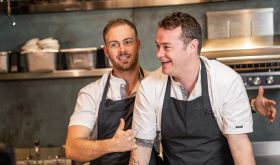
His approach to modern food and cooking is put into practice at his bright and sophisticated restaurant, Vincents, (a name he initially chose because everyone can pronounce it but also, I believe, because it legitimises his bright yellow van Gogh-like cooking trousers) where the food and drink sensibly reflect what is currently available.
I began with a glass of pure birch juice, as transparent as water, tapped from the tree in Ritjins's garden that morning, and progressed happily through local goat's cheese ravioli with a tomato fondue and a saddle of rabbit with a new season's spinach salad. Latvia's goat's cheese business is as young as the country, Ritjins explained. 'When I came back here in 1992 I saw that there were lots of goats but seemingly no cheese. One day I saw that there was a goat show 40 kilometres away and I went off and saw what was almost a beauty parade for goats. I found one man who was making goat's cheese more as a hobby than anything else but now there are three farmers successfully producing their own equivalents of feta, a camembert style and a soft goat's cheese.'
This meal contrasted sharply with an uninspiring meal at Skonto to which I had headed in search of fresh fish. The plastic coated menu was far too long and the proposed combinations amateurish, as was the overcooking of a large sturgeon that had been brought, wriggling in a net, to our table from the nearby fish tank.
This is a culinary past Latvia, Lithuania and Estonia must shrug off as quickly as possible. The signs are promising although, as elsewhere, this process is evolving initially more quickly in the kitchen, where chefs can learn from modern cookery books and the internet, rather than in the restaurant where the waiting staff are hampered by a lack of training and the opportunity to experience good service because they cannot afford to eat in the better restaurants.
One particular hangover from the Soviet era is that Latvian restaurants never close in the afternoon. This policy was initiated to allow waiters to supplement their meagre wages with tips whenever available but it now severely limits the possibility for staff training – even if it does make life a lot easier for any restaurant correspondent or hungry tourist.
Vincents
19 Elizabetes Street, Riga (tel 733 2634, web www.vincents.lv)
Open 1200-2400 every day.
Vincents' celeriac and potato latkes with marinated eel and wasabi crème fraîche
Serves 8
Latke ingredients:
1 cup grated celeriac
1 cup grated baking potato
1 small onion finely diced
2 tablespoons polenta flour
1 egg
sea salt and black pepper to taste
thyme leaves for coating
vegetable oil and/or clarified butter for frying
Instructions for the latkes:
- Squeeze the grated potato of excess liquid.
- Mix all the ingredients other than the polenta flour.
- Form very thin latkes in a 4/5 cm biscuit cutter to ensure a perfect round shape.
- Coat the latkes with polenta (this stops the celeriac mixture soaking up the frying oil).
- Fry the latkes in a preheated pan in a thin coating of oil.
- Transfer the ltakes on to a baking sheet and bake in a hot oven, 180 degrees C, until crisp – about 5/8 minutes. Keep warm.
Instructions for the eel:
- 4 freshwater eels approx 500gr each which willl yield 1kg cooked eel
- Ensure that the eel is skinned, filleted and boned. This is then cooked in a marinade of:
2 cups soy sauce
4 cups mirin
2 cups water
4 tablespoons sugar
- Put the marinade in a shallow pan. When it comes to the boil add the eel fillets skin side up.
- Cover and bring to the boil. Check after a few minutes to ensure the eel is not curling or sticking together. Gently simmer for approximately 15 minutes.
- Take off the heat and keep in the marinade another 15 minutes.
- Remove the eel and reduce the marinade by half.
(The eel can be made days in advance. It can also be put in freezer bags and frozen, a method which improves the eel as it develops a firmer texture).
Mix 240 gr crème fraîche with wasabi to taste.
To finish:
- Refresh the eel in a dry pan. It should be served warm. Make alternative layers of the latkes, crème fraîche and eel. Garnish with the thinned-down wasabi, the marinade and dill.
The celeriac adds colour and bite to the more normal latke recipe using just potato and onion and the dish works almost as well with any other smoked fish.